

Олександр Сич
8 August 2026
Family members of the first and second degrees of kinship (children, parents, a spouse, full siblings, grandparents, grandchildren) pay 0%. Other resident heirs pay 5% income tax plus the 5% military levy, 10% in all. Where either the heir or the deceased is a non-resident, the income tax rate is 18%, and with the military levy 23%. The basis is Article 174 of the Tax Code.
“How much will I pay the state for my inheritance?” is a question that arises before the visit to the notary. The answer turns on two things: what you were to the deceased, and whether both sides are tax residents of Ukraine. How the estate passes makes no difference: the same rates in Article 174 apply under a will and on intestacy alike.
Below: the table of rates, how the degrees of kinship are drawn in sub-paragraph 14.1.263, the three exceptions carrying a zero rate, the deadlines for the return and the payment, and the penalties for lateness. If a dispute about the estate itself lies ahead, start with the service page of our succession lawyer.
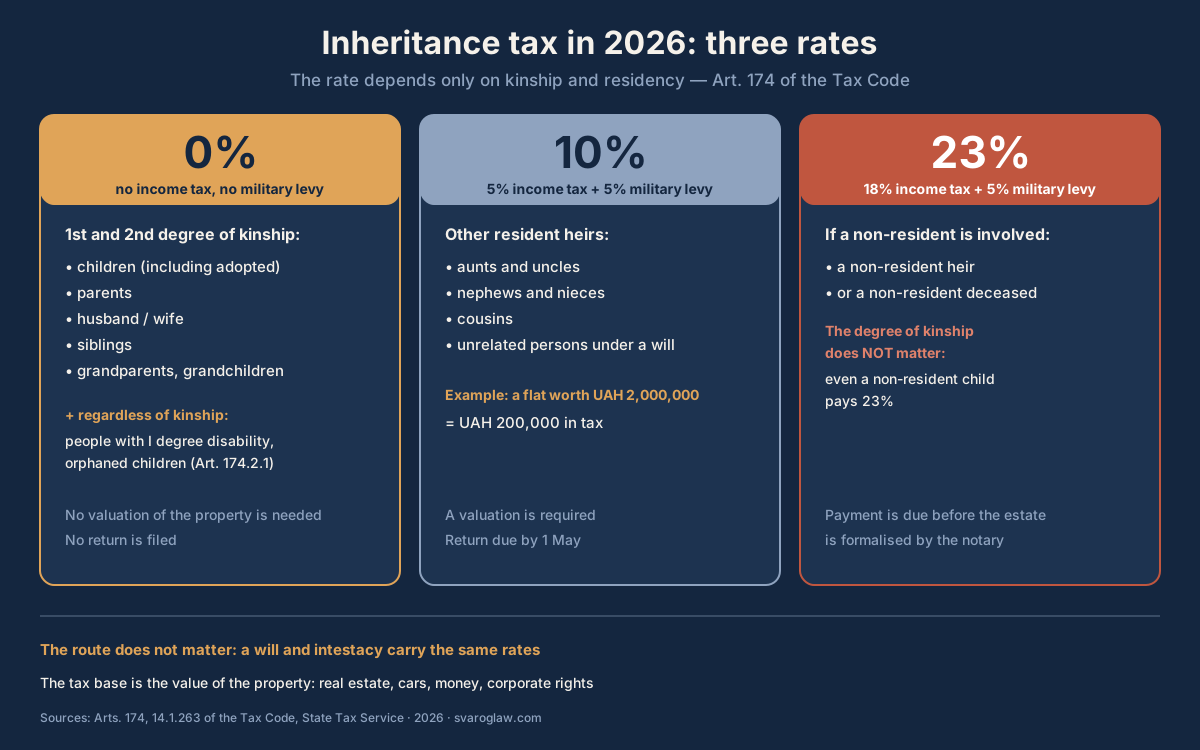
The table of inheritance tax rates in 2026
| Who the heir is | Income tax | Military levy | Total |
|---|---|---|---|
| Family members of the 1st and 2nd degrees: children (including adopted), parents, spouse, full siblings, grandparents, grandchildren | 0% | 0% | 0% |
| Other resident heirs: aunts, uncles, nephews and nieces, cousins, strangers under a will | 5% | 5% | 10% |
| A non-resident heir, or an estate from a non-resident deceased (the degree of kinship is disregarded) | 18% | 5% | 23% |
The degrees of kinship are defined in sub-paragraph 14.1.263, and its wording is narrower than the everyday idea of “close relatives”. The first degree covers parents, a spouse and children, adopted children included. The second covers full siblings, grandparents on both sides, and grandchildren. Everyone else, however close in life, falls under sub-paragraph 174.2.2 with its 5% rate, which refers back to paragraph 167.2. The 18% rate for non-residents comes from paragraph 167.1 through sub-paragraph 174.2.3.
The 5% military levy is charged on the income listed in Article 163 (sub-paragraph 1.3 of paragraph 16-1 of Subchapter 10 of Chapter XX). The zero for close relatives comes from a separate provision — sub-paragraph 1.7 of the same paragraph exempts income taxed at the zero income tax rate. So the “0%” in the first row of the table means neither payment is due, not merely the income tax.
The tax base is the value of what is inherited: property, vehicles, money in accounts and e-wallets, corporate rights, securities. For example: a resident nephew inherits a flat valued at 2,000,000 UAH and owes 100,000 UAH of income tax and 100,000 UAH of military levy, 200,000 UAH in all. A daughter pays nothing for the same flat.
The zero rate regardless of kinship: three exceptions
Sub-paragraph 174.2.1 sets out three further cases of a zero rate in which the degree of kinship is irrelevant:
- the heir has a group I disability, or is an orphan or a child deprived of parental care — as regards property, movables and cash or money in accounts;
- the heir is a child with a disability — as regards property and movables (money and cash are not included here, and that is the detail people get wrong most often);
- the estate includes savings deposited before 2 January 1992 with the Savings Bank of the USSR and USSR state insurance institutions — these pass at the zero rate to any heir.
Neither relatives nor heirs themselves often think of the first two exceptions, and people pay 10% where the law exempts them entirely.
When a valuation is needed and when it is not
The answer is written into paragraph 174.8: where an item of the estate is taxed at the zero rate, its market value is not determined for tax purposes. Heirs of the first and second degrees need no valuation for tax, and a notary’s request for one “just in case” has no basis. For the 5% and 18% rates the taxable object is the assessed or market value determined under paragraph 172.3, so a valuer’s report registered in the Unified Database of Valuation Reports is required. The value of cars, motorcycles and mopeds is calculated separately — under the third sub-paragraph of paragraph 173.1, by reference to the average market value.
Deadlines: when to file and when to pay

- Six months from the death — file the application to accept the estate with the notary (Article 1270 of the Civil Code). It has nothing to do with tax, but missing it costs more than any tax.
- Before the certificate is issued — establish your rate from the table above and, if it is 5% or 18%, commission the valuation.
- Before the notarial formalities — pay the tax if you are a non-resident: paragraph 174.4 forbids a notary to issue such an heir a certificate without proof of payment. A resident may also pay at this stage, and then no return is needed because of the inheritance.
- By 1 May of the following year — file the annual return of assets and income if the tax was not paid before the formalities (sub-paragraph 49.18.4). Inherit in 2026 and the return is due by 1 May 2027.
- By 1 August of the following year — pay the liability shown in the return (paragraph 179.7) and register title to any property in the Register of Real Property Rights.
Under paragraph 174.3, three categories need file no return on account of the inheritance alone: non-residents who paid before the notarial formalities, heirs at the zero rate, and residents who likewise paid before the formalities. For everyone else the return is mandatory, however modest the sum.
What else the formalities cost besides the tax
- state duty for the certificate of the right to inherit — 2 tax-free minimums, that is 34 UAH (Article 3(3) of Decree No. 7-93 “On State Duty”); minors are exempt;
- a private notary charges a contractual tariff instead of the duty, which under Article 31 of the Law “On Notaries” may not be lower than the duty, plus a separate charge for legal and technical services — and it is that part which makes up the bulk of the bill;
- the valuation — only for the 5% and 18% rates;
- the administrative fee for registering title to property;
- register extracts, duplicate documents, and certified translations where the documents are foreign.
What happens if you do not pay or do not declare
Notaries report the certificates they issue to the tax authority as a matter of course: state notaries monthly, private ones quarterly with a monthly breakdown (paragraph 174.4). The return separately identifies the heir’s income falling under the 5% rate. So estates rarely go unnoticed, and the consequences are:
- a 340 UAH fine for failing to file the return or filing it late, and 1,020 UAH for a repeat breach within a year (paragraph 120.1);
- a fine of 10% of the liability assessed by the tax authority, and 25% where the conduct is found to be deliberate (sub-paragraphs 123.1, 123.2);
- a fine for paying an agreed liability late: 5% for a delay of up to 30 calendar days inclusive and 10% beyond that (paragraph 124.1);
- interest under Article 129 for each day of delay.
If a tax assessment notice has already arrived, the steps and the deadlines for challenging it are on the page about challenging tax assessment notices.
Tax on selling an inherited flat
A second tax arises when an heir decides to sell what they received. The general rule in paragraph 172.1 exempts from income tax the proceeds of the first sale in a year of a flat, house or plot of land where the property was owned for more than three years. For inherited property that condition is lifted in the text of the provision itself: the three-year requirement does not apply to property received by inheritance. So an inherited flat can be sold the very month after title is registered, and the first sale in a year is not taxed. A second property in the same year is taxed at 5% plus the military levy (paragraph 172.2).
Heirs’ typical mistakes
- Confusing the degrees of kinship. Nephews, nieces, aunts and uncles are not in the second degree and pay 10%, while a grandchild is and pays nothing.
- Not checking residence. Even a daughter who has become a non-resident of Ukraine falls under the 23%; and conversely, an estate from a non-resident uncle is taxed at 23% in a resident’s hands.
- Commissioning a valuation at the zero rate, despite the express prohibition in paragraph 174.8 on determining market value in such cases.
- Missing the six months to accept the estate on the assumption that “the war stopped everything”: as our article on handling an estate from abroad explains, the Supreme Court has confirmed that the period runs during martial law too.
- Forgetting the return at the 5% or 18% rate where the tax was not paid before the notarial formalities: a fine for failing to file and interest are added to the tax itself.
When you do not need a lawyer
If you are the child, parent or widow of the deceased, live in Ukraine, the heirs are not in dispute and the documents are in order, there is nothing to do about tax: the rate is zero, no valuation is needed and no return is filed because of the inheritance. A lawyer is needed where residence is in doubt, where a business, corporate rights or property abroad is being inherited, where the notary demands a valuation at the zero rate, or where a dispute about the estate itself is running in parallel.
Questions and answers
How much inheritance tax do children and a spouse pay?
None. Family members of the first and second degrees are exempt from both the income tax and the military levy (sub-paragraph 174.2.1; sub-paragraph 1.7 of paragraph 16-1 of Subchapter 10 of Chapter XX). You pay only for the notarial formalities.
Who falls within the second degree of kinship?
Full siblings, grandparents on the mother’s and the father’s side, and grandchildren (sub-paragraph 14.1.263). The first degree covers parents, a spouse and children, adopted children included.
How much will a nephew pay on an inherited flat?
10% of the assessed value: 5% income tax and 5% military levy. On a flat worth 1,500,000 UAH that is 150,000 UAH. A valuation is mandatory at that rate.
I live abroad and am probably already a non-resident. What rate applies?
If you have lost tax residence in Ukraine the rate is 18% income tax plus the 5% military levy, even for the deceased’s own child. Residence is determined by the criteria in sub-paragraph 14.1.213: place of residence, centre of vital interests, 183 days of presence, citizenship. Status can sometimes be established in Ukraine’s favour, preserving the zero rate.
An estate from an uncle abroad — how much tax?
23%, that is 18% income tax and 5% military levy, because the deceased is a non-resident. The degree of kinship is disregarded entirely in that case (sub-paragraph 174.2.3).
Is the tax the same under a will and on intestacy?
Yes. Article 174 ties the rate to kinship and residence; how the estate passes does not affect the calculation.
Is tax payable on an inherited deposit or on cash?
The same rules apply: 0% for the first and second degrees, 10% for other residents, 23% where a non-resident is involved. The base is the money in the account, the e-wallet or the cash (sub-paragraph (e) of paragraph 174.1).
When do I file and when do I pay?
The return is due by 1 May of the year following the year of the inheritance (sub-paragraph 49.18.4) and payment by 1 August (paragraph 179.7). If the tax was paid before the notarial formalities, no return is needed on account of the inheritance.
Can I sell an inherited flat straight away without waiting three years?
Yes. The three-year ownership condition does not apply to property received by inheritance (paragraph 172.1), so the first sale of inherited housing in a calendar year is not taxed.
Can inheritance tax be reduced lawfully?
There are three workable routes: establishing Ukrainian tax residence, applying the reliefs in sub-paragraph 174.2.1 (group I disability, orphan status) and checking that the valuation the base rests on is correct. “Re-casting an inheritance as a gift” after the death is impossible, and during life a gift is taxed under the same rules in Article 174.
Sources
- Tax Code of Ukraine: Art. 174, sub-paras. 14.1.263, 14.1.213, paras. 167.1, 167.2, 172.1, 172.2, 179.7, sub-para. 49.18.4, Arts. 120, 123, 124, 129 — zakon.rada.gov.ua/laws/show/2755-17
- Tax Code of Ukraine, para. 16-1 of Subchapter 10 of Chapter XX (the 5% military levy and the exemption in sub-para. 1.7) — zakon.rada.gov.ua/laws/show/2755-17
- Civil Code of Ukraine, Arts. 1270, 1296, 1297 — zakon.rada.gov.ua/laws/show/435-15
- Cabinet of Ministers Decree “On State Duty” No. 7-93, Art. 3(3) — zakon.rada.gov.ua/laws/show/7-93
- State Tax Service of Ukraine, guidance on taxing inheritances and the military levy — tax.gov.ua
Handling an estate with Svarog
Tell us what you were to the deceased and what the estate consists of — we will calculate the exact tax, check whether you are overpaying because of residence or an unnecessary valuation, and see the notarial formalities through from the application to the registration of title. Related services: succession lawyer, tax disputes lawyer, establishing title, full price list.
+38 095 554-54-24 · Kyiv, 7 Khoriva Street (Podil) · Mon–Fri 9.00–18.00