There are almost always breaches in cases like these. The problem is that they are not recorded in the first hours: a week later it is one person’s word against a police officer’s, and the court has nothing to go on.
Challenging unlawful acts by law enforcement officers works when there is evidence: a medical report on the injuries, comments written into the record, video, witnesses, written complaints filed immediately. So the first thing we tell clients is to record everything at once, even when it feels as though nothing can be proved.
What is challenged, and where
Acts, decisions and inaction of an investigator or prosecutor — a complaint to the investigating judge (Art. 303 of the Criminal Procedure Code):
Complaint to the investigating judge
- failure to enter the case in the register: the report of a crime was not registered;
- inaction: steps the investigator is obliged to take are not being taken;
- closure of the criminal proceedings;
- refusal of applications to examine a witness, order an expert report or obtain documents;
- detention without a judge’s order and the other decisions expressly named in Art. 303.
Rulings of the investigating judge themselves (a preventive measure, seizure of property, temporary access) are not challenged under Art. 303: they are reviewed by the appeal court within 5 days of being announced, in the cases listed in Art. 309. A parallel route is an application to lift the seizure of property (Art. 174) or to vary or lift a preventive measure (Art. 201), filed with the court hearing the case.
The lawfulness of a detention is examined by the investigating judge when deciding on a preventive measure (Art. 206): the judge must establish the grounds for detention and release the person immediately if there are none. That is a separate procedure and it cannot be missed — the case offers no second such moment.
Acts of police officers that bear the marks of a crime — a report to the State Bureau of Investigation:
Report to the State Bureau of Investigation
- abuse of power or of official authority (Art. 365 of the Criminal Code), including with violence;
- torture (Art. 127);
- official negligence, abuse of office;
- unlawful detention or remand.
Breaches during administrative procedures — a complaint to the head of the body and to the National Police’s internal security department, or a claim to the administrative court.
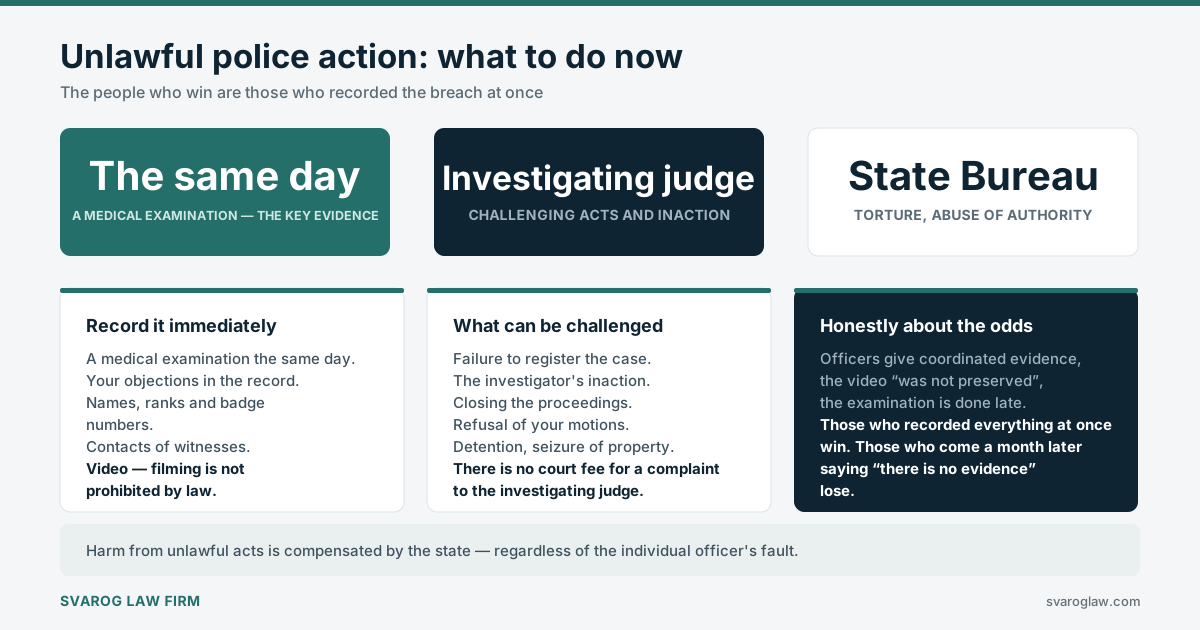
What to do right now
- A medical examination immediately. If force was used, go to a hospital emergency department or call an ambulance the same day. The first medical record describing the injuries is the basis for the forensic report. Bruises change appearance within days and some marks disappear within twenty-four hours, so every hour of delay weakens the evidence.
- Comments in the record. Do not sign a document that is not accurate. Write down exactly what was wrong: rights not explained, the lawyer not admitted, pressure applied.
- Names and ranks. Write down everyone you dealt with, their badge numbers and the number of the body camera.
- Witnesses. Take contact details at once: in a week they cannot be found.
- Video. Filming police action is not prohibited, and your recording is evidence. Copy the file to the cloud straight away: the phone may be seized.
- Written complaints. An oral complaint leaves no trace in the system. File in writing and keep the proof: the acknowledgement slip, the registry stamp, the postal receipt with a list of contents.
- Insist on copies of every document handed to you or put in front of you to sign.
A complaint to the investigating judge: how it works
Rules for filing
- the complaint goes to the local court where the pre-trial investigation is being conducted;
- the deadline is 10 days from the decision, act or omission (Art. 304(1)). Where the decision is a formal ruling, time runs from receipt of the copy. A missed deadline is restored only for good reason, which has to be documented;
- there is no court fee for such complaints;
- the court can order the investigator to act, quash their decision, or declare the inaction unlawful.
The judge’s ruling is binding, and after it an investigation that has been stalled for months usually starts moving: decisions appear, expert reports are ordered, interviews resume.
Compensation
Where the acts were unlawful, the damage is compensated by the state regardless of the fault of any particular official (Art. 1176(1) of the Civil Code). The procedure for criminal cases is set out in a separate Law No. 266/94-VR.
The grounds are: an acquittal, closure of the proceedings on rehabilitating grounds, or a finding that the detention or remand was unlawful.
What is compensated: lost earnings, property seized and not returned, fines paid, legal costs, and non-pecuniary damage, whose minimum is tied to the minimum wage for each month spent under investigation or before the court.
More on this: Compensation for damage caused by public authorities.
What decides the outcome
These cases are hard: officers give consistent accounts, body-camera footage “was not kept” because the retention period expired, the medical examination happens late.
One thing decides the result — whether the breach was recorded in the first hours. A medical record from the same day, comments in the protocol, a written complaint stamped as filed, and a copy of the video in the cloud give the court something to work with. A statement made a month later without any of these remains an assertion, and at the consultation we say plainly which evidence is missing and whether it can still be obtained: the camera recording called for, a witness examined, an expert report ordered on the medical file.
A case from our practice
In 2025 a man came to us whose phone and money had been seized by police during a document check, with the search record drawn up without witnesses. The police station accepted his report of an offence but never entered it in the register. We complained to the investigating judge about the failure to register, and the court ordered the proceedings opened; at the same time we applied for the return of the temporarily seized property. The phone and the money were returned, and the material on the officers’ conduct went to the State Bureau of Investigation. Less than a month passed from the first approach to the ruling, and preparing the documents and appearing in court cost 12,000 UAH. (details changed)
How we work
- We record the breach: we send you for a medical examination and collect the evidence while it still exists.
- We complain to the investigating judge about the act, decision or inaction within the ten-day period.
- We report to the State Bureau of Investigation where the conduct bears the marks of a crime, and check that the case is entered in the register.
- We have evidence ruled inadmissible: anything obtained in breach cannot form the basis of a conviction.
- We recover damages from the state where there are grounds.
- We defend in the main case in parallel, because challenging police conduct is rarely the only problem.
Cost of services
Court fees in 2026: no fee is payable for a complaint to the investigating judge or a report to the State Bureau of Investigation. A damages claim is a monetary one and costs an individual 1 % of its value, but not less than 1,331.20 and not more than 16,640 UAH. An administrative claim to declare an authority’s conduct unlawful, with no money claimed, is 1,331.20 UAH for an individual. Filing through the Electronic Court reduces the rate by 20 %.
Calculate the court fee for a damages claim
This concerns only a separate damages claim. A complaint to the investigating judge and a report to the Bureau are free.
Questions and answers (Challenging police conduct)
The investigating judge dismissed the complaint. What next?
Some of the judge’s rulings can be appealed within five days in the cases expressly listed in Art. 309 of the Criminal Procedure Code. If the particular ruling is not subject to appeal, the arguments do not disappear: they are raised again at the trial, when the court rules on the admissibility of evidence. A fresh complaint can also be filed if the inaction continues.
It all happened a year ago. Can anything still be done?
A complaint under Art. 303 is no longer available because of the deadline, but a report of a criminal offence by an official is not time-limited: it must be entered in the register within 24 hours of being filed, however long ago the events occurred. A damages claim is brought within the limitation period. The chances depend on whether medical records and recordings survive, so we start by reviewing what you actually have.
A police officer breached my rights in the street; there are no criminal proceedings. Where do I complain?
To the head of the territorial police body and the National Police’s internal security department, and where appropriate to the Parliamentary Commissioner for Human Rights. If the officer’s conduct caused you loss or led to administrative proceedings against you, it is challenged in the administrative court. The body-camera recording should be called for at once, before the retention period runs out.
We filed with the Bureau but the check is going nowhere. What now?
Inaction by a Bureau investigator is challenged before the investigating judge just like that of any other investigative body. The effective sequence is a written application for specific steps, and once the period for deciding it passes, a complaint to the court. Investigations do first what they were asked to do in writing and what a court then confirmed.
Can I be punished for complaining about a police officer?
Filing a complaint is not an offence and cannot be prosecuted. The risk arises only where a report knowingly gives false information about a crime, so we draft on the facts and the documents, without opinions or guesses. In practice the opposite is more common: after a complaint a “counter” administrative charge appears, and that is challenged too.
Contact a Svarog lawyer about challenging police conduct
If the incident has just happened, call today. A medical examination, comments in the protocol and a written complaint filed at once decide the outcome, and the deadline for a complaint to the investigating judge is only 10 days. Send us the protocols and the medical records and we will tell you what evidence can still be obtained.