Under Article 60 of the Family Code of Ukraine, all property acquired by spouses during marriage is joint matrimonial property — regardless of whose name it is registered in and who earned more. A wife who spent ten years running the household and raising children has equal rights to a flat bought “with the husband’s salary”.
A dispute starts with facts, not with the law. One side claims the flat was bought with money gifted by her parents, the car is transferred to a brother a week before the claim is filed, and the business is suddenly “worth nothing, it is all debt”. Each such claim is either disproved by evidence or it reduces your share.
This is exactly why you need a lawyer specialising in property division: to record the assets before they start being moved out of reach, to gather evidence of where the money came from, and to take the matter to a result — through a notarised agreement while agreement is still possible, or through the courts if it is not. Svarog has handled family cases since 2014; over that time we have run 55 matrimonial property division cases.
What is divided and what remains personal
Joint matrimonial property
- Real estate — flats, houses, country houses, land plots
- Vehicles — cars, motorcycles, boats
- Bank accounts and savings built up during the marriage
- Corporate rights, shares in an LLC, assets of a sole trader
- Valuables — jewellery, equipment, works of art
Personal private property
- Property acquired before the marriage
- Received by inheritance or as a gift — even during the marriage
- Bought with personal funds — for example, with money from selling a pre-marital flat
- Items of personal use, bonuses and awards for personal merit
- Property acquired after the marital relationship actually ended, even though the marriage has not been formally dissolved
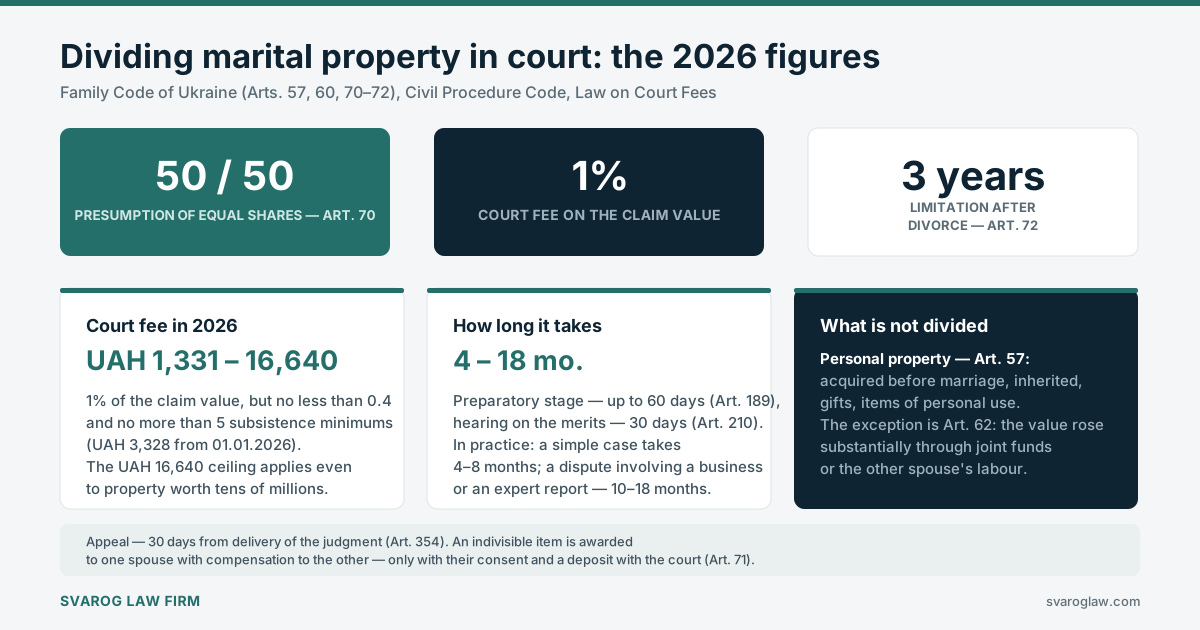
Article 62 of the Family Code allows personal property to be recognised as joint if its value increased substantially through the joint labour or money of the other spouse. The classic example is the husband’s pre-marital house that was renovated and extended with shared money for ten years. Everything here turns on evidence — receipts, contractor agreements, bank statements.
What takes a dispute to court
When a couple owns one flat, both agree to split it in half and neither has any claims, a notarised agreement is enough: the costs are limited to the notary’s fee and a valuation. Cases reach court for other reasons:
Assets are being moved out of reach
The car is “sold” to a relative, the LLC share is transferred to a partner, money is withdrawn from the accounts. Here you need interim relief and seizure of assets before the first hearing.
The parties disagree about where the money came from
“It was a gift from my parents” against “we took out the loan together” — a question of evidence, not of belief.
The assets include a business, a sole trader or corporate rights
The most complex category: valuation, analysis of constituent documents, often a forensic examination. We covered this in detail in the article “Are a business and sole trader income divided on divorce”.
The property is mortgaged or there are joint loans
The bank is not a party to a family dispute, so the division of property and the obligations to the lender have to be separated into two different proceedings.
You want to depart from equal shares
For instance, the children stay with you. That is a separate matter to be proved, not a request in the claim.
The limitation period is running out
Or the other side argues it has already expired. This has to be checked before filing, not afterwards.
Equal shares — and when the court deviates from them
As a general rule (Art. 70 of the Family Code) the spouses’ shares are equal, but this is a presumption that can be rebutted.
If that spouse did not provide for the family financially, avoided maintaining the child, concealed, destroyed or damaged joint property, or spent it to the detriment of the family’s interests.
Conversely, it increases the share of the spouse the children live with, or who supports an adult son or daughter unable to work, where maintenance is not enough to support them.
Both scenarios require evidence: a maintenance order, arrears certificates, account statements, witness testimony.
“He behaved badly” on its own does not convince a court, and this is where self-prepared claims most often fall apart.
Loans and mortgages: what not to expect
A common mistake is to assume the court will “split the loan in half”. It does not work that way. The bank is not a party to a family dispute: whoever signed the loan agreement remains the debtor. What does work in practice:
- If the loan was taken in the family’s interests and the money went into joint property, the spouse repaying it alone can recover compensation for part of the payments from the other.
- A mortgaged flat can be divided into shares, but an actual transfer requires the bank’s consent — we set out the mechanics step by step in the article “How to divide a mortgaged flat on divorce”.
- Obligations taken on by one spouse in their own interests (payday loans, betting, debts to third parties) are not imposed on the other, but this has to be proved: where the money went and what it was spent on.
Three years that are easy to miss
A three-year limitation period applies to claims for the division of property after the marriage is dissolved (Art. 72 of the Family Code).
This cuts both ways. The fact that you divorced eight years ago does not mean it is too late to file. And conversely: if you found out about the sale two years ago and did nothing, time is running out. And if the marriage has not been dissolved, no limitation period applies to division claims at all. This is the detail worth checking at the consultation before you pay for a valuation and the court fee.
Two options: an agreement or court proceedings
Property division agreement
from 1–2 weeksThe fastest and cheapest option. The spouses decide themselves who gets what, and not necessarily in equal parts. The procedure is as follows:
- We draw up a list of assets and check the title documents
- If necessary, we order a valuation
- We prepare the agreement on the division of joint property
- We have it notarised — notarisation is mandatory for real estate Art. 69 FC
- We register the transfer of ownership
It takes from one to two weeks. There is one main risk: an agreement copied from an online template. Such agreements are challenged later, and that costs both sides money.
Division through the courts
4–18 monthsWhere to file. A claim for the division of real estate is filed where the property is located, not where the respondent is registered. If there are several properties, it goes to the court where the most valuable one is located Art. 30(1) CPC (Civil Procedure Code of Ukraine). Getting jurisdiction wrong costs one to two months: the court will return the claim. The stages are:
- Assessment of prospects — what evidence exists and what will have to be proved
- Gathering evidence — registry extracts, lawyer’s requests to banks and registrars, a valuation
- Interim relief — seizure of assets and a ban on registration actions where there is a risk of assets being moved
- Statement of claim and payment of the court fee
- Preparatory hearing and hearing on the merits, with an expert examination if required
- Judgment, an appeal if needed, registration of ownership
An indivisible item such as a flat or a car is not physically split in two: under Art. 71 FC it is awarded to one spouse with monetary compensation to the other, and the court orders that compensation only with that person’s consent and provided the money has first been paid into the court’s deposit account. Without funds on deposit, the “I will take the flat and settle up later” strategy does not work.
Timing. The Civil Procedure Code allows the court up to 60 days for preparatory proceedings (Art. 189) and 30 days for the hearing on the merits (Art. 210). In practice a straightforward case with a single property takes 4–8 months, while a dispute involving a valuation, a business or an expert examination takes 10–18 months. A judgment can be appealed within 30 days (Art. 354 CPC).
What risks does someone face if they handle the case themselves?
- The assets are moved in time. While the claim is being prepared, the car is sold and the LLC share is transferred. Without a timely application for interim relief, recovering it takes years — through separate claims to have the transactions declared invalid.
- “Sudden” debts appear. In one 2024 case the opponent produced a promissory note for 900,000 UAH “dated” to the period of the marriage; a document-dating examination removed it from consideration, but such an examination has to be requested by a party and requested in time.
- An understated valuation. A valuer’s report commissioned by the other side cuts the flat’s value by a third — and your compensation with it.
- A missed deadline. It only takes the respondent to invoke the limitation period and the court dismisses the claim without examining the merits.
- An error in jurisdiction or in the value of the claim: the claim is returned, time passes, and the other side keeps acting.
How we work
- We analyse the history of each asset and separate joint property from personal property, so that no resources are spent on what cannot be divided.
- We block the removal of assets: an application for interim relief, seizure, a ban on registration actions.
- We look for what is hidden: lawyer’s requests to banks, state registers and the Unified State Register.
- We commission a valuation from an independent valuer and review the reports filed by the other side; an understated report is challenged by an application for a repeat valuation.
- We negotiate: where a settlement is worth more than two years in court, we show the figures for both options.
- We represent you in court and see the matter through to registration of ownership or receipt of compensation.
A case from our practice
In 2024 a woman came to us a year after her divorce: the flat in Kyiv was registered in her former husband’s name, he had managed to transfer the car to his brother, and verbally he was offering a “settlement” of 200,000 UAH. We filed a claim for division together with an application for interim relief; the court seized the flat and banned registration actions, so it could not be sold during the proceedings. The car transaction was challenged as a sham, and the valuation commissioned by the other side was rejected by the court, which ordered a fresh one. The case lasted about fourteen months and ended in a settlement: the flat stayed with the former husband, while the wife received compensation of half its value based on the new valuation, plus the car. The court fee was around 12,000 UAH and the legal fee started at 25,000 UAH for full representation (details changed).
Cost of services (lawyer specialising in property division)
The price depends on the number of assets, whether a business forms part of them, whether an expert examination is needed and how the other side behaves. Payments to the state and to third parties are charged separately:
- the court fee — 1 % of the value of the claim, but not less than 0.4 and not more than 5 subsistence minimums for able-bodied persons (the Law “On Court Fees”). In 2026 the subsistence minimum is 3,328 UAH, so the fee ranges from 1,331.20 to 16,640 UAH. For example: you are dividing a flat and your share is valued at 1,500,000 UAH — the fee will be 15,000 UAH. For assets worth 10 million you pay the same maximum of 16,640 UAH: the cap of five minimums works in your favour. Filing through the Electronic Court multiplies the rate by 0.8, so the claim in that example costs 12,000 UAH;
- valuation of the property by a certified valuer;
- notary’s fees — when a division agreement is concluded.
Порахуйте судовий збір
Вкажіть вартість вашої частки — покажемо суму з урахуванням мінімуму, стелі та знижки «Електронного суду».
Questions and answers (lawyer specialising in property division)
How is property divided in a civil partnership?
Property of a woman and a man who live as a family without registering their marriage is joint matrimonial property (Art. 74 of the Family Code), provided neither of them is married to someone else. The difficulty is that living together as a family has to be proved in court: joint contracts, payments, correspondence, witness testimony, dated photographs.
The flat was bought and registered in the child’s name. Is it divided?
No. Property acquired by the parents, or by one of them, in a child’s name belongs to the child and is not divided between the spouses (Art. 174 of the Family Code). That is why we check whose name each property is registered in before filing: sometimes half of the “joint” assets legally no longer belong to either spouse.
Three years have passed. Can anything be done?
The court applies the limitation period only if the respondent raises it, so a claim can be filed in any event. If it is raised, we show either that time has not started running (you learned of the infringement later) or that there are valid grounds to restore the period under Art. 267 of the Civil Code: lengthy medical treatment, hostilities, being abroad, or the other side concealing the assets.
I am abroad. Can the case be handled without me coming to Ukraine?
Yes. The lawyer acts under a warrant and a power of attorney certified by a consul or a notary where you are, and hearings can be attended by video conference. A trip is only needed for a notarised division agreement, and even that can be signed through a representative with the appropriate authority.
Who ultimately pays the court fee and the valuation?
The claimant pays first, but under Art. 141 of the Civil Procedure Code the court allocates costs between the parties in proportion to the claims granted: if the claim succeeds in full, the fee and the cost of expert examinations are recovered from the respondent. If there is no money to pay the fee up front, we apply for it to be deferred, paid in instalments or reduced (Art. 8 of the Law “On Court Fees”).
How is the value of the claim set if there is no valuation yet?
The value of the claim is based on the actual value of the property at the time of filing. Registry data and market listings are used for the initial calculation, while the precise figure is established by a valuer’s report or a forensic examination during the proceedings. If the value is set incorrectly, the court asks for the fee to be topped up, so there is no point in understating it.
Contact an advocate at Svarog regarding the division of property
Tell us about your situation at a consultation: we will analyse the documents, separate joint property from personal property and estimate the cost and timescale of the case. You will get the figures for both routes — what the court costs and what a notarised agreement gives you — because a settlement drawn up in two weeks sometimes yields more than a year of litigation.