
Most problems with the Military Registration and Enlistment Office arise not in the office itself, but before that – when a person does not know which documents they are required to present, what they are obliged to do by law, and what they cannot be required to do.
A lawyer specialising in the Military Registration and Enlistment Office is not needed to ‘get you off the hook’ – that is impossible and unlawful. They are needed to ensure that your legitimate grounds (deferral, health reasons, military service reservation, caring for a relative) are properly documented and submitted on time, and that the actions of the Military Registration and Enlistment Office remain within the bounds of the law.
We deal with three typical situations: a fine has already been imposed, a person is being detained at the TCC, you need to apply for a lawful deferral or appeal against a refusal to grant one.
+38 095 554-54-24 — legal advice
TCC fines: 17,000 – 25,500 UAH
The decision is issued by the head of the Military Registration and Enlistment Office, not a court — often in absentia. Consequently, these decisions contain many procedural flaws, and a significant proportion of them are overturned.
| Grounds | Fine during a special period |
|---|---|
| Article 210 of the Code of Administrative Offences — breach of military registration rules (citizens) | 17,000 – 25,500 UAH |
| Article 210-1 of the Code of Administrative Offences — breach of legislation on mobilisation (citizens) | 17,000 – 25,500 UAH |
| Article 210-1 of the Code of Administrative Offences (public officials and legal entities) | 34,000 – 59,500 UAH |
Two deadlines you need to be aware of: 10 days from the date the decision is issued — to lodge an appeal; 15 days from the date of service — for voluntary payment, after which the fine is doubled by the enforcement service.
For details on the grounds for cancellation, see the page Appealing a TCC fine.
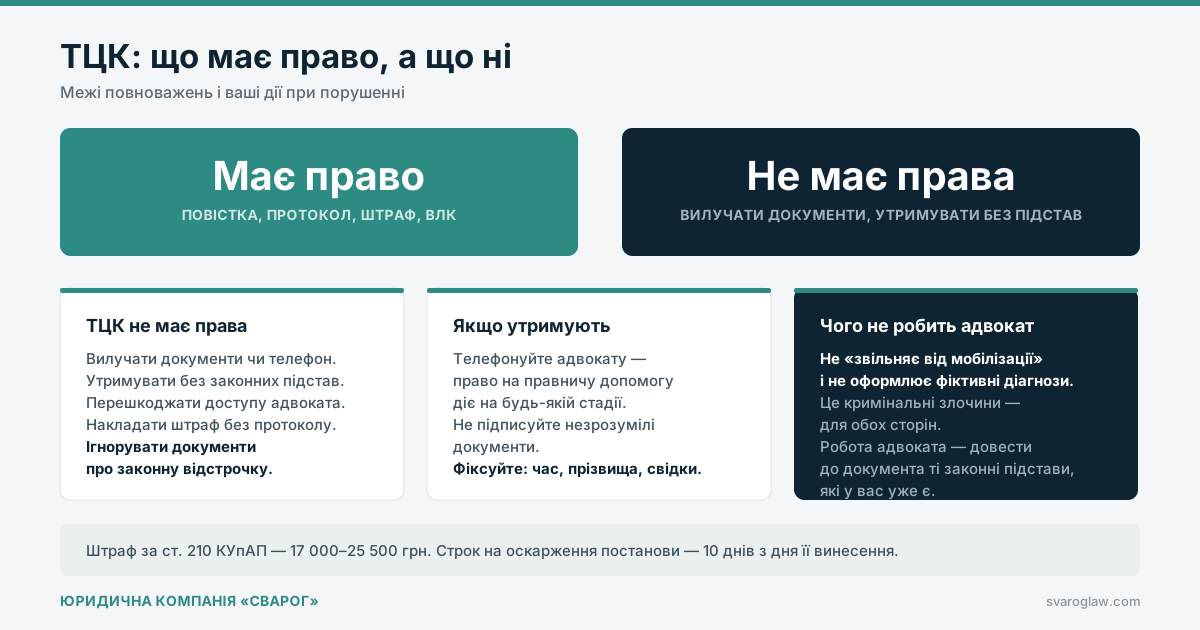
What the TCC is authorised to do, and what it is not
Authorised to:
- serve a summons in person against signature;
- draw up a report on an administrative offence;
- issue a decision imposing a fine;
- refer a case to a medical examination board;
- carry out notifications in conjunction with the police.
Is not authorised to:
- use physical force to compel attendance outside the bounds of the law;
- seize documents or a mobile phone;
- detain a person without lawful grounds;
- prevent access to a solicitor;
- impose a fine without drawing up a report;
- ignore documents regarding a lawful deferral.
If these limits are breached — document it: video, witnesses, written statements. It is precisely these documented breaches that subsequently lead to the annulment of decisions and form the basis of complaints.
If a person is being held at a TCC
You must act within the first few hours.
- Call a lawyer — the right to legal aid applies at any stage.
- Do not sign any documents whose content you do not understand. In particular, do not sign consent forms for mobilisation or a contract.
- State the grounds for deferment — both verbally and in writing, and demand that your statement be registered.
- Record — the time, place and surnames of the officials.
- A lawyer will visit the TCC, gain access to the individual, submit written applications and document any violations.
Unlawful detention can be challenged, and officials may be held liable. However, without a lawyer and without documentation, it is almost impossible to prove this.
Deferral and reservation
The most effective course of action is not to challenge the consequences, but to formalise the legal grounds in good time.
The most common grounds for deferral are: caring for a person with a disability, raising a child with a disability, having three or more children, bringing up a child as a single parent, health issues, education, and job retention.
The problem almost always lies with the documentation: the grounds exist, but there is nothing to substantiate them — certificates are out of date, status has not been formalised, or there is no record in the register. We compile the application package so that the Territorial Military Commissariat has no formal grounds to refuse it, and if a refusal has already been issued, we appeal against it.
Further details: Applying for a deferral from mobilisation.
When a lawyer is not needed
If you have updated your details, are registered with the authorities, have received a summons, and there are no grounds for deferment — a lawyer cannot help you, and we will be honest about this. Promises to ‘sort things out’ in this area are either fraud or a criminal offence.
You need a lawyer specialising in the TCC when:
- a fine has been imposed — and you wish to appeal against it;
- you are being held at the TCC right now;
- there is a legal basis for deferment, but the Military Registration and Enlistment Office does not recognise it;
- the Medical Examination Commission has deemed you fit for service contrary to your medical records;
- you are being sought for alleged evasion, even though you are registered with the authorities;
- you are abroad, and need to regularise your status;
- criminal proceedings have been initiated against you for evasion or illegal absence from military service.
How we work
- We assess the situation — identifying which grounds you actually have, and which are merely apparent.
- We submit solicitors’ requests to the Territorial Military Commissariat — obtaining rulings, minutes and case files.
- We formalise legal grounds — deferral, medical examination, reservation.
- We challenge fines and refusals — in the administrative court.
- We travel to the TCC if the person is being detained.
- We provide defence in criminal proceedings — evasion, special circumstances.
Cost of services
| Service | Price |
|---|---|
| Consultation with a military lawyer | from 1,500 UAH |
| Legal opinion: assessment of the situation and grounds | from 5,000 UAH |
| Preparation of documents for deferral, support at the Territorial Recruitment Centre | from 5,000 UAH |
| Preparation of a statement of claim and procedural documents | from 5,000 UAH |
| Participation in one court hearing | from 3,000 UAH |
| Legal representation in court | from 10,000 UAH |
| Comprehensive ‘turnkey’ representation in administrative cases | from 30,000 UAH |
| A lawyer’s participation in investigative proceedings | from 15,000 UAH |
| Comprehensive support for a criminal case (pre-trial investigation, evasion) | from 60,000 UAH |
Court fees: 665.60 UAH — appeal against a ruling on an administrative offence; 1,331.20 UAH — administrative claim (2026).
Questions and answers (Lawyer specialising in military service)
Can a lawyer ‘exempt’ someone from mobilisation?
No. A lawyer cannot exempt you from military service — they ensure that your legitimate grounds (deferral, health reasons, exemption) are recognised, and that the actions of the Military Registration and Enlistment Office remain within the law. Anyone who promises otherwise is offering you a criminal service.
What should you do if you’ve been served with a summons?
Do not ignore it. Failure to appear without valid reasons carries a fine of 17,000–25,500 UAH, whilst systematic evasion carries criminal liability. If there are grounds for deferral, ensure these are documented before the date of appearance.
How long do you have to appeal against a TCC fine?
10 days from the date the decision was issued. If you were not served with a copy, the time limit can be extended.
Does the TCC have the right to detain you?
The physical detention of a person without lawful grounds is unlawful. If this happens, document the incident (time, names, witnesses, video) and call a solicitor immediately: the right to legal aid applies at any stage.
Can I apply for a deferral if I’ve already received the summons?
Yes, provided there are genuine grounds. It’s simply a matter of the documentation: you need to gather and submit the documents in such a way that the Military Registration and Enlistment Office has no formal grounds to refuse.
The Medical Examination Commission has deemed me fit for service, even though I have a serious medical condition. What should I do?
You should appeal — either to a higher Medical Examination Commission or to an administrative court. You’ll need medical evidence and documentation of any procedural irregularities during the examination. For more details, see the page on Medical Examination Commissions.
I am abroad. Can I sort out matters with the Military Registration and Enlistment Office from there?
Yes. Updating your details, appealing against fines, and processing documents – all of this can be done remotely, with a solicitor representing you under a legal aid agreement.
What documents should I bring to the consultation?
Your military registration document, summons, Military Registration and Enlistment Office decision (if applicable), Medical Examination Commission report, documents confirming grounds for deferment, and any enforcement proceedings documents.
Contact a lawyer specialising in Military Registration and Enlistment Office matters at Svarog
Describe your situation — we will tell you what legal grounds you actually have, what can be done right now, and what has already been lost. An honest answer during a consultation is worth more than promises to ‘resolve the issue’, which in this field often end in criminal proceedings for both parties.
+38 095 554-54-24 · Kyiv, 7 Khoriva Street, Office 2 (Podil) · Mon–Fri 9.00–18.00