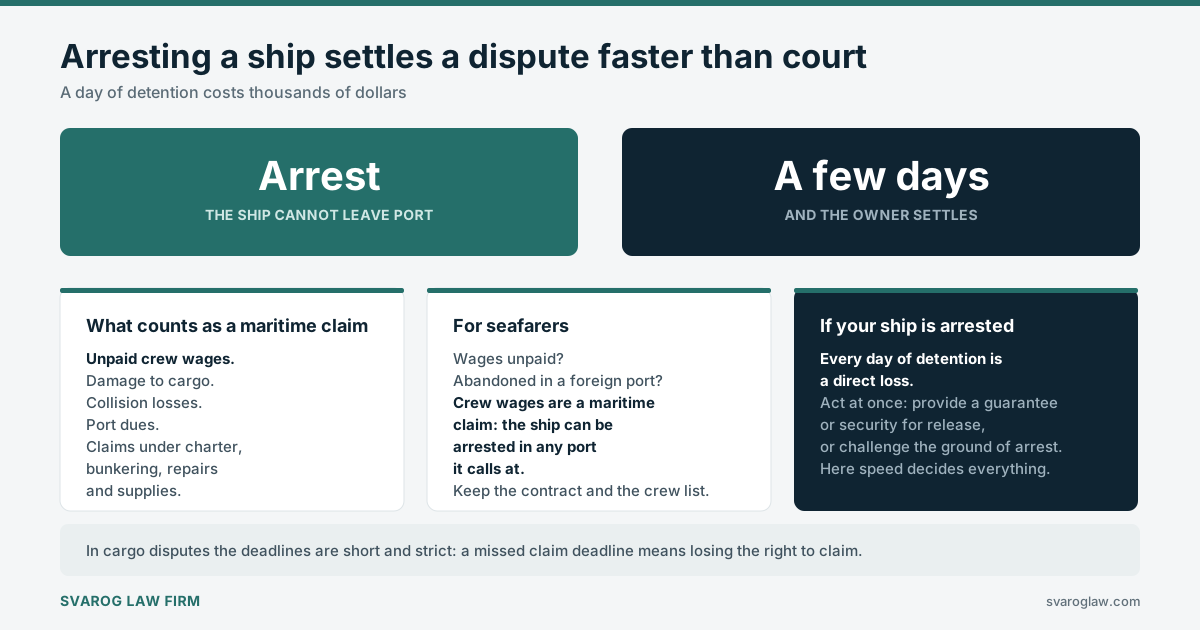
Maritime law has a tool no other field offers: a ship can be arrested in port before the dispute is heard on the merits. Lying idle costs an owner thousands of dollars a day, so after an arrest the parties usually settle within days.
Svarog’s maritime lawyer works both with business — owners, charterers, cargo interests, shipping agents — and with seafarers who have not been paid or who were left in a foreign port.
Areas of work
The ship
- arrest of a vessel for a maritime claim and, conversely, release from arrest;
- disputes over the sale and purchase of vessels, registration, mortgages;
- charter disputes: time charter, bareboat charter, voyage charter;
- collisions, casualties, salvage, general average.
Cargo
- damage to, loss of or shortage in cargo;
- disputes under bills of lading;
- demurrage and detention;
- cargo insurance disputes.
Seafarers
- recovery of unpaid wages;
- repatriation where a crew has been abandoned in a foreign port;
- compensation for injury or death on board;
- disputes under contracts, unlawful dismissal, crewing agencies’ blacklists.
Fisheries
- Fisheries law: quotas, licences, breaches of fishing rules, detained vessels.
Arrest of a vessel for a maritime claim
The basis: Art. 41–42 of the Merchant Shipping Code and the 1952 International Convention on the Arrest of Sea-Going Ships (Ukraine acceded in 2012). A ship is arrested only to secure a maritime claim; an ordinary debt unconnected with the operation of the vessel is not enough. Maritime claims under Art. 42 include crew wages, damage to or loss of cargo, collision damage, salvage, port dues, charter claims, bunkers, repairs and supplies, and a ship mortgage.
The procedure: the application is filed with the commercial court where the port is located — the port where the ship lies or to which she is heading (Art. 138 CPC). The court decides it without summoning the parties. It can be filed before the claim itself, in which case the claim must follow within 30 days of the order. The order goes to the harbour master, and the ship is refused clearance to sail.
Why owners settle
The next fixture and the contracts under it fall through. So within a few days the owner usually provides a bank guarantee or a P&I club letter, or simply pays, and the ship is released. Most cases end in settlement before any hearing on the merits.
If your ship has been arrested
The task is the opposite: release her as fast as possible. The options are to post security or provide a guarantee for the amount claimed; to challenge the order where the claim is not maritime or is unproven; or to ask the court for counter-security from the applicant.
Seafarers: how to recover wages
The usual situation: the contract has ended, the owner is out of contact, the company is registered offshore and several months’ wages are unpaid. The sequence is:
- A written demand to the owner and the crewing agency, with proof of sending.
- An approach to the ITF where the ship sails under a flag of convenience and an ITF collective agreement applies.
- Arrest of the vessel in any port of call, not necessarily the one where you served: crew wage arrears are a maritime claim.
- The owner’s financial security. Where the ship flies the flag of a state party to the Maritime Labour Convention (MLC 2006), an insurer’s certificate on board covers repatriation and up to four months’ wages. Ukraine has not ratified the convention, but the certificate applies regardless of the seafarer’s nationality.
- A claim in court where there are grounds for Ukrainian jurisdiction — for example the respondent or assets to enforce against are in Ukraine. Claimants seeking wages pay no court fee (Art. 5 of the Law “On Court Fees”).
Advice to seafarers: keep the contract, the crew list, the payslips and the correspondence — without them, proving you served on the ship is difficult.
Cargo: deadlines that are not restored
Under Art. 388 of the Merchant Shipping Code a one-year limitation period applies to claims under a contract for the carriage of goods by sea. The Hague-Visby Rules, which govern most international bills of lading, set the same year from the date the cargo was delivered. The deadline for notifying damage is shorter still: written notice is given to the carrier on receipt of the cargo, or within three days where the damage is not apparent; otherwise the cargo is deemed delivered in good order.
So we first fix the date of delivery and calculate the deadlines, then arrange a surveyor’s inspection, gather evidence (the bill of lading, tally receipts, reports, photographs), send a claim to the carrier and work with the insurer. In charter disputes the commonest subject is demurrage — payment for detention beyond laytime; most charter forms send such disputes to arbitration, usually in London.
When you need a maritime lawyer
A routine voyage with no claims does not need one. Come to us when:
- you have not been paid your wages on board;
- the crew has been abandoned in a foreign port;
- cargo has been damaged, lost or delivered short;
- you want to arrest a debtor’s vessel to secure a claim;
- your vessel has been arrested and must be released;
- a charter or demurrage dispute has arisen;
- there has been a collision or another casualty.
A case from our practice
In 2025 four Ukrainian seafarers from a bulk carrier under a flag of convenience came to us: the owner had not paid wages for three months and, after the ship called at a Danube port in Ukraine, stopped answering letters. We sent a written demand to the owner and the crewing agency and applied to the commercial court at the port for the ship’s arrest. The court made the order on the second day, the ship was refused clearance to sail, and a week later the owner agreed to pay the arrears to have the arrest lifted. Around 40,000 dollars for the four of them arrived within three weeks of our starting work; the case never reached a hearing on the merits (details changed).
How we work
- We assess whether there is a maritime claim and which deadlines under the Shipping Code, the bill of lading and the charter are still open.
- We prepare the arrest application at the port, obtain the order and negotiate security or payment.
- We defend owners: release of the vessel, challenging the order, counter-security.
- We act in court and arbitration, including the Maritime Arbitration Commission at the Ukrainian Chamber of Commerce and international commercial arbitration.
Cost of services
Court fees in 2026: an application for interim relief (arrest of a vessel) — 1,664 UAH; a monetary claim by a company in the commercial court — 1.5 % of the value, from 3,328 to 1,164,800 UAH; by an individual — 1 %, from 1,331.20 to 16,640 UAH. Seafarers pay no fee in wage claims; filing through the Electronic Court is 20 % cheaper.
Questions and answers (Maritime lawyer)
Can a ship be arrested before she enters port?
Yes. The application goes to the commercial court at the port the vessel is heading for, so we prepare the papers in advance and file on the day she arrives.
Can I work with a lawyer remotely while I am abroad?
Yes, that is the normal arrangement: documents by scan, consultations online, and a power of attorney certified at a Ukrainian consulate or by a local notary. If the ship is in a foreign port, a local lawyer applies for arrest under the law of that port while we prepare the evidence and coordinate their work.
What if the one-year period for a cargo claim has already passed?
The court applies limitation only if the respondent raises it, and may restore the period for valid reasons, although that is rare in commercial disputes. We also check whether time was interrupted by an acknowledgement of the debt and whether there are claims against the forwarder or the insurer.
What does an arrest cost the applicant besides legal fees?
A court fee of 1,664 UAH for the application and the ordinary fee for the claim. The court may require counter-security: a deposit in case the arrest turns out to be unjustified and the owner claims losses from the detention.
What documents should I bring to the consultation?
The contract, or the bill of lading or charterparty, the claim correspondence, the vessel’s documents and the calculation of the claim. Seafarers should also bring the crew list and payslips.
Contact a maritime lawyer at Svarog
Describe the situation and send us the documents. We will check whether your claim is a maritime one and in which port the vessel can be arrested, calculate the deadlines under the Shipping Code and the bill of lading, and propose a plan with costs.