
The most common scenario we encounter is as follows: the person has grounds for deferral, but these have not been formalised. A relative’s disability certificate has expired, guardian status has not been confirmed, details of children have not been entered into the register, and the employer has not made the necessary arrangements. The Territorial Recruitment Centre does not take your personal circumstances into account; it only considers what is in the documents and the register.
A deferral from mobilisation is neither a privilege nor an ‘arrangement’. It is a right, confirmed by documents. And it is granted only when the grounds exist at the time of consideration and are supported by appropriate evidence.
We do not ‘arrange deferrals’. We set out in writing the legal grounds you already possess — and challenge any refusal if it is unlawful.
+38 095 554-54-24 — legal advice
Main grounds for deferral
The list is defined by law and is exhaustive. The most common grounds are:
- caring for a person with a disability of Group I or II (provided there are no other persons obliged to support them);
- raising a child with a disability;
- three or more children under the age of 18;
- raising a child alone — where the other parent is absent;
- guardianship or care of a child;
- health condition — as determined by the Medical Examination Commission;
- pursuing education — on a full-time or dual-track basis;
- academic and teaching staff at higher education institutions;
- job retention at the place of work (a critically important enterprise);
- close relatives of military personnel who have been killed or are missing in action.
Each ground has its own conditions and exceptions — it is usually within these that the reason for refusal lies. For example, caring for a person with a disability does not qualify for a deferral if there are other relatives obliged to support them.
Why does the TCC refuse
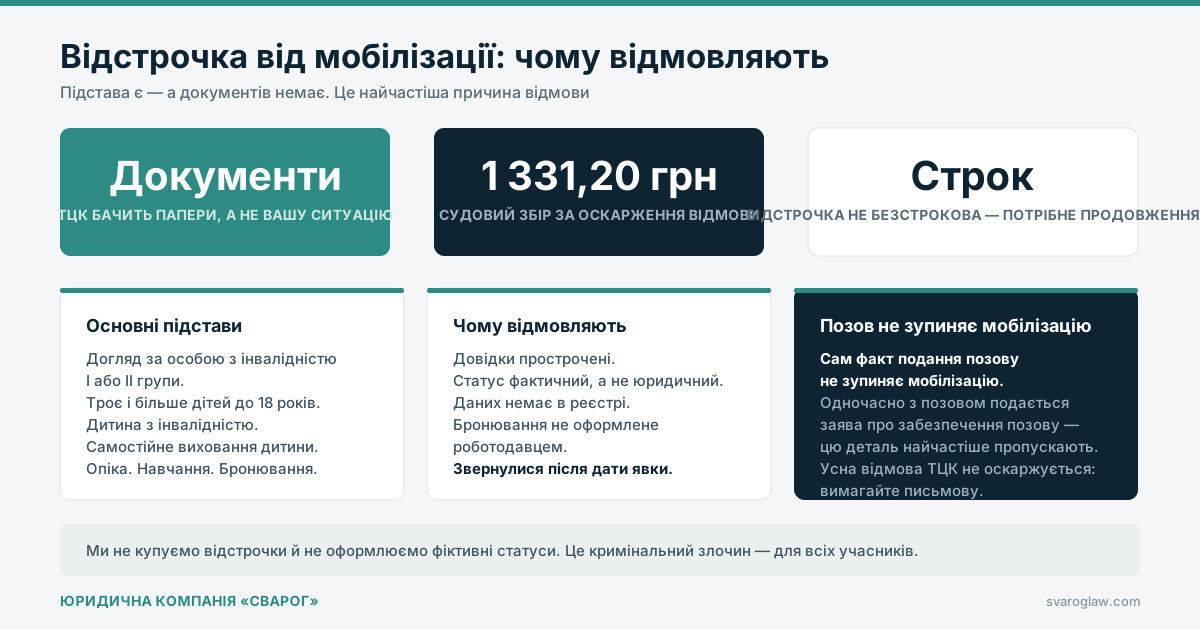
Not because of ‘arbitrariness’, but most often due to defects in the documents:
- the grounds are not supported by documentation — the fact exists, but the paperwork does not;
- documents have expired — certificates from the Medical and Social Expertise Commission (MSEK), family composition certificates;
- status has not been formalised — de facto guardianship exists, but there is no legal guardianship;
- data is missing from the registers — ‘Oberig’, the register of persons with disabilities;
- the reservation has not been processed by the employer or has been processed incorrectly;
- the person did not apply in time — by the date specified in the summons.
Therefore, 80 per cent of a lawyer’s work here is not in court, but ensuring the correct set of documents is compiled, submitted on time and duly registered.
Procedure for processing
- Verification of the grounds — whether they exist in law, and not merely in fact. This is the most important step: sometimes it is necessary first to arrange guardianship, establish a fact or update a status.
- Gathering documents — certificates, statements, extracts from registers, medical reports. All must be up to date as at the date of submission.
- Submitting the application to the TCC — this must be done with registration of the incoming document or by post with a list of contents. Verbal requests have no legal force.
- Updating details in the register — via ‘Rezerv+’ or in person.
- Receiving a decision. A deferral is granted for a specified period and requires timely renewal.
If your application has been refused
Step 1. Obtain a written refusal stating the grounds. A verbal statement such as ‘you are not eligible’ is not a decision and cannot be appealed. Demand a written document.
Step 2. Analyse the reason. If the refusal is due to missing documents, submit them. If the grounds for refusal are unfounded, appeal.
Step 3. Administrative proceedings. Decisions and omissions by the TCC may be challenged in the administrative court. Court fees amount to 1,331.20 UAH (0.4 times the minimum subsistence level in 2026).
Step 4. Securing the claim. This is crucial: the mere fact of filing a claim does not automatically halt mobilisation. Therefore, an application to secure the claim must be submitted at the same time.
Inaction on the part of the TCC (an application has been submitted but no decision has been made) is appealed in the same way as a refusal.
Extension of deferral
The deferral is not indefinite. The most common setbacks occur precisely when seeking an extension: a person has been granted a deferral, becomes complacent, and then the deadline expires, causing their status to be removed from the register.
Extensions must be sought in good time, with an updated set of documents. We keep track of these deadlines on behalf of the client.
What we do not do
We do not purchase deferrals, do not arrange fictitious guardianship, do not ‘negotiate’ with the TCC, and do not fabricate non-existent diagnoses. These are criminal offences — for all parties involved, including the client.
People who go down this path do not receive a deferral, but face criminal proceedings — and with it, everything they were trying to escape from.
When a solicitor is not needed
The grounds are clear, the documents are in order, and the register has been updated — submit the application yourself. We will tell you as much during the consultation.
You need a solicitor when:
- the grounds do exist in fact, but have not been formalised legally;
- the TCC has refused or is silent;
- the documents have been lost or have expired;
- you first need to establish the fact or obtain guardianship through the courts;
- the booking has been made with errors or the employer is delaying;
- the deferral is about to expire, and you need to extend it;
- you are abroad and cannot submit the documents in person.
Cost of services
| Service | Price |
|---|---|
| Consultation with a military lawyer | from 1,500 UAH |
| Legal opinion: verification of grounds for deferral | from 5,000 UAH |
| Compilation and submission of a set of documents to the Territorial Recruitment Centre | from 5,000 UAH |
| Preparation of a statement of claim and procedural documents | from 5,000 UAH |
| Participation in one court hearing | from 3,000 UAH |
| Court representation | from 10,000 UAH |
| Comprehensive support for an administrative case (appeal against a refusal) | from 30,000 UAH |
Court fee: 1,331.20 UAH for an administrative claim (2026).
Full price list · Lawyer specialising in mobilisation
Questions and answers (Deferral from mobilisation)
Is it possible to apply for a deferral if you have already received your summons?
Yes, provided there are valid grounds. It is simply a matter of the documents: they must be gathered and submitted by the date of appearance, with the incoming document registered at the Territorial Recruitment Centre.
Why is a request refused if there are valid grounds?
Most often, it is due to the documents: expired certificates, unregistered status, or missing data in the register. The Military Registration and Enlistment Office looks at the paperwork, not the actual circumstances.
Does filing a court claim halt mobilisation?
Not automatically. That is why an application for interim relief must be filed at the same time as the claim. This is an important detail that is often overlooked.
How much does it cost to appeal against a refusal?
The court fee is 1,331.20 UAH (2026). Plus the lawyer’s fee. If the case is won, the costs are recovered from the TCC.
Is it possible to obtain a deferral on the grounds of caring for parents?
Yes, if the person in question has a Group I or II disability and there are no other relatives obliged to support them. It is precisely this condition that most often forms the basis for a refusal.
What should I do if the Military Registration and Enlistment Office does not respond to my application?
Challenge their inaction in an administrative court. The court may order the Military Registration and Enlistment Office to consider the application on its merits.
Is the deferral valid indefinitely?
No. It is granted for a fixed period and must be renewed in good time. An expired deferral is removed from the register, and the person is once again subject to mobilisation.
Is it possible to apply for a deferral whilst abroad?
Yes, documents are submitted via a representative acting under a power of attorney, and details are updated remotely. A solicitor handles the process without you needing to be present in person.
What documents should I bring to the consultation?
Your military registration document, your mobilisation summons (if applicable), documents confirming the grounds for deferment (certificates from the Medical and Social Expertise Commission, children’s birth certificates, guardianship documents, booking confirmation), and a written refusal from the Territorial Recruitment Centre.
Contacting a lawyer regarding deferral from mobilisation at Svarog
Describe your situation — we’ll tell you whether you have a legal basis, which documents are missing and what you need to do first. If there is no legal basis — we’ll tell you straight: an honest answer is more useful than promises that end in a criminal case.
+38 095 554-54-24 · Kyiv, 7 Khoriva Street, Office 2 (Podil) · Mon–Fri 9:00–18:00