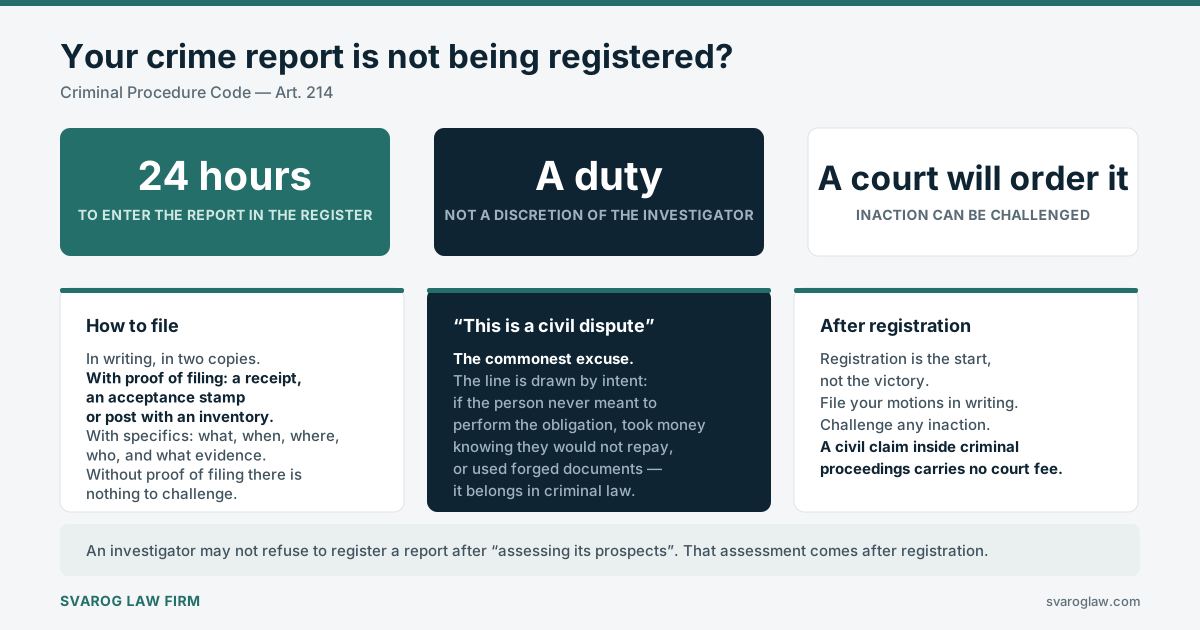
A criminal case begins with the fact that a report has been filed. Details of a criminal offence must be entered in the Unified Register of Pre-Trial Investigations within 24 hours of the report being filed (Art. 214(1) CPC), and the law requires no decision by the investigator about whether it is “worth it”.
An investigator has no right to refuse to enter the details after “assessing the prospects” or deciding that “there is no offence here”. Assessment belongs to the investigation, and it comes after registration, not instead of it.
In practice the complainant hears something else: “write it differently”, “this is a civil dispute”, “we will check and let you know”. Getting the details into the register takes effort.
How to file the report properly
- In writing. Oral reports “go missing”. Prepare the report in two copies.
- With proof of filing — an acknowledgement stamp on your copy, or postal despatch with an inventory of the contents and confirmation of delivery.
- With a receipt slip — when you file at a police station they are obliged to issue one. That is your proof of having applied.
- With specifics — what happened, when, where, who was involved, what evidence exists. A vague report gives the investigation a reason to play for time.
- Citing the article — not compulsory, but useful: it makes it harder to push the case into the civil sphere.
The report goes to the police, the prosecutor’s office, the State Bureau of Investigation, NABU or the Bureau of Economic Security, depending on jurisdiction (Art. 216 CPC). Choosing the wrong body is not a ground for refusal: they must register the report and pass it on, but it takes longer.
What to do if they will not register it
Having heard the complaint, the court orders the details to be entered in the register. The investigating judge’s ruling is binding, and after it the details are entered within the same 24 hours.
The complaint needs proof that the report was filed (the receipt slip, the postal receipt with the inventory, the acknowledgement stamp) and confirmation that the details were not entered (an extract from the Register, or the absence of a reply within the statutory period). Without proof of filing there is nothing to challenge, so recording the application matters as much as the wording of the report itself.
The deadlines that matter here
The timetable
- 24 hours from the filing of the report — to enter the details in the Register (Art. 214(1) CPC);
- 10 days from the day the person learned of the inaction or received the decision — to complain to the investigating judge (Art. 304 CPC);
- 72 hours from receipt — for the investigating judge to hear the complaint; for a complaint against a decision to close proceedings the period is longer, up to five days (Art. 306 CPC);
- a missed ten-day deadline can be restored, but that requires a valid reason supported by documents.
So the sequence is simple: file the report, record the filing, wait a day, request an extract from the Register, and complain if there is none. The delays that run into months begin precisely when the complainant decides to “wait a little longer for a reply”.
“This is a civil dispute” — the standard brush-off
The commonest way of avoiding registration: the investigator says the matter is one of civil-law relations and advises you to go to the commercial or civil court.
Sometimes that is true: failing to perform a contract really is not fraud.
But the line is drawn by intent. If the person never meant to perform the obligation, took the money knowing they would not return it, or used forged documents or someone else’s details, it is fraud (Art. 190 CC).
The lawyer’s work at this stage is to separate the two and word the report so that the investigator cannot wave it away: set out the signs of intent, attach the correspondence, the payment documents and evidence that the counterparty was a shell.
What happens after registration
Registration is only the beginning. After it the case can stall: the investigator takes no steps, questions no witnesses, orders no expert report.
So in parallel we:
- file applications for questioning, expert reports and the production of documents — in writing, with an acknowledgement stamp, so that a refusal can be challenged;
- keep track of the time limits of the pre-trial investigation and challenge inaction;
- challenge the closure of the proceedings where it comes too soon;
- prepare the civil claim within the criminal proceedings — it is filed free of court fees (Art. 128 CPC).
More on a victim’s rights: Help for victims in criminal proceedings.
A case from our practice
In 2025 a businessman came to us after paying 340,000 UAH in advance for equipment and receiving neither the goods nor his money back. The district police returned his report three times, explaining that it was a “commercial dispute”. We rewrote the report around the signs of intent: the seller company had been registered a month before the deal, was not at its stated address, and the scanned tax invoice turned out to be forged. We filed by post with an inventory of the contents, and when the details were not entered within a day we complained to the investigating judge. The court ordered the investigating body to enter the details in the Register under Art. 190 CC; that took about two weeks from the complaint. The client recovered his money within the proceedings after the seller’s accounts were frozen, and our fee was 25,000 UAH. (details changed)
Complainants’ typical mistakes
Reporting orally or through an app and keeping nothing
A month later it turns out there is no proof of the application at all, and so nothing to challenge.
Writing an emotional account instead of facts
Three pages about “what kind of person this is”, without dates, sums or documents, give the investigation a lawful reason to keep checking.
Taking the report back “for revision”
The moment you agree to rewrite it and take your copy back from the registry, the 24 hours start again — and that can go on for months.
Waiting for an “official reply” instead of an extract from the Register
A letter saying the “application has been considered” proves neither registration nor refusal. It is the extract that counts.
Missing the ten-day deadline for the complaint
It can be restored, but you will have to prove the reason was valid, and the time is already lost.
How we work
- We draft the report with the right classification and the evidence, so that there is no pretext for refusal.
- We file it with proof and keep the evidence of filing.
- We challenge the inaction before the investigating judge, and the court orders the details to be entered in the Register.
- We keep the investigation moving: applications, deadlines, the investigator’s steps.
- We challenge the closure of the proceedings.
- We bring the civil claim, so that the case ends in compensation as well.
Cost of services
No court fee is payable in criminal proceedings: not for the report of an offence, not for the complaint to the investigating judge, and not for a civil claim brought within the proceedings (Art. 128 CPC). By way of comparison, a separate claim for the same money in the civil court in 2026 would cost an individual 1 % of the sum, but not less than 1,331.20 and not more than 16,640 UAH, and a company 1.5 % of the sum, with a minimum of 3,328 UAH.
Questions and answers (Entry in the Register of Pre-Trial Investigations)
Is there a deadline after which a report will no longer be accepted?
The law sets no time limit for filing the report itself: it must be registered however long ago the events happened. What matters is something else — the limitation periods for criminal liability, from two to fifteen years depending on the gravity of the offence (Art. 49 CC). Once they expire the case will be closed, so it is better not to delay.
Can I file remotely, from another city or from abroad?
Yes. The report is sent by post with an inventory of the contents and confirmation of delivery, and the date of despatch counts as the date of filing. A lawyer can also file it in person on your instructions and then represent you in the proceedings on a warrant, so there is no need to travel to Kyiv.
Can a report be filed anonymously?
No. Anonymous communications are not entered in the Register: the report must give your full name and contact details, and the complainant is warned of criminal liability for knowingly false reporting of a crime (Art. 383 CC). That warning is a standard part of the procedure, not a means of pressure.
I was not harmed personally but I witnessed the events. Can I file a report?
Yes, anyone may report a criminal offence. The status of victim goes to the person harmed by the offence (Art. 55 CPC), while a witness to the events remains a witness and may be questioned in the proceedings.
How do I obtain an extract from the Register, and will a complainant be given one?
The investigator or the prosecutor provides it on a written request from the victim or their representative. It is the extract that confirms the case number, the date of registration and the legal classification, so ask for it as soon as you have filed: without it you will not know whether an investigation has begun at all.
How long does the investigation take after the details are entered?
The period depends on the gravity of the offence and runs from the day of the notice of suspicion; before that the investigation can go on for a long time. Real economic-crime cases in Kyiv run from a few months to two years, and the pace is set largely by the written applications made on the victim’s behalf.
Contact Svarog about entry in the Register of Pre-Trial Investigations
If your report is not being registered, or you are told there is “no offence here”, send us its text and everything you have: the receipt slip, the postal documents, the replies from the authority. We will reword the report so that it cannot be turned away, record the filing, and if necessary obtain the entry through the investigating judge.