A fine for failing to attend a territorial recruitment centre is imposed by the head of that centre, not by a court, and often in the person’s absence. That is why the court in such cases reviews the procedure: whether a report was drawn up, whether the summons was properly served, whether rights were explained, whether a copy of the decision was sent. A defect at any of those steps is a ground to set the fine aside, and it is with the search for such defects that the lawyer’s work begins.
The second part of the work concerns documents rather than decisions: the ground for deferral, the medical records and the workplace reservation must be in place before the date of attendance. Then the recruitment centre has no occasion either for a fine or for a posting to a unit.
We handle four typical situations: a fine has already been imposed, someone is being held at the recruitment centre, a lawful deferral needs to be arranged, a deferral has been refused.
Recruitment centre fines: 17,000–25,500 UAH
| Ground | Fine during the special period |
|---|---|
| Art. 210 CAO — breach of the military registration rules (individuals) | 17,000–25,500 UAH |
| Art. 210-1 CAO — breach of the mobilisation legislation (individuals) | 17,000–25,500 UAH |
| Arts. 210, 210-1 CAO (officials) | 34,000–59,500 UAH |
Two deadlines to know. 10 days from the date the decision was issued in which to challenge it (Art. 289 CAO), and 15 days from service in which to pay voluntarily, after which the fine is collected at double the amount through the enforcement service (Arts. 307, 308 CAO). A decision that was never served can be challenged later, with an application to restore the deadline.
For the grounds of annulment in detail, see challenging a TCC fine.
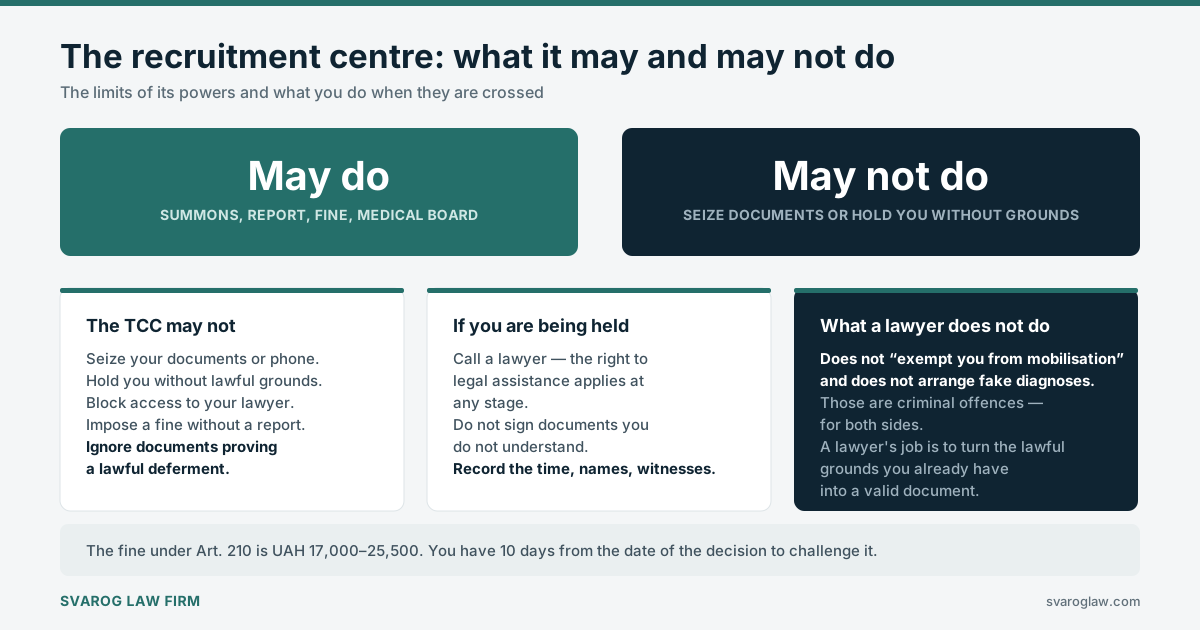
What a recruitment centre may and may not do
May
- serve a summons in person against signature, or send it by registered post (Procedure No. 560);
- draw up a report of an administrative offence (Art. 255 CAO);
- issue a decision imposing a fine under Arts. 210 and 210-1 CAO (Art. 235 CAO);
- refer you to a medical board;
- carry out notification, including together with the police.
May not
- use physical force to bring you in: administrative detention and conveyance are police powers, not those of recruitment centre staff;
- seize your documents or phone;
- hold a person without lawful grounds;
- obstruct a lawyer’s access (Art. 59 of the Constitution, the Law “On the Bar and Advocacy”);
- impose a fine without drawing up a report and without hearing the case with the person, properly notified, present;
- ignore documents establishing a lawful deferral.
Where those limits are exceeded, record it: video, witnesses, written applications registered on receipt. It is recorded breaches that later overturn decisions and form the basis of complaints to the courts and to the State Bureau of Investigation.
How a summons is served in 2026
A summons may be served in person: in the street, at home, at work or at a checkpoint, and in each case the official must identify themselves and state the date, time and place of attendance on the summons. It may also be sent by post to your registered or declared address. Under Procedure No. 560 such a summons counts as served both where you refused to accept it and where the letter came back marked “addressee absent” or “storage period expired”. Employers and educational institutions are also obliged to notify their employees and students.
So “not opening the door” does not save you from liability: failure to attend without a valid reason ends in a fine under Art. 210-1 CAO, and evading the call-up during mobilisation is a crime under Art. 336 of the Criminal Code. The defence is built on something else: on whether the summons was properly served, and on the deferral documents assembled before the date of attendance.
If someone is being held at a recruitment centre
Act in the first hours, before documents are signed and the medical board takes place.
- Call a lawyer. The right to legal assistance applies at every stage, including inside the recruitment centre.
- Do not sign documents whose content you do not understand — least of all a consent to mobilisation or a contract.
- State the grounds for deferral orally and in writing, insisting that the application be registered and a stamped copy issued.
- Record the time, the place and the names of the officials.
- The lawyer travels to the centre, obtains access on a warrant, files written applications and records the breaches.
Unlawful detention can be challenged, and officials may be held to account. Without a lawyer and without a record, that is almost impossible to prove.
Deferral and reservation
The most productive line of work is to document the lawful grounds in good time and never let the matter reach a fine. The commonest grounds for deferral are: caring for a person with a disability, raising a child with a disability, three or more children, raising a child alone, health, study, and reservation at your place of work.
The problem is almost always the paperwork: the ground exists but there is nothing to prove it, because the certificates are out of date, the status was never formalised, the register holds no data. Since 1 November 2025 the deferral application is filed through the Reserve+ app or an administrative service centre, and the recruitment centre only takes the decision. We check the ground, assemble the documents for the particular filing channel, and, where a refusal already exists, challenge it in the administrative court.
More on this: obtaining a deferral from mobilisation.
What the court examines in a fine case
The challenge is filed with the district administrative court where you live (Art. 288 CAO, Art. 286 CAP). The court checks:
The court’s checklist
- whether a report was drawn up and whether it bears the person’s signature or a note of refusal to sign;
- whether the person was notified of the time and place of the hearing;
- whether there is proof of proper service of the summons the fine was imposed for missing;
- whether the period in Art. 38 CAO has expired (3 months from discovery, and no later than a year from the act);
- whether a copy of the decision was served within three days (Art. 285 CAO);
- whether the person had valid reasons for not attending, or grounds for deferral as at the date of attendance.
In 2026 the court fee for such a challenge is 665.60 UAH. A first-instance judgment can be appealed within 10 days (Art. 286 CAP).
A case from our practice
In 2026 an employee of a Kyiv company came to us after being taken to a recruitment centre following a document check in the street. He had a ground for deferral — his wife has a group II disability — but the certificate was at home and the data had never been entered in Reserve+. On his wife’s call our lawyer reached the centre within an hour on a warrant, filed a written application setting out the ground and demanding it be registered, and sent a photograph of the certificate from the online account. He was released the same day with a referral to the medical board, and over the following fortnight the deferral application was filed through an administrative service centre and granted. The cost: the lawyer’s attendance and the preparation of the deferral documents. (details changed)
Cost of services
Court fees in 2026: 665.60 UAH for a challenge to a fine; 1,331.20 UAH for an administrative claim about a refusal of deferral or the centre’s acts or inaction (1,064.96 UAH through the Electronic Court). If you win, the fee and the legal costs are recovered from the recruitment centre.
Questions and answers (TCC lawyer)
The summons came through my employer. Is that lawful, and what should I do?
Yes, Procedure No. 560 obliges employers to notify employees of a call to the recruitment centre. Refusing to sign for it at work solves nothing: the notification is recorded by a certificate. The right step is to check, before the date of attendance, whether you have grounds for deferral or reservation, and to come to the centre with the documents or with a lawyer.
The ten days for challenging have passed. Is everything lost?
No, if there is a valid reason. The commonest is that you were never served with a copy of the decision and learned of the fine from Reserve+ or from an enforcement officer. The challenge then goes in together with an application to restore the deadline, evidencing the date you actually received the decision. The court assesses the reasons case by case.
Can I be fined twice for the same missed attendance?
No. Under Art. 61 of the Constitution no one may face the same type of liability twice for the same offence. If the centre issued two decisions for one episode, the court sets the second aside. It is different where separate summonses named separate dates: each missed attendance is a separate breach.
Does the lawyer have to attend the recruitment centre in person, or is a phone call enough?
If someone is being held, the lawyer must attend in person with a warrant: only then can applications be filed against signature, breaches recorded and access obtained. Consultations, preparing deferral documents and challenging fines are all handled remotely.
An enforcement officer is collecting the fine. Can anything still be done?
Enforcement proceedings open 15 days after the decision was served, and the officer collects double the amount plus the enforcement fee. If the decision was never served on you, it can be challenged with an application to restore the deadline and a request to stay enforcement. If the deadline was missed without a valid reason, only paying the debt remains; instalments are granted by the body that imposed the fine (Art. 307 CAO).
Contact a Svarog TCC lawyer
Send us a photograph of the decision or the summons, or describe the situation: we will check the deadlines and the procedure and tell you what grounds you have for annulment or deferral, and what to do in the next few days.