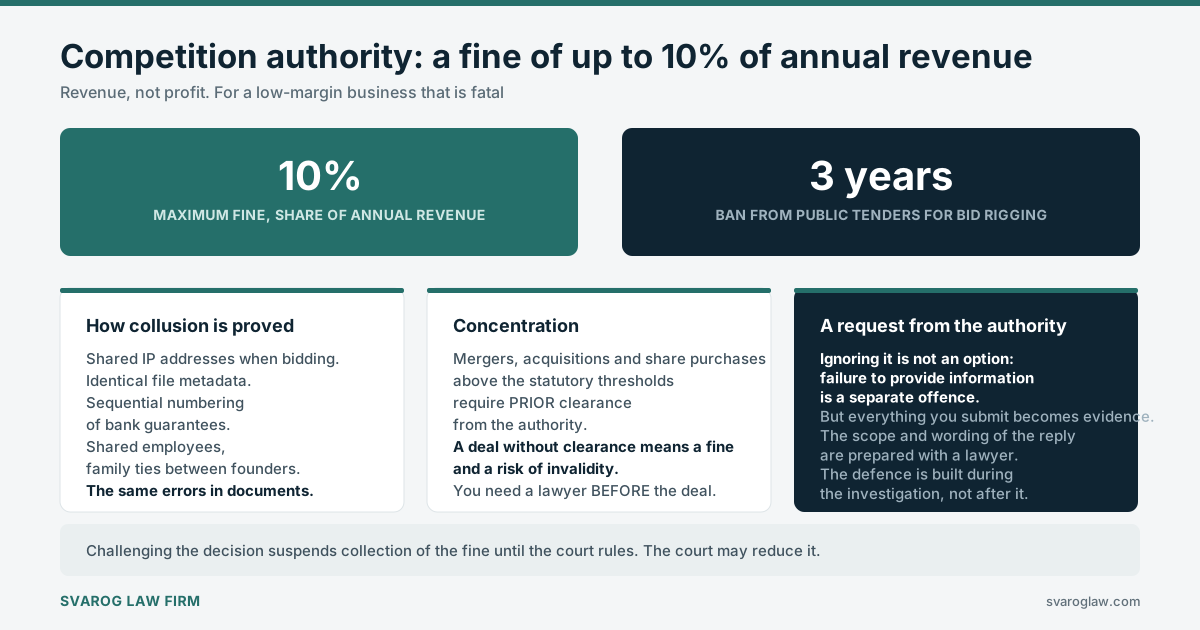
A fine from the Antimonopoly Committee can reach 10 % of a company’s annual revenue for the previous reporting year (Art. 52 of the Law “On Protection of Economic Competition”) — and the base is revenue, not profit. Run it on your own figures: at revenue of 50 million UAH and a 4 % margin, annual profit is 2 million UAH while the maximum fine is 5 million — two and a half years of profit.
Another feature of the procedure: the committee investigates, decides and fines on its own. So a defence works above all during the investigation, while it is still possible to influence how the conduct is characterised and what evidence is gathered. Once a decision is made, two months remain to go to the commercial court (Art. 60 of the same Law).
A competition lawyer is not only for disputes. More often the work comes earlier: agreeing a transaction, obtaining merger clearance, and not being fined for something that was always done “the usual way”.
What the committee fines for
Anticompetitive concerted practices
The most serious category. Besides formal cartels it covers price fixing, market sharing and, most often, bid rigging. The classic scenario: two related companies bid for the same tender, one of them merely making up the numbers. The committee detects it through shared IP addresses, identical errors in documents and shared employees — and fines both.
Abuse of a dominant position
Imposing unfavourable terms, unjustified refusal to contract, discriminatory pricing.
Unfair competition
Copying the appearance of someone else’s product, spreading misleading information, misappropriating another’s reputation, comparative advertising in breach of the rules.
Concentration without clearance
A merger, or the acquisition of a company or a shareholding, requires prior clearance where the parties’ figures exceed the thresholds in Art. 24. Implementing a concentration without clearance is itself an offence carrying a fine.
Failing to provide information, or providing false information
On the committee’s request this is a separate offence, and the fine is imposed even where the main allegation is not made out.
Bid rigging: why it is the most dangerous
This category accounts for the largest share of the committee’s fining decisions and the heaviest consequences for a company.
Besides the fine, Art. 17(1)(4) of the Law “On Public Procurement” bites: a contracting authority rejects any bidder held liable, within the past three years, for anticompetitive concerted practices distorting tender results. For companies working with public contracts that effectively halts the business, which is why such decisions are fought to the end.
What the committee treats as evidence: shared IP addresses when bids were submitted, identical files and document metadata, consecutively numbered bank guarantees, shared employees, family ties between founders, identical errors in documents.
What works both during the investigation and in court: showing there was no coordination (coincidence, a shared internet provider, the same consultant), economic justification of the pricing, incorrect characterisation of the conduct, procedural breaches during the investigation, and errors in calculating the fine, whose base is revenue for a particular year.
Merger clearance
The application is filed before the agreement is signed: the committee has 45 days to consider it, or 25 under the simplified procedure, and that time has to be built into the deal timetable.
The thresholds are set by Art. 24 of the Law “On Protection of Economic Competition”. They are calculated for the last financial year, taking control relationships into account, in two alternative ways: by the combined worldwide assets and turnover of all parties together with a minimum Ukrainian figure for at least two of them, or by the target’s Ukrainian figures combined with another party’s turnover. The amounts are expressed in euro, so financial statements and the exchange rate on the date are needed. Implementing a concentration without clearance means a fine and the risk that the transaction is declared invalid.
What we do
- check whether clearance is needed at all: the first and cheapest question;
- prepare the application with a complete document pack, because an incomplete one suspends the review;
- handle the review before the committee;
- challenge a refusal of clearance.
The clearance period is built into the deal structure in advance; otherwise it becomes the reason the deal with the counterparty falls through.
A dawn raid or inspection: what to do
- Check the authority: the inspection order, the composition of the team, the scope of their powers.
- Do not hand over documents at a glance: everything handed over becomes evidence. We provide what is required, and only to the extent required.
- Do not give explanations without a lawyer: employees’ oral explanations become part of the file.
- But do not ignore requests either: failing to provide information is a separate offence with its own fine.
- Record any procedural breaches: they will be needed on appeal.
Challenging the committee’s decisions
Decisions of the Antimonopoly Committee are challenged in the commercial court. The deadline is two months from receipt of the decision (Art. 60(1) of the Law), and it is not restored indefinitely, so preparation starts as soon as the document arrives.
In the claim we run the same lines as during the investigation: coordination not proved, incorrect characterisation, procedural breaches, disproportionality of the fine (which the court may reduce), and errors in its calculation. We also check whether the committee followed its own procedure: deadlines, the body of evidence, the company’s right to be heard.
Filing the claim suspends enforcement of the decision so far as the fine and interest are concerned, until the case is decided (Art. 60(3)), so no money is taken while the proceedings run.
Situations where you need a lawyer
- you have received a request or demand from the committee for information;
- an investigation has begun;
- a decision finding an infringement has been taken and a fine imposed;
- you are preparing a transaction — a merger, an acquisition, buying a shareholding;
- you bid for tenders alongside related companies: that is a risk even where nothing was agreed, because the committee proves coordination by circumstantial evidence;
- a competitor is copying your product or spreading misleading information about you.
A case from our practice
In 2024 a Kyiv construction company received a decision finding anticompetitive concerted practices at a tender: a company registered to a former employee had bid alongside it, and both bids were submitted from one IP address through the same tender consultant. The fine exceeded the company’s annual profit and came with a three-year exclusion from public procurement. We filed in the commercial court within the two-month window, which suspended collection of the fine, and focused on two lines: an economic justification of the pricing from the cost estimates, and evidence that the shared IP address was explained by a consultant who worked with dozens of clients. The court of first instance reduced the fine several times over and found part of the committee’s conclusions unproven. The case took about a year; the client’s costs were the court fee and the fee for comprehensive handling of a commercial case (details changed).
How we work
- We assess the risk: whether the company’s conduct amounts to an infringement, before the committee reacts at all.
- We handle inspections and information requests, controlling how much is disclosed.
- We defend during the investigation: that is the stage where the evidence base of the case is formed.
- We challenge the decision in the commercial court and seek a reduction of the fine.
- We obtain merger clearances: from checking the thresholds to the committee’s decision.
- We act against unfair competition where it is your rights being infringed, not the other way round.
Cost of services
The court fee is payable on top of the legal fee. A claim to annul a decision of the committee is a non-monetary claim, so for a company in the commercial court in 2026 it is one subsistence minimum — 3,328 UAH; an appeal costs 150 % of that (4,992 UAH) and a cassation appeal 200 % (6,656 UAH). Filing through the Electronic Court reduces the fee by 20 %.
Questions and answers (Competition lawyer)
Can a fine be avoided by reporting the cartel yourself?
Yes — the law exempts a participant in concerted practices who, before the others, voluntarily reports them to the committee and provides information of material importance to the case (Art. 6 of the Law). The conditions are strict: you must report before the other participants do, and you must not have been the initiator, so the decision is taken after assessing what evidence the committee already has.
Can we keep bidding for tenders while the appeal is running?
The committee’s decision remains in force until a court annuls it, so contracting authorities reject such bids citing Art. 17 of the Law “On Public Procurement”. The suspension covers collection of the fine, not the fact of the finding itself. There is one practical answer: press for annulment as quickly as possible and, in parallel, assess bidding through other group companies where that does not create a fresh risk.
The two months to file have passed. What now?
The deadline is procedural, so the claim is filed together with an application to restore it, supported by evidence of good reasons: the decision went to an old address, the company was in a combat zone, the director was ill. There are no guarantees, and every week of delay reduces the chances, so work on the decision starts the day it is received.
How long do proceedings take before the committee and in court?
The committee’s investigation is not strictly limited by law and runs from a few months to over a year, depending on the size of the market and the number of parties. A court challenge at first instance usually takes 6–12 months, with an appeal adding several more. A merger notification is faster: 45 days under the general procedure, 25 under the simplified one.
Is clearance needed for transactions inside our own group?
Not always: the law does not treat as a concentration a range of transactions between entities linked by control, nor certain intra-group reorganisations (Art. 22). But the boundaries are narrow and a mistake costs a fine, so we check the deal structure against the control documents before signing, not after.
Contact a competition lawyer at Svarog
If you have received a request from the committee, do not answer blind — everything you provide becomes evidence in the case. If you are preparing a transaction, check the merger thresholds before signing and build 45 days for the review into the timetable. If a decision has already been issued, you have two months to file in the commercial court — and filing itself suspends collection of the fine.