The commonest customs dispute in Ukraine is an adjustment of customs value. The pattern is standard: the declarant states the contract price, customs refuse to accept it, demand additional documents under Art. 53(3) of the Customs Code, and then issue an adjustment decision, assessing duty and VAT on “their” value, most often by the fall-back method.
The law is more on the declarant’s side than it looks. Under Arts. 54–55 of the Customs Code the customs authority must prove that its doubts about the declared value are well founded: it must name the specific discrepancies in the documents and explain how they affect the price. A reference to the price being “below the level in the database” is not accepted by the courts as such a ground, and this position is now settled in the Supreme Court’s practice on Arts. 53–58 of the Customs Code.
A customs disputes lawyer is there so that you do not pay the assessment just to get the goods released, but release them against a guarantee, have the decision set aside and get the money back together with your legal costs.
The main categories of dispute
Adjustment of customs value
Customs disagree with the declared price and determine it by another method. The result: duty and VAT assessed, sometimes penalties too.
Classification of goods under the tariff nomenclature
Customs change the commodity code and the duty rate rises. The dispute is purely technical, and it is won with an expert report and the manufacturer’s documentation.
Refusal to recognise the country of origin
Losing the preference under a free trade agreement means paying the full rate of duty.
Breach of customs rules
Non-declaration, false declaration, movement outside customs control. The consequences: fines, and often confiscation of the goods.
Refusal of customs clearance
And delayed release of the goods: direct losses to the business from idle transport, storage and broken contracts.
Refund of overpaid duties
Once an adjustment decision is set aside, the money still has to be recovered.
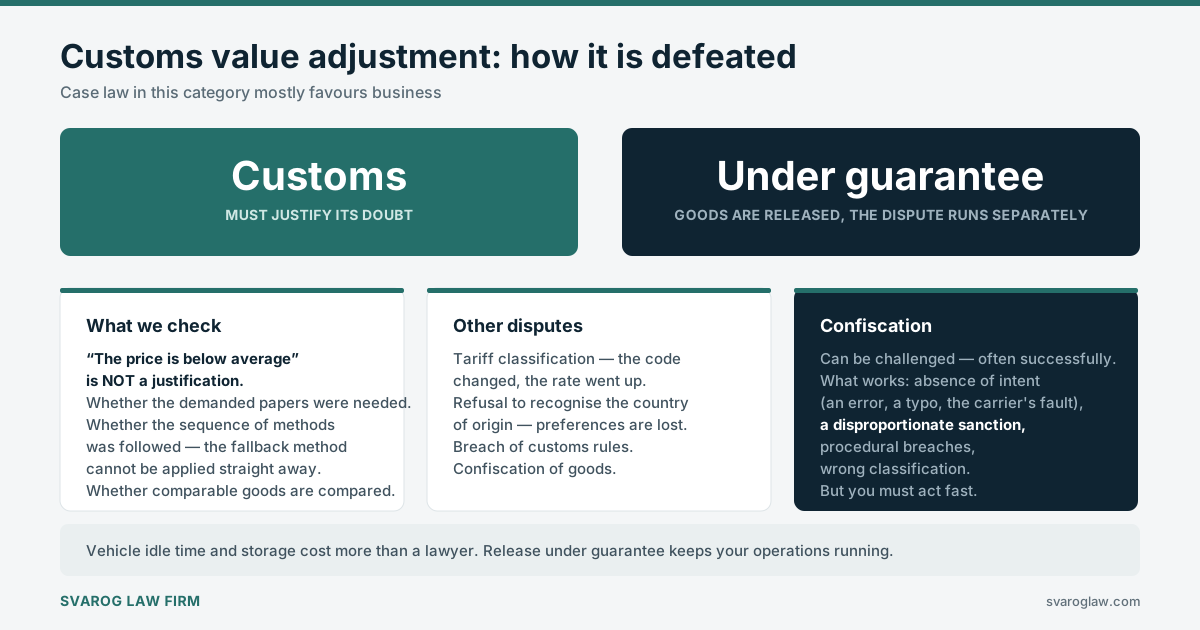
Adjustment of customs value: what the court checks
Customs are entitled to doubt, but they must justify the doubt. This is what the court examines in an adjustment decision, and what we build into the claim:
Whether the documents demanded were needed at all
The list of documents evidencing value is set out exhaustively in Art. 53 of the Customs Code; additional documents (Art. 53(3)) may be demanded only where the basic ones contain discrepancies. A typical customs error is to demand the manufacturer’s price list or the export declaration for a consignment whose documents contain no discrepancies at all.
Whether a specific reason for the doubt is given
“The declared value is below the price level for similar goods” is not a justification. Specific discrepancies in the documents are needed, with an explanation of how they affect the price.
Whether the sequence of methods was followed
Customs cannot go straight to the fall-back method: Art. 57 of the Customs Code requires them to work through the earlier methods in order and justify why each is impossible to apply.
Whether the goods compared are genuinely similar
Often the “analogue” is a product of different quality, specification, consignment size or delivery terms.
Whether discounts and contract terms are taken into account
A volume discount, a long-standing relationship and the Incoterms terms lawfully affect the price, and each of these is on its own a ground for setting the decision aside.
What to do when clearance is disputed
- Do not accept the adjustment automatically. Paying the assessment does not lose you the right to challenge the decision, but nor does it make the challenge automatic.
- Release the goods against a guarantee (Art. 55(7) of the Customs Code). The goods are released on payment of duties at the declared value with a guarantee for the difference, and the dispute runs separately. Idle time costs more than a lawyer.
- File additional documents within 80 days of release (Art. 55(8)): customs must consider them and may cancel their own decision.
- Record every customs demand in writing: which documents were requested, and on what basis.
- Keep the full file: contract, invoice, payment and transport documents, manufacturer’s price lists, correspondence.
- Challenge the decision in the administrative court.
Challenging a decision: deadlines and procedure
Decisions on value adjustment and classification, and a refusal card, are challenged in the administrative court within six months of the day you learned of the decision (Art. 122 of the Code of Administrative Procedure). An administrative appeal to a higher customs authority is also possible (Arts. 24–25 of the Customs Code), but it rarely produces a result.
Court fees in 2026: for a company, 3,328 UAH for a non-monetary claim (one subsistence minimum); for a monetary claim 1.5 % of the value, but not less than 3,328 and not more than 33,280 UAH; for a sole trader a monetary claim is 1 %, from 1,331.20 to 16,640 UAH. Filing through the Electronic Court multiplies the rate by 0.8.
If you win, the court fee and the legal costs are recovered from the customs authority. Overpaid duties are refunded on the declarant’s application (Art. 301 of the Customs Code).
Confiscation of goods
The harshest consequence of a breach of customs rules. Cases of breaches carrying confiscation (Arts. 472, 473, 476, 482, 483 of the Customs Code) are heard by the local general court (Art. 522), and the court’s ruling can be appealed within 10 days of it being made (Art. 529). So this category runs separately from administrative proceedings, and the two procedures must not be confused.
What works in the defence:
- absence of intent: an error in the declaration, a typing mistake, a carrier’s error;
- disproportion of the penalty: confiscation of a consignment worth millions over a discrepancy of a few percent;
- procedural breaches in drawing up the report and seizing the goods;
- wrong classification of the offence.
Speed is decisive here: the longer the goods sit in the customs warehouse, the larger the losses and the harder it is to prove their condition.
A case from our practice
In 2025 an importer of industrial equipment came to us: customs had refused to accept the contract value of a consignment worth 2.1 million UAH, demanded the manufacturer’s price list and the export declaration, and after those were provided still issued an adjustment decision under the fall-back method, assessing about 340,000 UAH in duty and VAT. We advised releasing the goods against a financial guarantee so as not to derail the customer’s installation, filed additional documents within the 80 days, and after customs refused, brought an administrative claim. The court agreed that the documents filed contained no discrepancies and that the decision did not explain why the primary method could not be applied, and set the adjustment aside; customs appealed and the decision stood. About 11 months passed from clearance to the refund, the client’s costs came to about 45,000 UAH, and part of that was recovered from customs (details changed).
How we work
- We analyse the customs decision: whether the doubt is justified and whether the sequence of methods was followed.
- We review the documents and show what is missing to make the decision fall apart.
- We advise on release against a guarantee, so the business does not stand still while the dispute runs.
- We prepare the administrative claim with full reasoning.
- We run the case through every level of court.
- We recover the overpaid duties: a separate stage after the win.
Cost of services
The court fee is paid separately: 3,328 UAH for a company’s non-monetary claim in 2026, and for a monetary claim 1.5 % of its value within the range 3,328–33,280 UAH (through the Electronic Court × 0.8); plus a goods expert report where needed.
Questions and answers (Customs disputes lawyer)
We have already paid the assessment without a guarantee and released the goods. Can we still challenge it?
Yes. Paying duties at the adjusted value is not agreement with the decision, and the deadline for the claim is the same: six months from receipt of the adjustment decision. Once the decision is set aside, the difference is refunded on application to customs, and if they drag their feet that becomes a separate claim in court.
Do we need a lawyer if we have a customs broker?
The broker prepares the declaration and deals with customs at the clearance stage; they do not run a value or classification dispute in court, and their actions sometimes become part of the problem, for example when documents are filed with discrepancies. We work alongside the client’s broker: they supply the underlying data, we build the legal position.
Who pays for the goods expert report and can the cost be recovered?
The expert report is commissioned and paid for by the party relying on it, usually the declarant. The cost depends on the goods and the size of the consignment. Expert fees count as legal costs, and if you win the court recovers them from the customs authority along with the court fee and the lawyer’s fees.
How long is there to reclaim overpaid duties after a win?
The refund application goes to the customs office that collected them, within 1,095 days of payment (Art. 301 of the Customs Code, Art. 43 of the Tax Code), with the court judgment attached. It is not worth delaying: the closer to the end of the period, the more scope there is for refusals on formal grounds.
The customs authority issued the penalty decision itself, without a court. Where is it challenged?
A customs decision in a customs-offence case can be challenged before a higher customs authority or directly in the local general court; we choose depending on the size of the fine and the evidence. The deadline is short, and we calculate it at the consultation from the date the decision was served.
Can a customs dispute be run remotely if the company is not in Kyiv?
Yes. Customs declarations, decisions and correspondence are usually already electronic, the claim is filed through the Electronic Court, and hearings are held by video. Attendance in person is needed only for an inspection of the goods or an expert examination.
Contact a Svarog customs disputes lawyer
Send us the customs decision and the declaration: we will check whether the doubt about the declared value is justified and whether the sequence of valuation methods was followed, and tell you the deadline you have to meet with the claim.