Loan restructuring means changing the terms of a credit agreement so that the payment becomes affordable, instead of letting arrears and penalties build up while you wait for the bank to sue. The Law of Ukraine “On Consumer Lending” No. 1734-VIII defines restructuring as amending the material terms of the agreement so as to change the terms and/or the way the debt is repaid. In other words it is broader than “paying in instalments”: the term, the schedule, the interest rate and the order in which principal and interest are repaid can all be changed, and part of the penalties and fines is often written off.
The list of conditions in paragraph 7-1 is longer, so we check compliance against the specific agreement. There is a separate ground for revising terms during martial law: a material change of circumstances (Article 652 of the Civil Code) and force majeure (mobilisation, relocation, loss of housing or income) confirmed by a Chamber of Commerce certificate for the particular obligation.
We assess your agreement, determine whether you have the right to demand restructuring, prepare a reasoned request to the bank or the microfinance lender and conduct the negotiations. If the lender stalls, we complain to the National Bank and file a claim in court.
What exactly can be changed when a loan is restructured
Because the law treats restructuring as a change to the material terms of the agreement, the toolkit is fairly broad:
Ways to change the agreement
- extending the term of the loan and reducing the monthly payment;
- a deferral (a payment holiday): paying interest only for a time, or pausing payments;
- reducing or fixing the interest rate;
- changing the currency of the obligation for foreign-currency loans;
- writing off or reducing accrued penalties, fines and part of the interest;
- changing how payments are applied (principal first, then interest).
The particular package depends on the type of loan, whether it is secured and on your ability to pay. This service should not be confused with broader debt restructuring: here we are dealing specifically with credit agreements with banks and microfinance lenders and with the borrower’s rights under the Law “On Consumer Lending”.
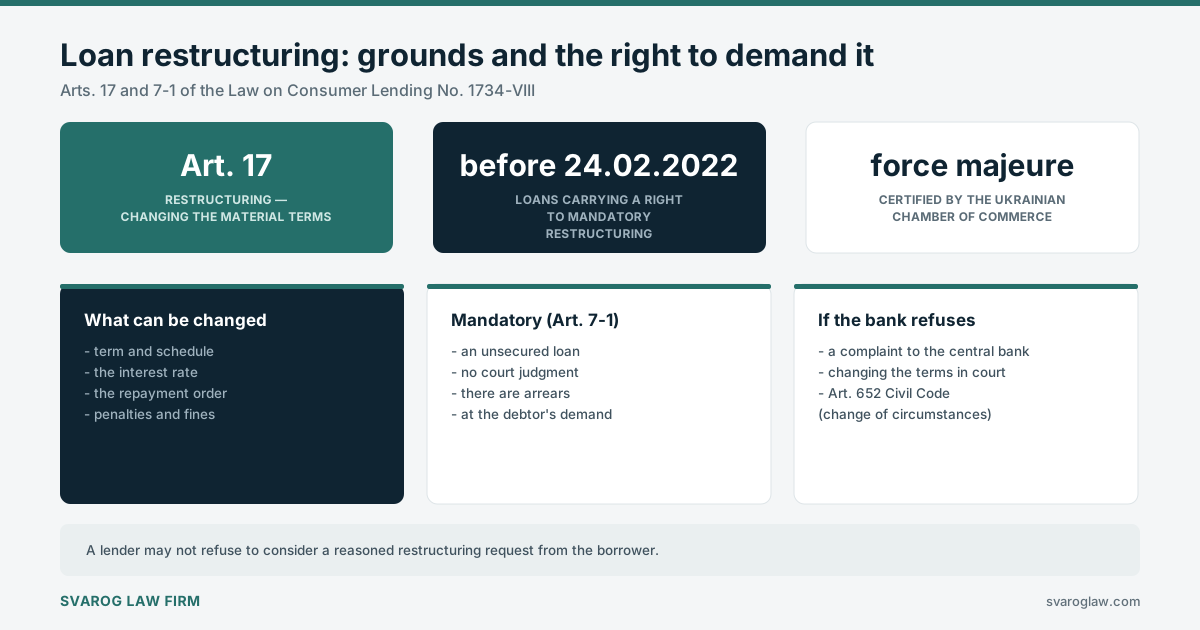
When the bank must restructure a loan
A right to demand is what separates a well-founded request from asking the bank to be understanding. Mandatory restructuring under paragraph 7-1 of Section IV of the Law “On Consumer Lending” applies to loans taken out before 24 February 2022, unsecured, with no court judgment or enforcement proceedings, and in arrears. The law also prohibits a lender from evading consideration of a borrower’s reasoned request. Breaching that prohibition is grounds for a complaint to the National Bank, which supervises the protection of financial services consumers: complaints are considered within one month, or 45 days in complex cases (Article 20 of the Law “On Citizens’ Appeals”). Where the ground for revising the terms is a material change of circumstances, Article 652 of the Civil Code applies, allowing the agreement to be changed by a court.
When restructuring makes sense and when to think about bankruptcy
Makes sense where there is something to pay from: you have income, the current payment is temporarily too high, and on new terms you really can service the loan.
If there are several debts and the total payment exceeds your income, stretching them out only increases what you overpay. In that situation we calculate personal bankruptcy with a write-off: at the consultation we compare the total overpayment under a new schedule with the cost and duration of bankruptcy, so the client sees both figures side by side.
How we handle a loan restructuring
- we analyse the credit agreement, the schedule and the penalties charged, and establish your rights under the law;
- we determine whether there are grounds for mandatory restructuring or for changing the terms through the courts;
- we prepare a reasoned request to the bank or lender with specific demands and citations;
- we negotiate and record what is agreed in a written supplementary agreement;
- if we are refused or ignored, we complain to the National Bank and go to court;
- we check whether the penalties, fines and fees already charged were lawful.
Restructuring through negotiations with a bank usually takes a few weeks. If the National Bank or the courts become involved, it takes longer: a complaint is considered within a month, and a court case to change an agreement takes several months.
What to check in the agreement the bank offers
Banks and lenders are happy to offer “restructuring” on their own terms, and the commonest mistake is signing without doing the maths. The typical trap: overdue penalties and interest are capitalised into the principal, so the debt actually grows even though the payment falls. The second: in the new agreement the borrower acknowledges a debt figure that includes fees which could have been challenged as unlawful. The third: restructuring is chosen where a write-off through bankruptcy would have been better, and people spend years paying what they could have been released from. Before signing we compare the new principal with the old one, check every charge and remove clauses acknowledging disputed amounts.
A case from our practice
In spring 2025 a client came to us with an unsecured consumer loan taken out in 2021. After losing her job she had missed three months of payments, and the bank offered “restructuring” under which some 38,000 UAH of penalties and overdue interest would be added to the principal, increasing what she would overpay over three years by about 60,000 UAH. We rejected that offer and served a demand for mandatory restructuring under paragraph 7-1: the loan predated 24 February 2022, it was unsecured, there was no judgment or enforcement, and there were arrears. The bank agreed to a new schedule extending the term by two years, writing off the penalties and leaving the principal unchanged. Around six weeks passed from the first consultation to signing the supplementary agreement; the client’s legal costs were 6,500 UAH (details changed).
Cost of services (loan restructuring)
A complaint to the National Bank is free. If the terms have to be changed through the courts, an individual’s claim to amend an agreement is non-monetary: the 2026 court fee is 0.4 of the subsistence minimum, that is 1,331.20 UAH, or 1,064.96 UAH through the Electronic Court (the rate × 0.8). If recovery of the debt from you is also on the table, see the page on debt recovery: we defend such cases as part of our credit and debt practice.
Questions and answers (loan restructuring)
The loan was sold to a collection or factoring company. Can restructuring be demanded from the new creditor?
Yes. Selling the debt does not change the terms of the agreement or remove the borrower’s rights under the Law “On Consumer Lending”: the new creditor is bound by the same rules as the bank. We address the demand to whoever now holds the claim, having first checked that you were properly notified of the assignment.
Can a restructuring be arranged remotely?
Yes, in most cases. You send us the agreement, the schedule and your correspondence with the bank by messenger or email; we prepare and submit the request on your behalf under a power of attorney or through your online banking, and banks usually sign the supplementary agreement electronically. Attending in person is only needed in court, and not always then.
The bank has already sued. Is restructuring still possible?
You can reach agreement at any stage, including a settlement approved by the court. But the right to mandatory restructuring under paragraph 7-1 applies only while there is no judgment, so once you receive a summons you should act immediately.
Will restructuring damage my credit history?
Restructuring is recorded in your credit history, but it is far better than arrears, litigation and enforcement. For future borrowing, a debt that was settled always looks better than a default.
What happens if I miss a payment again after restructuring?
The supplementary agreement usually provides that on a fresh default the bank reverts to the old schedule or demands early repayment of the whole loan. So the new payment must be genuinely affordable with room to spare, not right at the limit. If your income falls again, approach the bank before missing a payment: a second restructuring is possible, but negotiating is easier while payments are still being made.
What does the procedure itself cost, apart from legal fees?
A request to the bank and a complaint to the National Bank cost nothing. A Chamber of Commerce force majeure certificate for individuals is charged at the chamber’s rates. The court fee for a non-monetary claim to amend an agreement is 1,331.20 UAH in 2026; notarisation of the supplementary agreement is required only for mortgage loans.
Contact Svarog about restructuring a loan
Send us the credit agreement, the payment schedule and whatever the bank has already written to you. We will establish whether you can demand restructuring under paragraph 7-1, work out which option is better and take over the negotiations with the lender. If the figures show bankruptcy is the better route, you will see that calculation at the first consultation.