A service member’s pay consists of the post salary, the rank salary, the long-service supplement, the monthly additional elements of pay and the bonus. Article 9 of Law of Ukraine No. 2011-XII “On the Social and Legal Protection of Service Members and Their Families” obliges the state to pay it at a level matching the conditions of service, and for the period of martial law Cabinet Resolution No. 168 of 28 February 2022 adds the allowance for performing combat tasks. Where these payments are delayed, understated or never calculated at all, they can be claimed from the finance authority and, after a refusal, recovered through the administrative court.
The reasons for underpayment repeat from unit to unit. Combat pay is not calculated because the order records the sub-unit in the “wrong” area. A monthly allowance is left out of the calculation of the recreation grant or the discharge grant on the footing that it was a one-off. Payment of the lump-sum grant for a wound is held up by the wording of the medical board certificate. After a transfer the money hangs between two finance authorities, each believing the other should pay. In every one of these situations the sum is the service member’s by law; what remains is to gather the documents that prove it.
We establish which payment was missed and whose fault it was, gather the evidence through formal reports and lawyer’s requests, and recover what is due from the unit or the relevant authority: first out of court, and if the answer is no, in court.
Which payments can be recovered
Disputes most often arise over four groups of payments:
Basic pay
Salaries, the long-service supplement, the monthly additional payments and the bonus (Art. 9 of Law No. 2011-XII; the Procedure approved by Ministry of Defence Order No. 260 of 7 June 2018; the rates set by Cabinet Resolution No. 704 of 30 August 2017).
Additional pay for combat tasks
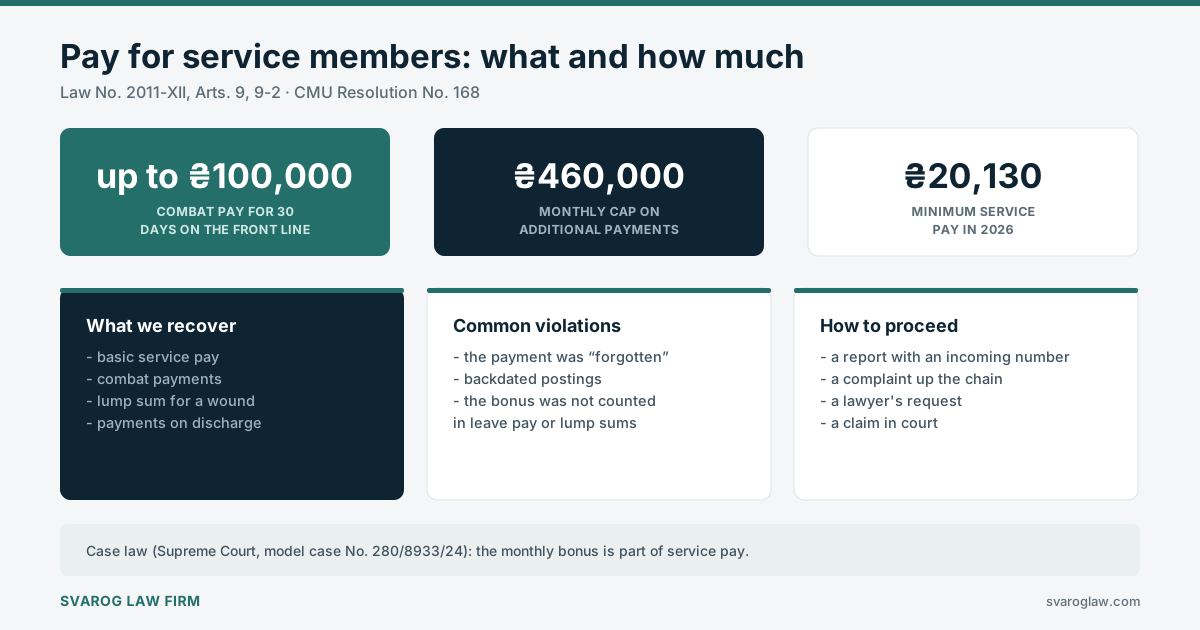
Under Cabinet Resolution No. 168: up to 100,000 UAH for 30 days of direct participation in combat on the front line and 30,000 UAH for the other categories, both pro rata to the actual days. For example, 12 days on the front line give 100,000 × 12/30 = 40,000 UAH.
The lump-sum grant
Under Art. 16 of Law No. 2011-XII: in the event of death, 750 subsistence minimums (2,496,000 UAH in 2026); in the event of disability or partial loss of capacity, a multiple of the subsistence minimum depending on the group and degree; and in the event of death during martial law a further 15 million UAH under Resolution No. 168.
Payments on discharge
Pay up to the day of removal from the unit’s rolls, compensation for unused leave, the recreation grant, and the lump-sum grant on discharge for length of service.
Why payments “disappear”, and what the case law says
The commonest situation: money actually paid every month is called one-off or temporary by the finance authority and left out of the calculation of the recreation grant or the lump-sum grant on discharge. The final figure comes out one and a half to two times smaller. In a series of cases the Supreme Court has held that the name of the payment is not decisive: where an allowance was paid systematically and was tied to the conditions of service, it forms part of pay, and the shortfall is recovered together with compensation for the delay.
The second situation: combat pay is not calculated because the unit’s order attaches the sub-unit to the “wrong” area, although the service member was in fact on the front line. Here the case is decided by combat orders, situation reports, war diaries and certificates of actual participation, not by the name of the sub-unit on the establishment. The third: after a wound the lump-sum grant is withheld because the medical board certificate says “illness unconnected with service”, and then the finding itself has to be challenged first.
Deadlines that are not restored without good reason
If the period has already expired, the court will restore it only for a valid reason: being in hospital, in captivity, or on positions without communications. These circumstances must be evidenced by certificates, and we gather them before filing. Where a wound bears on a finding of fitness, help with the medical board may be needed in parallel, and in difficult health cases discharge on health grounds.
A case from our practice
In the spring of 2025 a senior sergeant came to us who had spent 47 days on tasks at the front line, but whose sub-unit was recorded by the unit’s order as being in a rear area, so for two months he was paid at the 30,000 UAH rate instead of 100,000. He had made his report orally and received no answer. We filed a written report, obtained the combat orders and an extract from the war diary by lawyer’s request, and after the finance authority refused in writing filed an administrative claim. The court awarded the difference of about 110,000 UAH; seven months passed between the first consultation and the money arriving (details changed).
How we recover service members’ pay
- we establish which payment was missed and under which instrument it is due;
- we help you submit the report through the chain of command properly and have it stamped with an incoming number;
- we send lawyer’s requests to the unit and the finance authority and gather the orders, certificates and calculations;
- we prepare the pre-action demand and, if it is refused, a claim to the district administrative court where you live;
- in court we establish the legal character of the payment, relying on the Supreme Court’s case law;
- we recover both the sum itself and compensation for the delay, and then see the judgment enforced.
Typical mistakes before people come to us
An oral report with no incoming number means there is no proof you applied at all, and six months later the authority will say you never did. A claim filed after the one-month period with no explanation is returned or left without consideration. A demand addressed to “the Ministry of Defence” instead of the particular unit or finance authority ends in a refusal on procedural grounds rather than on the merits. A refusal of the lump-sum grant is often taken as final, although it rests on wording in the medical board certificate that can be changed. Each of these mistakes costs tens, and sometimes hundreds, of thousands of hryvnia.
Cost of services (service members’ pay)
Court fees in 2026: an individual’s administrative claim with a non-monetary demand costs 1,331.20 UAH; with a monetary demand, 1 % of the value of the claim, but not less than 1,331.20 and not more than 16,640 UAH; through the Electronic Court the rate is multiplied by 0.8. Combat veterans are exempt from the fee in cases concerning breaches of their rights (Art. 5 of the Law “On Court Fees”).
Calculate the fee for recovering a shortfall
Combat veterans are exempt — we check the exemption before filing.
Questions and answers (service members’ pay)
I am on position and cannot come to Kyiv. Can the case be handled remotely?
Yes. A power of attorney for the lawyer is certified by the unit commander (Art. 245 CC), documents are exchanged by messenger and through the Electronic Court, and hearings are held by video or without you. There is no need to travel.
The one-month deadline has already passed. Is everything lost?
No, if there is a valid reason: treatment, captivity, tasks carried out without access to communications. We file an application to restore the deadline with the claim, supported by certificates, and in such circumstances the courts do restore it. Without documentary proof of the reason the chances are slim, so we gather it in advance.
Who receives the payments for a service member who has died, and in what order?
The lump-sum grant goes to the family members listed in Art. 16-1 of Law No. 2011-XII: parents, spouse, children and dependants, in equal shares. Pay unpaid during their lifetime also belongs to the family. Any dispute between relatives about the shares is decided by a court.
The unit I served in was disbanded or reorganised. Whom do I sue?
The successor named in the disbandment order, or the body that took over the unit’s financial affairs. We establish this by lawyer’s request to the superior body, so that the court does not return the claim for naming the wrong defendant.
The finance authority admits the debt but is “waiting for funding”. Do I still need to go to court?
Not if the debt is admitted in writing and there is a realistic payment date. We press for a written answer stating the sum and the date; if none is given, or the date passes with no money, the written admission becomes evidence in the claim, and compensation for the delay is calculated for the whole period.
How long does recovery through the courts take?
The pre-action stage (report, requests, the authority’s answer) takes three to six weeks. A hearing in the district administrative court takes two to six months, and enforcement a further one to three. If the authority appeals, add three to five months.
Contact Svarog about service members’ pay
At the consultation we will work out what you are owed, why it did not arrive, and whether recovery has a prospect. If a written report settles it, we will draft it and record the answer; if court is needed, we run the case from the first request to the judgment. This work is handled by our military lawyer, and where necessary we work alongside it on the recalculation of a military pension.