Buying debt works both ways: some people acquire other people’s claims, others are told their own debt has been sold. This page is for both.
If you are buying a debt, first check whether it exists in law: whether the limitation period has expired, whether the contract has been challenged, and whether the debtor has assets worth enforcing against. A time-barred claim against someone with no assets will still be nothing but paper after you buy it.
If your debt has been sold to debt collectors, check that the assignment was lawful. It is often defective, and the claim against you is then invalid in whole or in part.
How it works in law
Assignment of a claim (cession) replaces the creditor in an obligation (Arts. 512–519 CC). Four rules determine whether the claim is valid:
The four rules of assignment
- the debtor’s consent is not required, but they must be notified in writing of the assignment (Art. 516 CC);
- the new creditor takes the same rights as the original creditor held (Art. 514 CC). If part of the debt is time-barred or was charged unlawfully, it stays that way;
- the debtor may raise against the new creditor every defence they had against the original one (Art. 518 CC): limitation, invalidity of the contract, partial payment, counterclaims;
- the form of the assignment must match the form of the underlying transaction (Art. 513 CC): where the contract was notarised, the assignment must be notarised too.
A breach of any of these rules is a ground to challenge the claim or to refuse to pay the new creditor.
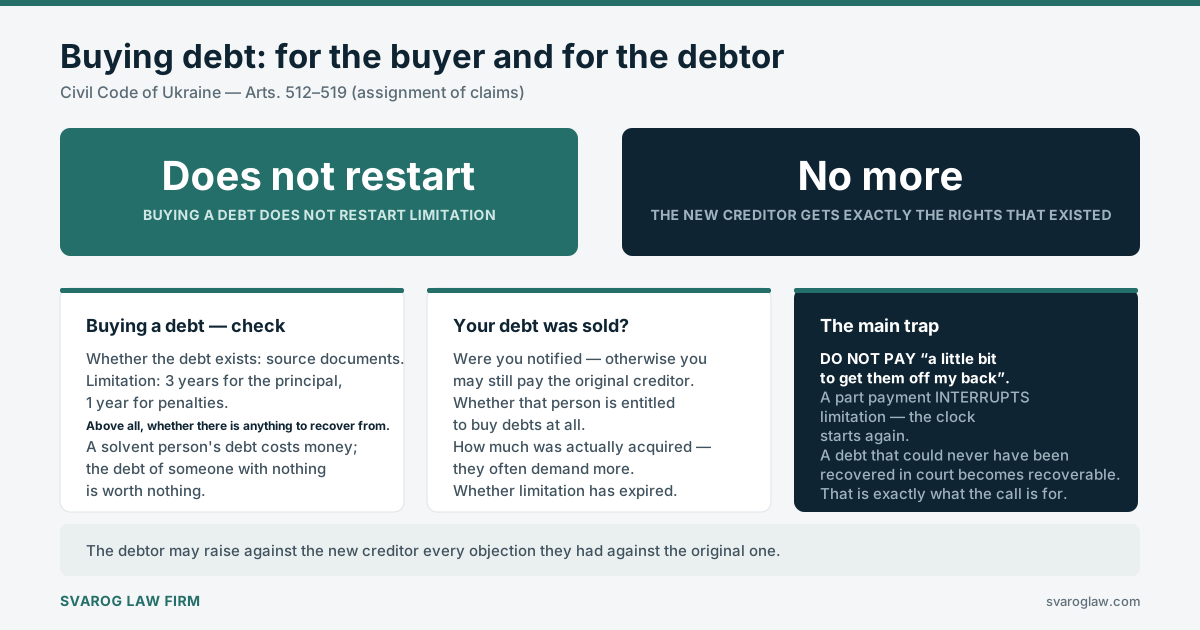
If you are buying: what to check
Whether the debt exists at all
The primary documents: the contract, delivery notes, certificates, the calculation of the debt. Without them the claim cannot be proved in court, and the seller of a debt by no means always has the full set.
Limitation
Three years on the principal (Art. 257 CC), one year on the penalty (Art. 258 CC). A court will not enforce a time-barred claim if the debtor pleads limitation, and they almost certainly will. Note separately: limitation periods, suspended from 2 April 2020 for the quarantine and martial law, started running again on 4 September 2025. Periods that seemed “frozen” are expiring once more, so at the consultation we recalculate them for each instalment.
Whether the contract has been challenged
The one the debt arose from, and whether the debtor has counterclaims against the seller.
Whether there is anything to recover from
We check the debtor against the State Register of Real Property Rights, the companies register (shareholdings), the Unified Register of Debtors and the automated enforcement system: whether there is property or a vehicle, whether earlier enforcement was closed with a certificate of no assets, whether there are signs of insolvency. That check takes 2–3 working days and costs a fraction of what buying an empty debt does.
Whether enforcement has already been tried
Court judgments, closed enforcement proceedings, writs returned to the creditor.
The realistic price
Two multipliers set it: the likelihood of recovery and the time to actual money. So a 400,000 UAH debt owed by a sole trader with no assets and two closed enforcement files is worth a few per cent of face value, while a fresh corporate debt with property and a judgment already in hand is worth a substantial share of the sum.
If your debt was sold: what to check
Whether you were notified of the assignment
Without written notice you may perform the obligation to the original creditor, and that is good performance (Art. 516 CC). The new creditor cannot then demand payment again.
Whether this entity may buy debts at all
Under consumer credit contracts the law allows assignment only to a bank or a financial institution, and only a debt collection company on the National Bank register may pursue it out of court. The requirements for such companies are set by the Laws “On Consumer Lending” and “On Financial Services and Financial Companies”, and from 30 July 2026 also by the Law “On Factoring” No. 4466-IX. You can check a collector in the register of debt collection companies on the National Bank’s website: if they are not there, both the demand in their name and the calls themselves are unlawful.
What exactly was bought
Collectors often demand far more than they actually acquired the right to: the assignment names one figure and the “demand” sent to you another.
Whether limitation has expired
Buying a debt does not restart it. A collector cannot enforce a time-barred claim if you plead limitation in court — and they will certainly not remind you of that.
Whether the charges are lawful
Penalties, commissions, interest after the contract term ended.
The methods of collection
Threats, calls to relatives and to your workplace, and disclosing the debt to third parties are prohibited by the Law “On Consumer Lending”. We record every such call, and it becomes the basis for a complaint to the National Bank and an argument for a discount in negotiations.
The main trap for a debtor
Do not acknowledge a debt before it has been checked.
A part payment, or signing a document acknowledging the debt, interrupts the limitation period (Art. 264 CC), and time starts running afresh. On the Supreme Court’s case law a part payment interrupts limitation only for the part of the debt or the instalment it relates to, but a collector will not explain that detail. A debt that could never have been enforced through the courts becomes enforceable after a single “symbolic” payment of 100 UAH made just to be left alone. Most of the calls are aimed at exactly that payment.
A case from our practice
In 2025 a client came to us with a debt collection company’s demand for 84,000 UAH on a loan from 2015: the principal was 19,000 UAH and the rest was penalties and commissions. We obtained the assignment agreement and saw that she had never been notified of the change of creditor, and that her last payment had been in 2016 — so the three-year period had expired before the quarantine suspension even began. When the collector sued, we pleaded limitation on every instalment and argued that the charges after the end of the contract term had no basis. The court dismissed the claim in full. About five months passed between the first consultation and the judgment, and our fee was 12,000 UAH. (details changed)
Typical mistakes before people come to us
They buy a portfolio on the seller’s schedule without checking even a sample of the primary documents. They price the claim at face value rather than against the debtor’s assets. They do not recalculate limitation now that, since September 2025, the periods are running again.
They pay “100 UAH to be left alone” and then receive a claim for the whole sum. They sign a collector’s “restructuring schedule”, which is a written acknowledgment of the debt. They ignore the court summons: the court gives judgment in default, and it applies limitation only if a party pleads it (Art. 267(3) CC), so without your plea nobody will take the period into account.
How we work
- We check that the debt exists: the primary documents, the calculation, the underlying basis.
- We calculate limitation for each component separately.
- We assess the debtor’s means against the registers of property, debtors and enforcement proceedings.
- We draft or audit the assignment so that it cannot be challenged.
- We recover the debt: from the demand to enforcement.
- We defend debtors: challenging an unlawful assignment, pleading limitation, stripping out unlawful charges.
Cost of services
Court fees in 2026: a claim to recover a debt costs an individual 1 % of the sum, but not less than 1,331.20 and not more than 16,640 UAH, and a company 1.5 % of the sum with a minimum of 3,328 UAH. A non-monetary claim to have an assignment declared invalid costs 1,331.20 UAH for an individual and 3,328 UAH for a company. Filing through the Electronic Court reduces the rate by 20 %.
Calculate the court fee for enforcing a purchased debt
Having an assignment declared invalid is a non-monetary claim: 1,331.20 UAH.
Questions and answers (Buying debt)
Can an individual buy a debt from a bank?
Under consumer credit contracts a claim may be assigned only to a bank or a financial institution, so the sale of such a debt to a private person can be challenged. For an ordinary loan between individuals, or a debt for goods supplied, there are no restrictions: anyone may buy the claim, including an individual.
How do I check whether a collector is operating lawfully?
Look the company up in the register of debt collection companies on the National Bank’s website. If it is not there, it has no right to demand money from you on a creditor’s behalf, and the calls and threats can be reported to the National Bank. Ask them at the same time to send a copy of the assignment: without it the claim is unsubstantiated.
The court has already given judgment in default for the collector. What now?
File an application with the same court to review the default judgment within 30 days of its pronouncement. If you were never handed a copy, the period can be restored by applying within 20 days of receiving it. In the application we plead limitation and the unlawfulness of the charges straight away.
Can a debt already covered by a judgment be sold?
Yes, and such a debt is worth more, since it no longer has to be proved. After the purchase the new creditor applies to the court to be substituted as the enforcing party (Art. 442 CPC), and the enforcement officer continues in their favour.
Can everything be handled remotely?
Yes. You send the documents by messenger or email, we sign the engagement electronically, and in court the lawyer acts on a warrant, so you need not attend hearings. Originals are needed only for a handwriting examination if the seller disputes a signature.
How long does checking a debt before purchase take?
A single claim with a full set of documents is checked in 2–3 working days: the primary documents, the limitation calculation, the property and enforcement registers. A portfolio of dozens of claims we sample, and give our opinion within 1–2 weeks.
Contact Svarog about buying debt
Buying a debt: send us the documents and we will check whether it exists in law and whether there is anyone to recover from. Your debt has been sold: send us the collector’s demand and we will check the lawfulness of the assignment and the size of the charges. And above all: pay nothing until the debt has been checked.