

Олександр Сич
27 July 2026
A flat bought on a mortgage during a marriage is the spouses’ joint property (Article 60 of the Family Code) and is divisible despite being charged to the bank. The mortgagee must be joined to the case as a third party. The court fee on a monetary claim in 2026 is 1% of its value, from 1,331.20 to 16,640 UAH. Limitation after the marriage ends is three years, but it does not run from the date of the divorce.
A mortgaged flat brings three participants into one dispute: both spouses and the bank. Hence the main misconception — that while the loan is outstanding there is nothing to divide. The law says otherwise: Article 9 of the Law “On Mortgages” only forbids the mortgagor to dispose of the charged property without the bank’s written consent; possessing and using it remains free.
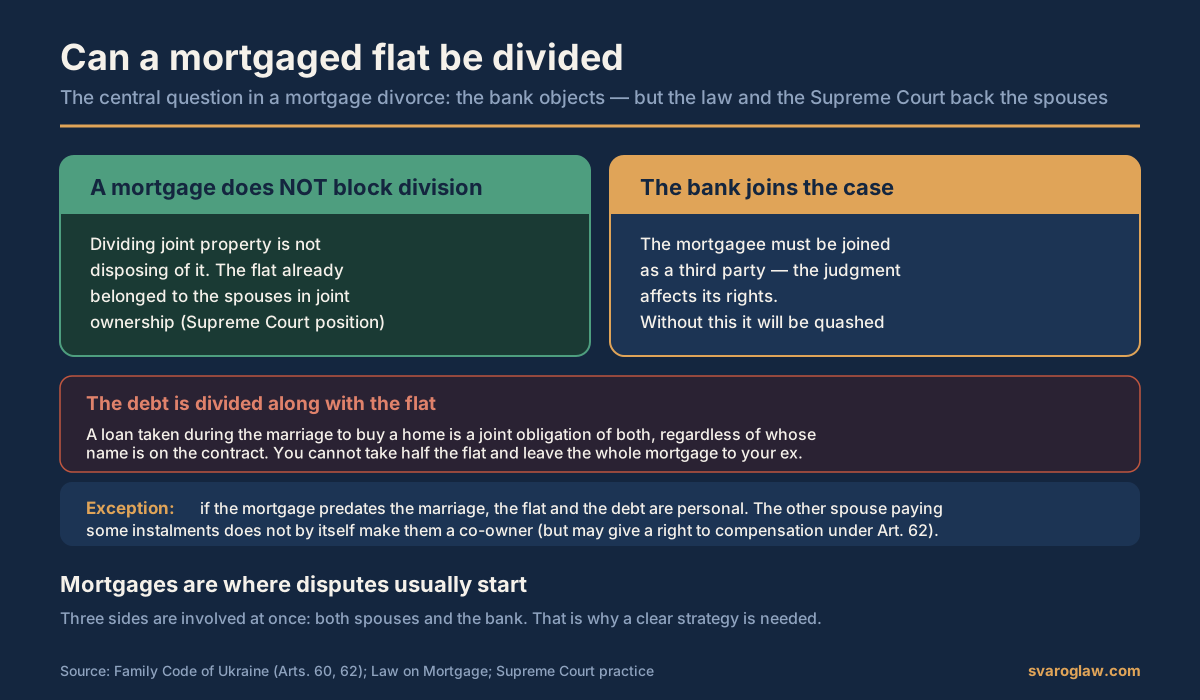
Dividing spouses’ joint property is not a disposal: the flat does not leave the mortgagors’ ownership, only the regime changes from joint to shares. That is the basis of the case law of the Civil Cassation Court within the Supreme Court. Below: how it works in practice, what happens to the loan, what a claim costs and which deadlines cannot be missed.
Can a flat still under mortgage be divided
Yes. Property acquired by spouses during a marriage belongs to them jointly whoever the paperwork names and whichever of them earned the money (Article 60). The charge does not change that, and the shares are presumed equal (Article 70).
The practical consequence: there is no need to wait until the loan is repaid. The court can recognise half a share in the flat for each spouse, and the mortgage does not disappear — the charge remains over the whole property and the bank keeps its right to enforce on default. That is precisely why the courts see no infringement of the mortgagee’s rights.
Why the bank is always joined to the case
A decision dividing charged property affects the mortgagee’s rights and interests, so the bank is joined as a third party without independent claims. The logic is procedural: after the division the loan obligation effectively acquires a second interested party, and the bank is entitled to say how that will affect servicing the debt and enforcing the charge.
The price of getting this wrong is high. Deciding on the rights and obligations of a person not joined to the case is itself a ground for setting the judgment aside on appeal or in cassation. So the bank is named in the claim from the outset, and an application is filed with it for the bank to produce a statement of the outstanding balance — without that figure neither the compensation nor the value of the claim can be calculated.
What happens to the mortgage debt
Here a qualification is needed that popular articles usually omit. A loan agreement signed by one spouse does not automatically make the other a borrower towards the bank: a division judgment does not change the parties to the contract. The Supreme Court proceeds on the basis that an obligation counts as incurred in the family’s interests where two conditions coincide — the agreement was made by one spouse in the family’s interests and what was obtained under it was used for the family’s needs (Article 65(4)). The burden of proof lies on whoever relies on that.
Where both conditions are met, the debt is taken into account in the division: either the share of the spouse who keeps the encumbered flat is reduced, or compensation is awarded. A second mechanism operates after the division — the spouse who repaid the joint loan from their own money may claim half of what they actually paid from the former partner. The claim is supported by receipts and statements, so payment records are worth keeping from the very first month after the marriage ends.
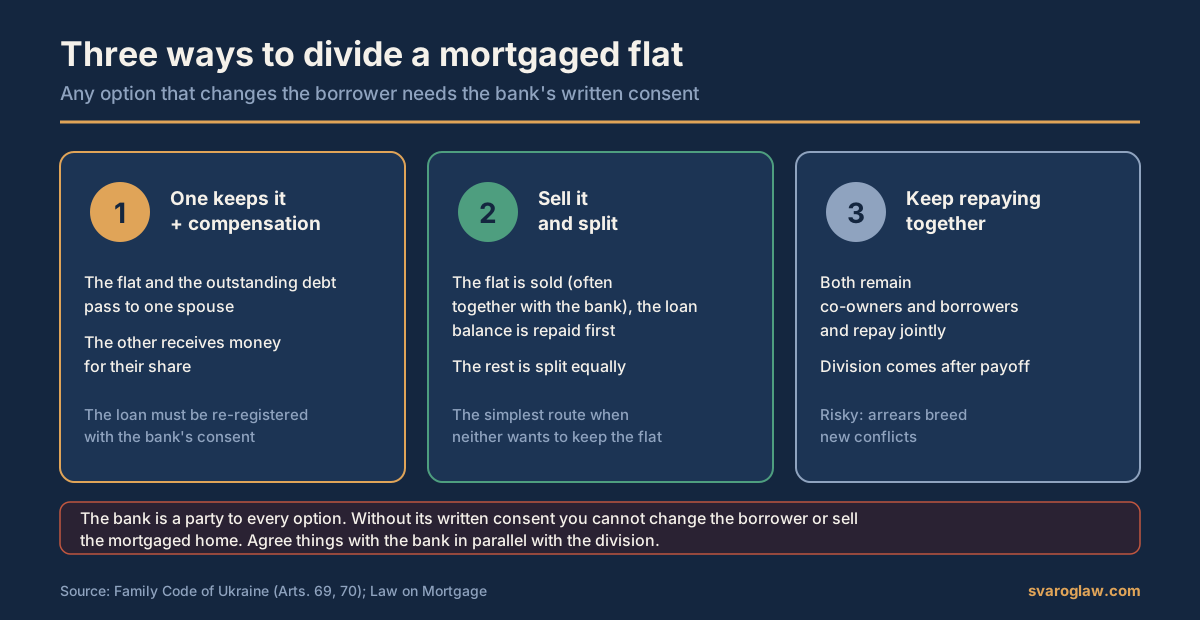
Three ways to divide a mortgaged flat
Any option that changes the borrower or sells the charged property requires the bank’s written consent under Article 9 of the Law “On Mortgages”.
| Option | How it works | What to bear in mind |
|---|---|---|
| One keeps it and pays compensation | The flat and the outstanding debt pass to one spouse; the other receives money for their share | The loan must be transferred to a single borrower with the bank’s consent; the bank reassesses affordability |
| Sale and division of the proceeds | The home is sold, the loan balance is repaid first, the rest is split equally | Without the mortgagee’s written consent the sale can be declared invalid |
| Continuing to repay together | Both remain co-owners and borrowers, repay the loan, and divide in kind once it is cleared | A default by one leads to enforcement against the whole property and damages both credit histories |
If the mortgage predates the marriage
A flat bought before the marriage is the personal property of whoever entered into the contract (Article 57), and the loan obligation stays with them. The other spouse paying part of the monthly instalments during the marriage does not by itself create co-ownership.
The other spouse’s claim is built on Article 62: where during the marriage joint funds or labour substantially increased the value of the home (major renovation, reconstruction, an extension) or a significant part of the loan was repaid from joint funds, the property may be declared jointly owned or compensation awarded. That is proved by works contracts, receipts for materials, a valuer’s opinion on the increase in value, and statements showing where the payments came from.
Division by agreement or through the courts: timing and cost
The contractual route is simpler. The spouses make a division agreement, and where it covers property it must be notarised (Article 69). The notary will check the charge and require the mortgagee’s consent, so visit the bank before the notary.
Litigation costs more. A division claim is a monetary one, so the court fee is 1% of its value, but not less than 0.4 and not more than 5 subsistence minimums for working-age people. In 2026, with a minimum of 3,328 UAH, that is a range of 1,331.20 to 16,640 UAH. Filing through the Electronic Court reduces it by 20%.
On deadlines. Limitation does not apply to claims to divide joint property while the marriage subsists. After it ends a three-year period applies, but it runs not from the date of the divorce but from the day the co-owner learned or could have learned of the infringement of their ownership (Article 72). A further factor: limitation in Ukraine was suspended from 2 April 2020 and started running again only on 4 September 2025 under Law No. 4434-IX, so in many older disputes the period is far from exhausted.
What to do
- Gather the documents on the property: the sale contract, the loan and mortgage agreements, and an extract from the Register of Real Property Rights showing the charge.
- Ask the bank for a statement of the outstanding balance as at the date of your request — both the compensation and the value of the claim are calculated from it.
- Have the flat valued. Market value less the outstanding debt gives the sum that is genuinely divisible. The valuation is commissioned from a certified valuer and is also used to calculate the court fee.
- Try to agree, and ask the bank in writing for its consent to the option chosen. The bank’s answer is needed either way — by the notary and by the court.
- If there is no agreement, file the claim, naming the bank as a third party and framing the relief as establishing title to a share rather than as disposing of the charged property.
Typical mistakes when dividing mortgaged housing
- Not joining the bank. A judgment given without the mortgagee is set aside on exactly that ground, and the case has to be started again.
- Claiming half the flat without part of the debt. The court weighs the asset and the liability together, so “half for me, the debt for him” has no prospect.
- Selling or transferring the home without the bank’s written consent. Such a transaction is challengeable under Article 9 of the Law “On Mortgages”.
- Not keeping the payment records. Without receipts a claim for half of what you paid for your former partner will fail for want of proof.
- Relying on an oral understanding. Until there is a notarised agreement or a judgment, the register shows the old ownership regime and the bank sees only its own borrower.
When you do not need a lawyer
If the spouses have agreed, the outstanding balance is small and the bank is ready to approve the transfer, the whole division comes down to one agreement before a notary — a lawyer adds nothing. Help is needed where the shares are disputed, where the other spouse denies the debt was joint, where the flat was partly bought before the marriage, where the bank refuses the transfer, or where enforcement has already begun. Indicative rates are in the section on legal service prices.
Questions and answers
Can a flat be divided if the mortgage is not yet repaid?
Yes. The charge does not deprive the flat of its status as the spouses’ joint property, and division is not a disposal of the charged property. There is no need to wait for the loan to be cleared.
Who repays the mortgage after the divorce?
The person who signed the loan agreement remains liable to the bank. The other spouse becomes liable where it is established that the loan was taken in the family’s interests and the money went on the family’s needs (Article 65(4)).
Why is the bank joined to the case?
The judgment affects the mortgagee’s rights, so it takes part as a third party. Hearing the case without it is a ground for setting the judgment aside on appeal or in cassation.
Is a flat bought on a mortgage before the marriage divisible?
As a rule no: it is the borrower’s personal property (Article 57). The other spouse may claim that it be declared joint, or claim compensation, on establishing a substantial increase in value from joint funds (Article 62).
What does filing a claim to divide a mortgaged flat cost in 2026?
1% of the value of the claim, but not less than 1,331.20 and not more than 16,640 UAH. Through the Electronic Court it is 20% cheaper.
Can a mortgaged flat be sold on divorce?
Yes, with the mortgagee’s written consent. The loan balance is repaid from the proceeds first, and the rest is divided between the spouses.
Can the mortgage be transferred to one spouse?
Only with the bank’s consent; it reassesses the sole borrower’s affordability and may require a guarantor.
How long is there to divide property after a divorce?
Three years, but time runs from the day you learned or could have learned of the infringement of your right, not from the date the marriage ended (Article 72). Allow also for the suspension of limitation until 4 September 2025.
What if my former spouse stops paying the joint mortgage?
Keep paying yourself, keep the receipts, and claim half of what you paid. In parallel, notify the bank in writing so that default does not lead to enforcement against the flat.
Sources
- Family Code of Ukraine, Arts. 57, 60, 62, 65, 69, 70, 71, 72 — zakon.rada.gov.ua/laws/show/2947-14
- Law of Ukraine “On Mortgages” No. 898-IV, Art. 9 — zakon.rada.gov.ua/laws/show/898-15
- Civil Code of Ukraine, Arts. 257, 261, 578 — zakon.rada.gov.ua/laws/show/435-15
- Law of Ukraine “On Court Fees” No. 3674-VI, Art. 4 — zakon.rada.gov.ua/laws/show/3674-17
- Law of Ukraine No. 4434-IX on limitation running again — zakon.rada.gov.ua/laws/show/4434-20
- Review of the case law of the Civil Cassation Court within the Supreme Court on mortgage cases — supreme.court.gov.ua
Dividing a mortgaged flat with Svarog
Send us the loan and mortgage agreements and the statement of the outstanding balance — we will work out what serves you better: compensation, a sale, or transferring the loan to one borrower; agree the position with the bank; and prepare either the notarised agreement or a claim framed correctly. Related services: property division lawyer, divorce, credit disputes, property, full price list.
+38 095 554-54-24 · Kyiv, 7 Khoriva Street (Podil) · Mon–Fri 9.00–18.00