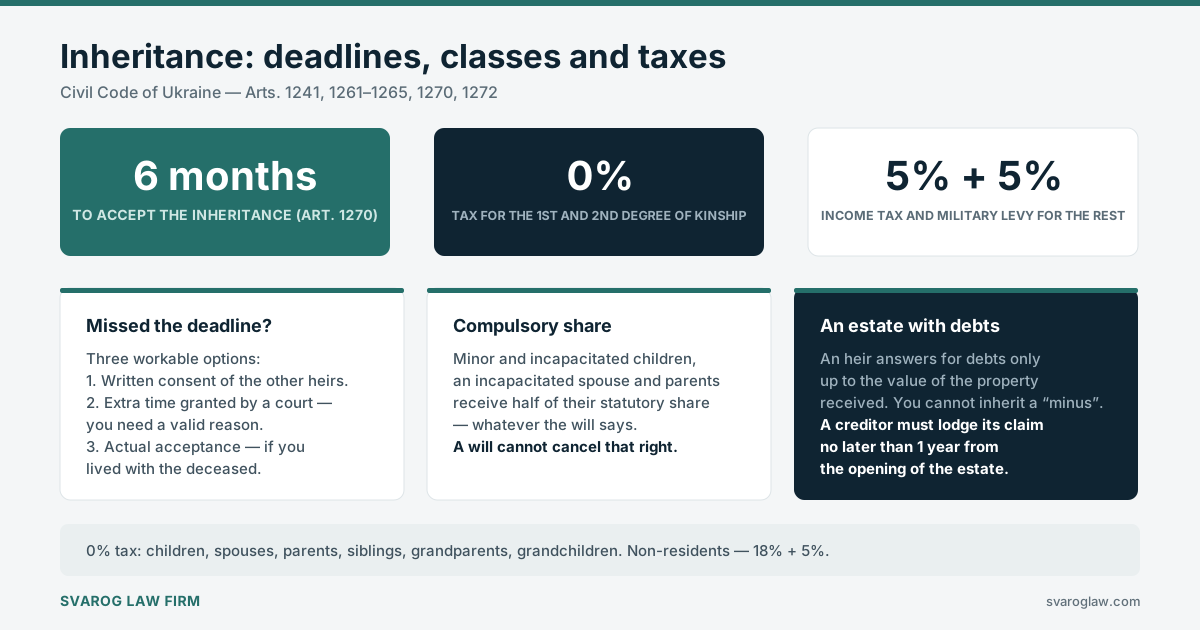
The law allows six months from the date of death to accept an inheritance Art. 1270 CC. If no application is made to a notary within that time, you are treated as not having accepted it, and the matter then has to be resolved either through the written consent of the other heirs or through the courts.
The most common reason people come to us looks like this: someone lived in their parents’ flat for years, paid the utility bills and assumed “it is all mine anyway”, only to discover that they are not the legal owner and cannot sell the property.
An inheritance lawyer is needed where the notary can no longer help: the deadline has passed, documents are missing, the heirs are in conflict, or the will raises doubts. We register inheritances, restore missed deadlines, challenge wills and divide estates between heirs.
Six months: what to do if the deadline has passed
There are three workable options, and the right choice decides how much time and money you will spend.
- Consent of the other heirs. If others have already accepted the inheritance, they may give written consent to add you to the group of heirs Art. 1272(2) CC. The consent is given to the notary. This is the quickest and cheapest route, but it only works where everyone agrees.
- Additional time through the courts. Where there is no consent, the court may grant additional time to accept the inheritance if the deadline was missed for a valid reason Art. 1272(3) CC. Courts accept lengthy medical treatment, being abroad without any way to travel, or other heirs concealing the death. Not knowing that an application had to be made is not a valid reason.
- Acceptance in fact. An heir who permanently lived with the deceased at the time the inheritance opened is treated as having accepted it, even without filing an application Art. 1268(3) CC. Living together is proved by registration records, utility bills and witness testimony.
What the court examines in a case about additional time
The court establishes three things: whether the obstacle genuinely existed, whether it lasted for almost the whole six-month period, and whether you applied as soon as it fell away. That is why documents rather than explanations go with the claim: hospital records, a passport with border stamps, evidence that other heirs concealed the death or your whereabouts.
An application to establish a fact (a family relationship, or living together as a family) is made in separate proceedings, where the court fee is lower: 0.2 of the subsistence minimum, that is 665.60 UAH. Where the heirs are in dispute, however, the same fact has to be proved in adversarial proceedings.
Who inherits and in what order
Where there is no will, five classes of heirs apply Art. 1261–1265 CC. Each class inherits only if there is nobody in the preceding one:
- Children, the surviving spouse, parents.
- Full siblings, grandmother, grandfather.
- Uncles and aunts by blood.
- People who lived with the deceased as a family for at least five years before the inheritance opened.
- Other relatives up to the sixth degree of kinship, and dependants.
The reserved share. Even where a will leaves everything to an outsider, minor and adult incapacitated children, an incapacitated widow or widower and incapacitated parents receive half of the share they would have taken on intestacy Art. 1241 CC. A will cannot remove that right, and most successful challenges are built on it.
Challenging a will
A will can only be challenged in court. The grounds that work are:
- The testator did not understand what they were doing: dementia, serious illness, the effect of medication. This is decided by a posthumous forensic psychiatric examination based on medical records.
- Pressure, deception or violence by the person named in the will.
- Defects of form: the will was not notarised, or was certified by someone without authority.
- The will was made by a person without full legal capacity.
- The right to a reserved share was infringed.
The unfairness of a will on its own (“father left everything to the neighbour”) is not a ground. You need medical records, witness evidence and an expert examination.
That is why our first step is to assess whether there is a case at all, and we tell you the prospects before any agreement is signed.
Tax: what it costs to accept an inheritance
The question of tax comes up at every consultation, although for close relatives the rate is zero.
| Who inherits | Income tax | Military levy |
|---|---|---|
| First and second degree of kinship: children, spouses, parents, full siblings, grandmother, grandfather, grandchildren | 0 % | 0 % |
| People with group I disability, orphans, children deprived of parental care, children with disabilities (real estate, movable property, funds) | 0 % | 0 % |
| Other resident heirs (an aunt, a nephew, a neighbour under a will) | 5 % | 5 % |
| A non-resident heir, or an inheritance from a non-resident | 18 % | 5 % |
At the zero rate no tax return is required, unless there is some other reason to file one. Otherwise the asset declaration is filed by 1 May of the following year and the tax is paid by 1 August.
The notary’s fees and the valuation are charged separately: a valuation is mandatory whenever the rate is not zero, because the tax is calculated from the assessed value.
Situations where a notary cannot help
Where there is a single heir, the deadline has not passed, the title documents are in order and there is no will, the inheritance is registered by a notary without a lawyer. An inheritance lawyer is needed when:
The six-month deadline has been missed
You need the other heirs’ consent or a court order granting additional time.
The heirs are in conflict or someone is concealing assets
Tracing assets through lawyer’s requests, and a dispute over the division.
The will raises doubts, or you were left out of it
A court challenge, an expert examination, the reserved share.
There are no title documents for the deceased’s property
An unprivatised flat, an unregistered land plot, a garage never re-registered after a death.
Family relationships have to be proved
Discrepancies in surnames, lost certificates, archives in occupied territory.
The estate includes a business, an LLC share or debts
Valuation, analysis of constituent documents, liability limited to the value of the assets.
A separate case: the deceased died abroad, or the property is located in another country.
An inheritance with debts
Heirs are liable for the deceased’s debts only up to the value of what they received Art. 1282 CC. You cannot inherit a deficit: if the debts exceed the assets, you will not be paying out of your own pocket.
A creditor must bring its claims against the heirs within six months of learning that the inheritance has opened, and no later than one year from the date it opened Art. 1281 CC. Miss that, and the right to claim is lost.
This is the provision behind our objections whenever a bank remembers the deceased’s loan several years later.
A case from our practice
In 2024 a woman came to us who had missed the six-month deadline after her father’s death: she had spent almost all of that time receiving treatment abroad and learned of the death late, because her sister had not told her. The sister had managed to obtain a certificate of inheritance for the Kyiv flat in her own name. We filed a claim for additional time and for the certificate to be declared partly invalid, supported by clinic records and border-crossing stamps. The court of first instance granted the claim and the flat was split equally between the sisters. Together with the notarial registration the matter took about ten months; our client’s costs were the court fee of 1,331.20 UAH for a non-monetary claim and court representation from 10,000 UAH. (details changed)
How we work
- We analyse the situation: whether the deadline has passed, who the heirs are, whether a reserved share applies.
- We trace the deceased’s assets through lawyer’s requests to the property register, banks, the Unified State Register and the vehicle register. Assets the family knew nothing about often turn up.
- We restore documents: archive extracts, certificates, proof of family relationships.
- We run the case in court: additional time, establishing facts, challenging a will, dividing the estate.
- We handle the notarial stage through to the certificate of inheritance.
- We register ownership of the inherited property.
Cost of services
The court fee, notary’s fees, valuation, forensic examination and archive certificates are paid separately. Court fees in 2026: for a monetary claim by an individual, 1 % of the value of the claim, but not less than 1,331.20 UAH and not more than 16,640 UAH; for a non-monetary claim (challenging a will, seeking additional time) 1,331.20 UAH; for an application in separate proceedings to establish a fact, 665.60 UAH. Filing through the Electronic Court reduces the fee by 20 %.
Calculate the court fee for a monetary claim
This applies to dividing an estate. For non-monetary claims the fee is fixed at 1,331.20 UAH.
Questions and answers (inheritance lawyer)
Can I accept an inheritance while I am abroad?
Yes. The application can be filed through a Ukrainian consulate or sent to the notary by post with a notarised signature, after which a representative can act under a power of attorney. The key point is the six-month window: being abroad does not by itself suspend it.
Is a valuation needed if the tax rate is zero?
No. No assessed value is determined for inherited assets taxed at the zero rate. A valuation is needed where the rate is 5 % or 18 %, and also to divide property between heirs or to calculate the court fee for a monetary claim.
The heir is under 18. Who accepts the inheritance for them?
A child or a legally incapable person is treated as having accepted the inheritance without filing anything (Art. 1268(4) of the Civil Code). The parents or guardian apply to the notary for the certificate, while renouncing an inheritance on a child’s behalf requires permission from the guardianship authority.
Another heir has already transferred everything into their own name. What now?
A certificate of inheritance is declared invalid by a court (Art. 1301 of the Civil Code). Along with the claim for additional time, we seek to have the certificate declared invalid in whole or in part and the registration of ownership cancelled. If the property has already been sold, the dispute is about its value or recovery from the buyer.
What if the deceased’s flat was never privatised?
Unprivatised housing cannot be inherited: it did not belong to the deceased. But if they applied for privatisation during their lifetime and did not manage to complete it, the right can be recognised in court. This is a separate category of case, and it succeeds where there is evidence the application was made.
How do I find out whether there is a will?
The notary checks the Inheritance Register when opening the inheritance file. During the testator’s lifetime information about a will is closed; after the death an heir obtains an extract through a notary by producing the death certificate.
Contact an inheritance lawyer at Svarog
Tell us about your situation at a consultation: we will check the deadlines, the heirs and the assets, find property you may not have known about, and tell you whether court is needed or whether a notary can settle it in two weeks.