We start by establishing what exactly you did to the flat. The answer determines the whole procedure: some work needs no permits and is closed off with a new technical passport, while other work requires a design, commissioning, and sometimes a structural strengthening design as well.
A change of layout that does not touch load-bearing structures or shared utility networks. Removing a non-load-bearing partition, moving a doorway, combining ancillary rooms.
Anything affecting load-bearing walls, floor slabs or shared utilities. Opening a kitchen into a room through a load-bearing wall, moving a bathroom, altering the heating system. This is a different procedure, with a design and commissioning.
Confusing the two is a classic mistake that costs people months and unnecessary money. We handle the regularisation of a flat’s layout in Kyiv from classifying the work to amending the register.
Why it cannot be put off
Unregularised alterations directly get in the way of dealing with the flat:
- A bank will not take the flat as security: the technical passport is part of the lender’s mandatory file, and any mismatch with the actual layout stops the deal.
- The buyer and the valuer will spot the discrepancy with the technical passport, and the sale either falls through or goes at a discount.
- An insurer may refuse to pay if the loss relates to altered structures or utilities.
- Your heirs will face the same thing, only without you.
- If the work is found unsafe, you can be ordered to restore the previous state at your own expense.
A notary does not check the actual layout and can certify a contract without a technical passport. The problem appears the moment a bank, a valuer or an attentive buyer enters the deal — that is, in most real sales. Usually people discover it a week before completion, once the buyer has been found.
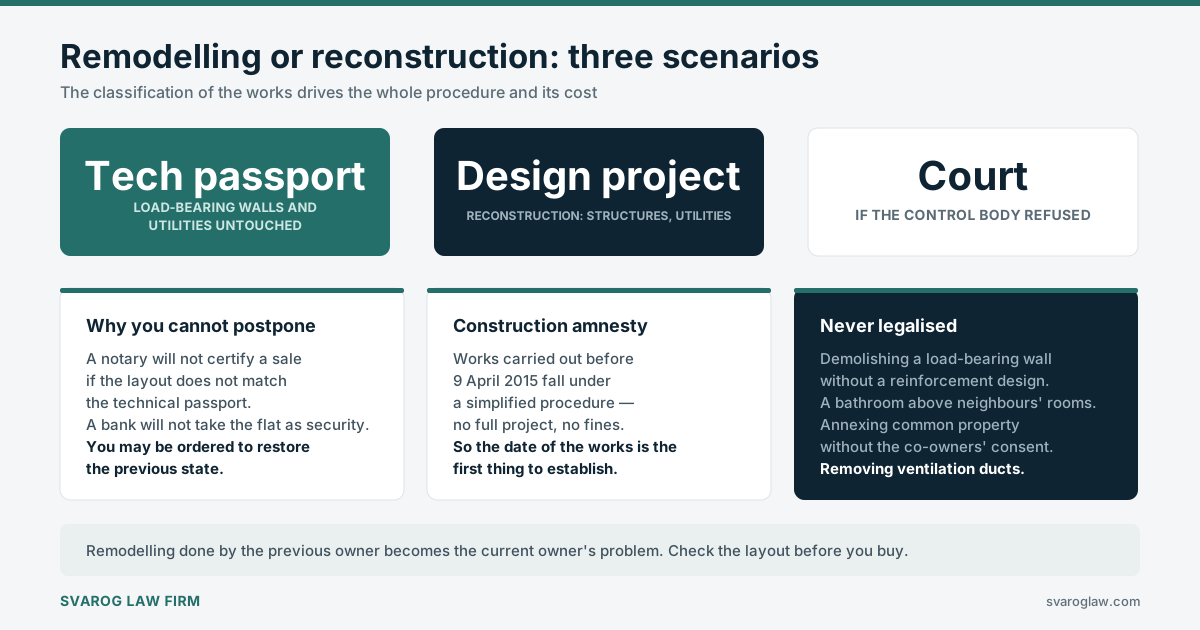
Three routes
1. No permit needed
2–4 weeksIf the work does not touch load-bearing structures or shared utilities, no separate permit is required. It is enough to commission a new technical passport recording the actual layout and to amend the documents. This is the cheapest and quickest route: 2–4 weeks, with costs limited to the technical survey.
2. A design and commissioning are needed
2–5 monthsIf load-bearing walls, floor slabs or utilities are affected, this is reconstruction. The order is:
- a survey of the structural condition
- a design from a firm with the appropriate specialists (and a strengthening design where needed)
- a notification of the start of works, or a permit, depending on the consequence class
- a declaration that the property is ready for use
- a new technical passport and amendment of the State Register of Property Rights
Timeline: 2–5 months. The main cost here is technical (the survey and the design), not legal.
3. The court route
when the rest is exhaustedNeeded once the administrative route is exhausted:
- The architectural and construction inspectorate has refused.
- Co-owners or neighbours object.
- Common property of the building is affected.
- There are no documents for the original layout.
- The previous owner did the work and you are left dealing with it.
Old work and the “construction amnesty”
The simplified commissioning procedure without a permit (the so-called construction amnesty) applies to individual houses, garden and country houses and outbuildings erected between 1992 and 2015. It does not extend to altering or reconstructing a flat in an apartment block, so promises to “regularise a flat under the amnesty” are worth checking.
The date of the work still matters. If the alterations were made in the 2000s or by a previous owner, it is important to find the technical passport of that time, the sale contract with its description of the flat, and other documents showing the state in which you received it. That determines who is answerable for the work and whether the inspectorate’s time to issue an order has run out.
What will not be regularised
Work that will pass neither the administrative procedure nor the court:
- Removing a load-bearing wall without a strengthening design where the survey shows a risk to the structure.
- Moving a bathroom above the living rooms of the neighbours below.
- Annexing part of the common property (a stairwell, corridor or loft) without the co-owners’ consent.
- Removing ventilation ducts.
- Moving gas equipment in breach of the rules.
In such cases only one route remains: restoring the previous state. We say so at the first consultation, after looking at the technical passport and the photographs, and before any design is commissioned.
Common mistakes made before coming to a lawyer
- First: commissioning the design before the structural survey. If the survey shows the wall has to be restored, the design has to be redone.
- Second: filing with the inspectorate without the co-owners’ consent where common property is affected. A refusal is guaranteed, and the breach is recorded along with it.
- Third: buying a flat having checked only the register and not the technical passport against the actual layout, and inheriting someone else’s problem.
- Fourth: leaving it until the day of the deal. Even the simplest route needs 2–4 weeks for the technical passport.
A case from our practice
In 2025 the owner of a two-room flat in Obolon came to us while preparing it for sale to a mortgage buyer. A previous owner had opened the kitchen into the living room in the 2010s by cutting through a load-bearing wall and had moved a doorway; the buyer’s bank refused because of the mismatch with the technical passport. We arranged a structural survey, commissioned a strengthening design for the opening on the strength of it, prepared the notification and the declaration, and after commissioning obtained a new technical passport and amended the register. Regularisation took about 4 months; the technical work cost the client around 35,000 UAH, and our handling of the administrative procedure was charged at our standard rates. The flat was sold to the same buyer and the deal went through with the mortgage (details changed).
How we work
- We classify the work: reconfiguration or reconstruction. Everything else follows from that.
- We check the flat’s history: when the work was done and by whom, and what documents support it.
- We organise the technical side: the survey, the design, the technical passport.
- We take the administrative procedure through to amendment of the register.
- We challenge a refusal, or regularise through the court.
- We get the flat ready for the deal so the bank and the buyer have nothing to object to.
Cost of services
Paid separately: the technical passport, the structural survey, the design, any construction expert report, and the court fee.
Court fees in 2026: an individual’s claim to keep a flat in its altered state is a non-monetary one, so the fee is 1,331.20 UAH (0.4 of a subsistence minimum); challenging the inspectorate’s refusal in the administrative court costs the same; through the Electronic Court the rate is multiplied by 0.8.
Full price list · Regularising houses
Questions and answers (Regularising a flat’s alterations)
Is the residents’ association’s consent needed to join a balcony to a room?
Usually yes. Taking in a balcony or loggia affects the outer wall and the façade, which are common property, so a design and a decision of the co-owners are required. Without it the inspectorate will refuse, and the neighbours can demand that the previous state be restored.
What about alterations in a new building not yet commissioned?
Until the building is accepted into use, any change of layout is agreed with the developer and entered in their design documentation. Unauthorised work at this stage can delay commissioning of the whole building, so approach the developer first, and once title is registered follow the ordinary procedure.
Can alterations be regularised remotely?
Yes, provided someone you trust can give the surveyor and the technical inventory engineer access to the flat. Everything else — filing the notification and the declaration, registering the changes, representation in court — the lawyer does under a notarised power of attorney.
What does the procedure cost apart from the fee?
The largest items are the technical passport, the structural survey, the design and, where needed, the strengthening design. Their cost depends on the area and the complexity of the work, so we quote once we have seen the documents. Registering the change in the register costs 0.1 of a subsistence minimum, about 330 UAH, and the court fee for a non-monetary claim is 1,331.20 UAH.
What if the inspectorate has already ordered the previous state to be restored?
The order can be challenged in the administrative court within the period it states, which is usually short. At the same time it is worth commissioning a survey: if the structures are safe, that is the main argument both in court and for a fresh application to regularise. Ignoring the order is unwise, because a fine and enforcement follow.
Can alterations be regularised if the old technical passport is missing?
Yes. The original layout is reconstructed from the technical inventory archive or the building’s design documentation, and the current state is recorded by a new technical survey. Comparing the two is what determines which work has to be regularised.
Contact a Svarog lawyer about regularising alterations
Send us the old technical passport and describe what you changed. We will tell you whether it is a reconfiguration or a reconstruction, which route to regularisation applies, and what it will cost including the technical work.