

Олександр Сич
6 September 2026
Mobilised personnel, reservists, service members taking part in defence operations, and their spouses have no interest, penalties or late-payment charges accrued on their credit (paragraph 15 of Article 14 of Law No. 2011-XII). The relief does not extend to credit taken to buy housing or a vehicle, and it is not automatic: a written application with proof of service must go to each lender.
Paragraph 15 of Article 14 of the Law “On the Social and Legal Protection of Service Members and Their Families” has been in force since 2014, but in practice it fails in two places. Banks do not apply the relief until they receive an application with the documents, and some microfinance lenders ignore the application too, continuing to charge interest disguised as servicing fees. The result is predictable: someone returns from service to a debt that should not exist in law, and it has to be stripped back retrospectively.
The second common problem is inflated expectations. The provision stops charges accruing; it does not forgive the debt, and it has two express exceptions that lenders tend to mention only after the application has been filed. Below: who is entitled, how to claim it, what to do about unlawful charges, and what happens to the credit of those killed in action. Individual assistance is on the page of our credit and microloan lawyer.

Who is entitled to credit holidays
The categories under paragraph 15 of Article 14 of Law No. 2011-XII:
- service members called up during mobilisation — from the first day of the call-up until the special period ends;
- reservists and those liable for service called up during the special period;
- other service members taking part in operations to secure the defence of the state — from the first day of that participation;
- the spouses of those serving — on their own credit agreements.
The commonest point of dispute is contract soldiers who serve in the rear throughout and were never assigned to combat or defence operations: for them interest accrues as normal. The question is settled by a certificate of participation in defence operations (form 12) issued by the unit. For spouses, the marriage certificate and the serving partner’s service documents are added.
What stops, and what does not
| Element | During service |
|---|---|
| Interest on the credit | Does not accrue |
| Penalties and late-payment charges | Do not accrue |
| The principal | Not written off; the obligation to repay remains |
| Credit taken to buy housing (a mortgage) | Excluded from the relief: charges continue under the contract |
| Credit taken to buy a vehicle | Likewise excluded from the relief |
The two exceptions in the last rows are the provision’s express wording: it does not extend to credit agreements made in order to acquire property classified, or to be classified, as housing stock, or to acquire vehicles. It is worth knowing that before you calculate what will be left of the debt on your return.
On the other hand the provision reaches further than people usually think as regards lenders: it covers obligations not only to banks but to microfinance companies, pawnbrokers, credit unions, enterprises and institutions of every form of ownership, and even to individuals. The argument “we are not a bank, the law does not apply to us” has no legal basis.
How to claim it: the application and the documents
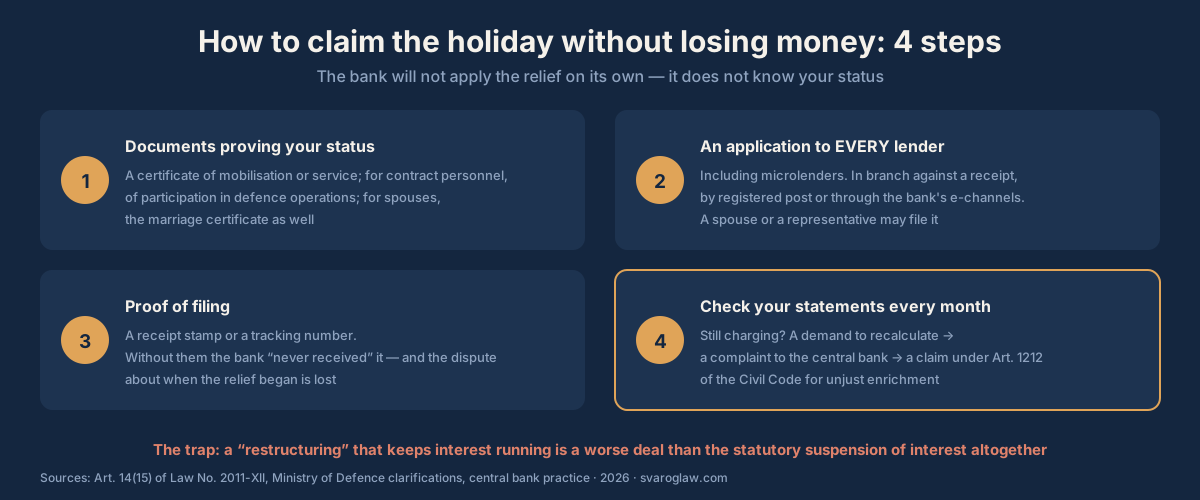
- Gather proof of status: a certificate of mobilisation or of service (form 5), an extract from the enlistment order, for contract soldiers a certificate of participation in defence operations, and for spouses the marriage certificate.
- File a written application with each lender for paragraph 15 of Article 14 of Law No. 2011-XII to be applied, enclosing copies of the documents: at a branch against an acknowledgement, by registered post with an inventory of the contents, or through the bank’s official electronic channels. It can be filed by the service member, by a spouse, or by a representative under a power of attorney.
- Record the date of filing. The right arises on the first day of service or of participation in defence operations, but the lender does not know your status without the application, and the earlier it is filed the less there is to recalculate.
- Check the statement for the following month. If charges continue, send a written demand for recalculation at once, and then a complaint to the National Bank.
- File a separate application with the enforcement officer if enforcement proceedings are already open against you: under Article 34 of the Law “On Enforcement Proceedings”, enforcement action is suspended where the debtor is called up for military service during mobilisation.
The bank or microfinance lender keeps charging: how to get it back
Everything charged in breach of the relief is money acquired without sufficient legal basis and is recoverable under Article 1212 of the Civil Code. The sequence is: reconcile the account, send a written demand for recalculation and for the money to be returned or credited against the principal, complain to the National Bank about the lender, and sue if it is not put right voluntarily.
A separate front is microfinance lenders who disguise interest as “servicing fees”. Here the charging caps come into play: the daily rate on a consumer credit is capped at 1 % inclusive of all fees and payments (Article 8(5) of the Law “On Consumer Lending”), so a fee that pushes the rate above the cap is unlawful regardless of military status. There is a detailed analysis in our article on recalculating a microfinance debt, and if the lender has already gone to court, the steps are in our article on setting aside a court order.
What happens to the credit of those killed in action
Here it matters not to repeat a common mistake. As of September 2026 the law provides for no automatic write-off of consumer credit owed by fallen defenders or by those disabled as a result of the war. The general rule of succession applies: heirs answer for the deceased’s debts up to the value of the property inherited (Article 1282 CC). Where the debts exceed the assets, the estate can simply be refused.
In practice banks often forgive such debts of their own accord, and over the years of the full-scale war there have been thousands of such cases. What stands in the way is tax: a forgiven sum counts as an additional benefit for tax purposes, so income tax and the military levy are charged on it, and some banks pay those taxes themselves rather than pass them to the family. Draft law No. 15458 has been tabled in parliament to let lenders write off up to 100 % of the debts of service members, the missing, prisoners of war and veterans with disabilities without tax consequences. Until it is passed, writing off remains the lender’s right rather than its duty.
For the family this means: before paying a fallen relative’s credit out of habit, apply to the bank in writing for the debt to be forgiven, and at the same time assess what the estate consists of and do not accept it if the obligations exceed the value of the property. Succession is dealt with by our succession lawyer.
An alternative for families: mandatory restructuring
If the relief does not apply — where the credit is a mortgage or a car loan, for instance — the second mechanism is worth checking. Paragraph 7-1 of Chapter IV of the Final Provisions of the Law “On Consumer Lending”, added by Law No. 3156-IX, obliges a lender to restructure the debt where several conditions coincide: the contract was made before 24 February 2022, the credit is unsecured, there were no arrears as at 23 February 2022, and the borrower is an internally displaced person or lived in or left an area of hostilities or temporarily occupied territory and meets one of the vulnerability criteria, among them a family member’s disability caused by the war. Repayment is spread over three years at the National Bank’s discount rate plus five percentage points. Restructuring by agreement is open to a wider group: the details are on the page about restructuring credit.
Typical mistakes
- Expecting the bank to apply the relief itself. Without an application the lender does not know your status, and recalculating past months takes longer than filing straight away.
- Applying only to the “main” bank. The relief is claimed from each lender separately, microfinance companies, pawnbrokers and credit unions included.
- Agreeing to restructuring instead of the holidays. Restructuring with interest is worse than the lawful suspension of interest where the relief genuinely applies.
- Not keeping proof that the application was filed. Without an acknowledgement or a tracking number the lender will say it never received one, and the argument about when the relief began is lost.
- Ignoring the statements while serving. Unlawful charges are cheaper to stop in the second month than to strip back after two years.
When you do not need a lawyer
If there is one lender, the status is proved by a standard certificate and the bank stopped charging correctly after the application, a lawyer adds nothing. Help is needed when the bank refuses a contract soldier despite the certificate of participation in defence operations, when a microfinance lender ignores the application, when what has already been charged must be recovered through the courts, and where a fallen relative’s credit arises in a succession case. Our fees are in the section on legal service prices, and related service matters are covered by our military lawyer.
Questions and answers
Does service release me from repaying the credit altogether?
No. During service no interest, penalties or late-payment charges accrue, but the principal remains and is repaid once service ends. The law provides for no automatic write-off.
Do the holidays apply automatically from the day of mobilisation?
The right arises on the first day of service, but the lender applies it only after your application with the documents. File as early as you can and keep proof of filing.
I am a contract soldier in a rear unit. Am I entitled to the holidays?
If you were never assigned to combat or defence operations, no. If you took part even for a single day, yes, from the first day of that participation; it is proved by a certificate from the unit.
Does the relief extend to a serviceman’s wife?
Yes, the spouses of those serving are entitled to have interest, penalties and late-payment charges suspended on their own credit. The marriage certificate and the service documents go with the application.
Do the holidays apply to microfinance loans?
Yes, the provision covers obligations to enterprises, institutions and organisations of every form of ownership, microfinance lenders included. In practice it is microfinance lenders who breach the relief most often, disguising interest as fees.
What about a mortgage or a car loan?
Both are expressly excluded: the relief does not extend to credit taken to buy housing or vehicles. For those, check mandatory or contractual restructuring instead.
The bank keeps taking interest despite my application. What should I do?
A written demand for recalculation citing paragraph 15 of Article 14 of Law No. 2011-XII, a complaint to the National Bank, and if necessary a claim to recover money acquired without basis under Article 1212 CC. You can also approach the free legal aid system.
What happens to a fallen service member’s credit in the estate?
There is no automatic write-off. Heirs answer for the debts up to the value of what they inherited (Article 1282 CC), and forgiving the debt is the bank’s right. File an application with the lender for forgiveness and assess whether the estate is worth accepting at all.
Can a debt be enforced against me while I am serving?
Under Article 34 of the Law “On Enforcement Proceedings”, enforcement action is suspended where the debtor is called up for military service during mobilisation. File an application with the enforcement officer together with the certificate of service.
My service has ended. From when does interest start again?
Charges resume under the contract once service ends. Reconcile the account with each lender immediately on your return: confirm that nothing accrued during your service and agree a schedule for repaying the principal.
Sources
- Law of Ukraine “On the Social and Legal Protection of Service Members and Their Families” No. 2011-XII, paragraph 15 of Article 14 — zakon.rada.gov.ua/laws/show/2011-12
- Civil Code of Ukraine, Articles 1212, 1281, 1282 — zakon.rada.gov.ua/laws/show/435-15
- Law of Ukraine “On Enforcement Proceedings” No. 1404-VIII, Article 34 — zakon.rada.gov.ua/laws/show/1404-19
- Law of Ukraine “On Consumer Lending” No. 1734-VIII, Article 8 and Chapter IV — zakon.rada.gov.ua/laws/show/1734-19
- Law of Ukraine No. 3156-IX of 10 June 2023 (mandatory restructuring of consumer credit) — zakon.rada.gov.ua/laws/show/3156-20
- National Bank of Ukraine, protection of financial services consumers — bank.gov.ua
Credit holidays without the traps, with Svarog
Send us the list of your credit agreements and your service documents — we will prepare the applications for every lender, check whether your contract falls within the housing and vehicle exceptions, follow the relief through, and if a bank or microfinance lender has overcharged, reconcile the account and recover the money, in court if need be. We work remotely: the application can be filed by a spouse or by a representative under a power of attorney. Related services: credit and microloan lawyer, military lawyer, court representation, full price list.
+38 095 554-54-24 · Kyiv, 7 Khoriva Street (Podil) · Mon–Fri 9.00–18.00