By the time a case reaches a judge, the prosecution has already gathered its evidence, recorded the statements and settled the classification. At trial all of that has to be rebutted, and rebutting finished evidence is far harder than preventing it from being created.
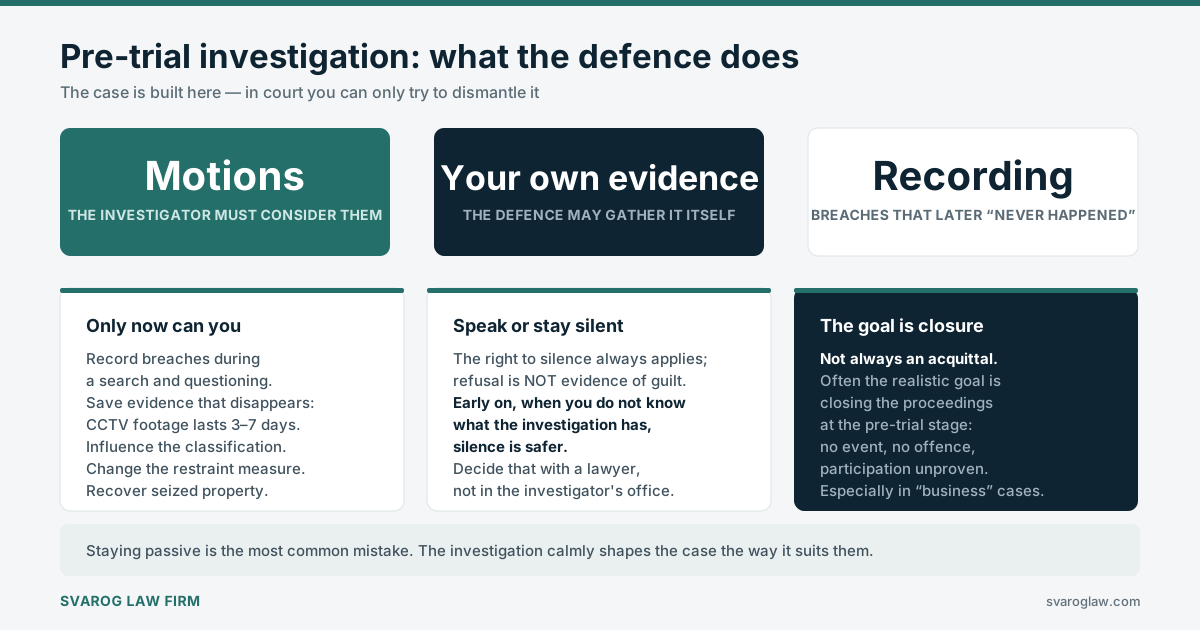
Defence during the pre-trial investigation means working with applications the investigator is obliged to consider, with evidence they are obliged to add to the file, and with breaches that must be recorded while they still can be: camera recordings get overwritten, witnesses forget the details. A passive stance remains the commonest mistake: the person stays silent and waits for the trial while the investigation shapes the case as it pleases.
What an active defence achieves before trial
Applications
The investigator must consider a defence application to question witnesses, order an expert report, obtain documents or hold a reconstruction, and must do so within three days (Art. 220 CPC). A refusal must give reasons, and it is challenged before the investigating judge.
Evidence of our own
The defence has the right to gather evidence itself (Art. 93(3) CPC): lawyer’s requests, reports by experts and specialists, documents, witness statements. This builds a body of evidence of our own, parallel to the investigation’s.
Expert reports
Often they decide the case. The defence initiates the examination, puts its own questions to the expert, challenges the report and asks for a repeat where the work was incomplete.
Recording breaches
Keeping the lawyer out, pressure, breaches during a search or questioning are recorded in writing: in objections noted on the record, in applications and in complaints. That is the basis for excluding evidence later.
Working on the classification
Conduct is often charged under a graver article than the facts warrant, in order to obtain a stricter preventive measure. Reclassification at this stage is entirely realistic, and it decides whether it will be custody or bail.
What is challenged at this stage, and where
The route depends on who made the decision:
- inaction by the investigator or prosecutor (details not entered in the Register, seized property not returned) — a complaint to the investigating judge under Art. 303 CPC;
- refusal of an application for investigative steps — a complaint to the investigating judge under Art. 303(1)(7) CPC;
- a decision closing the case — a complaint to the investigating judge;
- an investigating judge’s ruling on a preventive measure — an appeal under Art. 309 CPC; in parallel an application to vary the measure can be made under Art. 201 CPC;
- the freezing of property — an appeal against the ruling, and, once circumstances change, an application to lift it under Art. 174 CPC.
Complaints about the investigator’s conduct are filed within ten days of your learning about the decision; an appeal against a ruling on a preventive measure is filed within five days.
To speak or to stay silent
This is the central decision during the investigation, and it is better taken with a lawyer than alone in the investigator’s office. The right to silence applies at every stage, and refusing to give evidence is not proof of guilt.
Silence is right when you do not know what evidence the investigation has, your position is not yet formed, or there is a risk your words will be used against you. At the start of a case that covers most situations.
Giving evidence makes sense when you have an alibi that is easy to verify, documents that disprove the accusation, or a need to put your version on record before the investigation locks in its own.
A particular trap is summoning someone as a witness when they are in fact already a target. Witness status obliges you to answer and carries liability under Art. 385 CC, so before such questioning it is worth establishing whether you really are only a witness.
The window that closes
These steps become pointless once the investigation ends:
While the investigation is running
- record the breaches during a search, an arrest, questioning;
- preserve evidence that disappears with time: camera recordings are usually overwritten within days, witnesses forget the details;
- keep the defence evidence from vanishing: obtain documents while they still exist;
- influence the classification before it is fixed in the indictment;
- vary the preventive measure as circumstances change;
- recover seized property.
Closing the case before trial
An acquittal is not the defence’s only goal. Often the quicker goal is having the case closed during the investigation.
This matters most in “commercial” cases, where a civil dispute is pushed into the criminal sphere: non-performance of a contract is presented as obtaining property by deception.
Typical mistakes in the first weeks
- giving statements without a lawyer. The account of “how it all was” becomes the foundation of the case, and later has to be rebutted using your own words;
- signing a record without objections. An objection that is not written down does not exist in law, and a record with your signature counts as agreed;
- asking the investigator orally. Only written applications with an acknowledgement stamp are considered and can be challenged;
- waiting for “it all to sort itself out”. The deadlines for complaints pass and the defence evidence disappears;
- handing over original documents without an inventory and copies: getting them back is harder than it looks.
A case from our practice
In 2025 the director of a small construction company came to us: a client had not received what the contract promised and filed a report, on which a case was opened for obtaining money by deception. The investigator charged the paragraph covering large-scale loss, and the prosecutor asked for remand in custody. We gathered the primary documents, the completion certificates and bank statements showing the money had gone on materials, and applied for a forensic accounting report and for the subcontractors to be questioned. After the report the supposed sum obtained fell several-fold, the charge was changed to a less serious paragraph, and the preventive measure chosen was a personal undertaking. The pre-trial stage took about five months (details changed).
How we work
- We establish your status: witness, suspect or already accused, and what the investigation has at this point.
- We settle the strategy on giving evidence and agree it with you before the first questioning.
- We file applications: expert reports, questioning, the production of documents.
- We gather defence evidence through lawyer’s requests and specialists’ reports.
- We challenge acts, inaction, the preventive measure, the freezing of property, the suspicion itself.
- We press for closure or reclassification, and if the case does go to court we enter the trial prepared.
Cost of services
Court fees in 2026: there are none at the pre-trial stage. No fee is set by law for a complaint to the investigating judge under Art. 303 CPC or for an appeal against a ruling on a preventive measure or the freezing of property. Separate costs may arise for an expert report where it is carried out other than at a state institution, and for bail, which is returned when the proceedings end provided the obligations imposed were observed (Art. 182 CPC).
Questions and answers (Defence during the pre-trial investigation)
How long can a pre-trial investigation last?
Time runs from the notice of suspicion, and the period depends on the gravity of the offence: from two months for less serious crimes, extendable by the prosecutor or the investigating judge. If the period has run out and no indictment has been sent to court, that is a ground for applying to close the case.
Can I change lawyer in the middle of the investigation?
Yes, at any moment and without giving reasons. The new lawyer files a warrant and the investigator must admit them to the case. If your previous lawyer was appointed free of charge, a separate withdrawal of that appointment is filed.
Can the investigator take my phone or laptop?
Temporary seizure is possible during a search or an arrest, but the prosecutor must then apply to the investigating judge to freeze the property. If the application is not made in time, the property must be returned: we demand it by application and, if refused, by complaint to the investigating judge.
Can the case be handled while I am abroad?
A lawyer works with the file and files applications without you, but personal participation in investigative actions cannot be delegated. If you were notified of suspicion while abroad, we assess separately the risks of proceedings in absentia and of a search being declared: the date of attendance is best agreed in advance through your lawyer.
What happens if I do not appear when summoned by the investigator?
Failure to appear without a valid reason leads to being brought in by force or to a financial penalty imposed by the investigating judge. A valid reason (illness, a work trip) must be confirmed by a document and a request to reschedule sent in advance, or the absence will be recorded as evasion.
Contact Svarog about defence during the pre-trial investigation
Send us the documents you have: summonses, records, the notice of suspicion, court rulings. We will establish your status and tell you what the investigation is doing now, which deadlines are already running, and what has to be done this week, while the evidence still exists.