The main decision when buying a business is taken before the contract is signed: whether to buy the company or its assets. That choice determines what exactly you receive along with the property and what you will be answerable for afterwards.
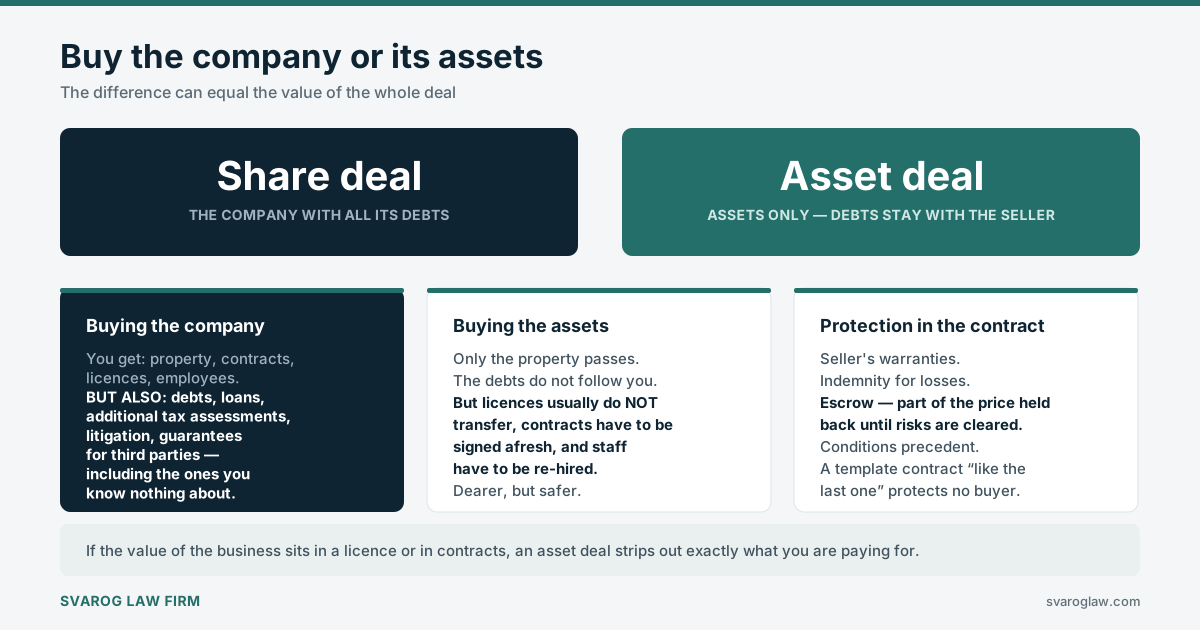
Means you receive the legal entity with everything inside it: equipment, contracts, licences — and also debts, court cases, tax assessments and guarantees given for third parties that the seller may have “forgotten” to mention.
Means you buy specific property: real estate, equipment, vehicles, trade marks. The seller’s debts do not follow you, except for encumbrances registered against the asset itself (mortgage, pledge, attachment). This route is more expensive and slower: re-registering property and vehicles usually takes another 2–4 weeks, and a sale of property, unlike a sale of a shareholding, attracts VAT. But it is far safer.
What transfers and what does not
| Buying the company (share deal) | Buying the assets (asset deal) | |
|---|---|---|
| Property | transfers | transfers |
| Contracts with counterparties | continue automatically | have to be re-signed |
| Licences and permits | usually continue | usually do not transfer |
| Employees | stay | have to be re-engaged |
| Debts and loans | pass to you | stay with the seller |
| Tax assessments | pass over | stay behind |
| Litigation | passes over | stays behind |
| Encumbrances on the asset itself (mortgage, pledge, attachment) | transfer | transfer with the property |
| History and reputation | transfers | does not transfer |
If the value of the business lies in its licences, permits or long-term contracts, buying the assets may deprive you of the very thing you are paying for. If the value lies in the property, an asset purchase is safer. So we choose the structure on the strength of the review, not because “it works out cheaper”.
Risks the balance sheet does not show
Suretyships and guarantees for third parties
The company guaranteed a partner’s loan, and the balance sheet may say nothing about it. The guarantee is called in after you have bought the company.
Tax assessments
An audit may arrive years later covering periods when you were not yet the owner. Along with the company you inherit its tax history.
Assets that do not belong to the company
Equipment on lease, premises rented, the fleet registered to the director. You buy a “business” that owns nothing.
Encumbrances
Mortgage, pledge, tax lien, attachments in enforcement proceedings. They follow the property whatever the structure of the deal.
The seller’s insolvency
The most dangerous risk. A transaction made by a debtor within three years before insolvency proceedings are opened can be declared invalid under Art. 42 of the Bankruptcy Code as harmful to creditors, and the asset will be taken from you even years later. Checking the seller for signs of insolvency is therefore essential.
Shareholder conflicts
A share sold without the other members’ consent, articles restricting disposal, a sale decision taken improperly: the co-owners challenge the deal.
Antitrust clearance
If the parties’ figures exceed the thresholds in Art. 24 of the Law “On Protection of Economic Competition” (as a guide: combined assets or turnover of the parties above 30 million euro with at least two of them above 4 million euro in Ukraine; or a target in Ukraine above 8 million euro and another party above 150 million euro), the deal needs prior clearance of the concentration. Without it: a fine and the risk of invalidity.
Protection in the contract
A template contract does not protect the buyer. What an asset purchase agreement should contain:
Seller’s warranties
A written confirmation that the company has no hidden debts, guarantees, disputes or tax risks; and that the assets belong to it and are unencumbered.
Indemnity
The seller’s undertaking to compensate losses if the warranties prove untrue. It is this clause that turns warranties into a basis for recovery.
Escrow of part of the price
Part of the sum, usually 10–20 % of the price, is held for 6–12 months and paid to the seller only if the hidden risks do not materialise.
Conditions precedent
The deal takes effect only once certain conditions are met, in particular repayment of debts, antitrust clearance, and release of encumbrances.
Payment terms and the moment title passes
These must be aligned with each other. The most dangerous arrangement is to pay everything before re-registration.
Common mistakes made before people come to us
- Only the companies register was checked, without the register of encumbrances over movable property or the property rights register: the equipment turned out to be pledged to a bank.
- The price was paid in full before re-registration, and meanwhile the seller’s property was attached in another case.
- A holding in an LLC was bought without checking the articles: the other members had a pre-emption right and challenged the deal.
A case from our practice
In 2025 the owner of a logistics company came to us having agreed to buy a holding in an LLC with a warehouse and six trucks for 14 million UAH. The seller insisted on a purchase of corporate rights “so the licence would not have to be reissued”. During due diligence we found the LLC’s guarantee for a related firm’s loan of 6 million UAH and a tax lien over two of the trucks. We restructured the deal as a purchase of assets: the warehouse and four unencumbered vehicles were transferred to the client’s company, and he obtained the haulage licence himself in three weeks. The deal closed in two months, the price came down by 2.3 million UAH, and the guarantee and the tax debt stayed with the seller (details changed).
How we work
- We run due diligence: we check what you are really buying.
- We choose the structure: company or assets, with the tax consequences calculated.
- We check whether antitrust clearance is needed while the terms are still being agreed.
- We draft the contract with warranties, indemnity, escrow and conditions precedent.
- We handle the payments and the re-registration through to registration of title in your name.
- We defend you if a risk materialises: recovery from the seller, challenging the deal.
Cost of services
The court fee in a dispute with the seller in 2026 for a company: 1.5 % of the value of the claim, from 3,328 to 1,164,800 UAH; a non-monetary claim (to have the contract declared invalid) costs 3,328 UAH. Through the Electronic Court the rate is 20 % lower.
Calculate the court fee for a dispute with the seller
Declaring a contract invalid without recovering money is a non-monetary claim: 3,328 UAH.
Questions and answers (Purchase of a company’s assets)
How long does an asset purchase take from agreement to registration?
Checking the seller and the assets takes 1–3 weeks, agreeing the contract another 1–2 weeks, and re-registering property and vehicles 2–4 weeks. If antitrust clearance is needed, add the time for its review. On average a deal closes in 1.5–3 months.
What happens to the employees in an asset purchase?
The employment contracts are with the selling company and do not pass to the buyer of the assets automatically. Staff are hired by you afresh, or transferred with their consent; terms for the people you need are worth agreeing in the contract.
Is VAT payable on an asset purchase?
A sale of property by a VAT payer is a taxable supply: tax is added to the price, and a VAT-registered buyer credits it as input tax. A sale of corporate rights is not subject to VAT. We calculate the consequences of both options at the structuring stage.
Can the deal be done remotely?
Register checks, drafting and negotiations we handle online. A contract for real estate or for a holding in an LLC is certified by a notary, so on the day of signing the parties or their lawyers must attend in person.
What if after the deal the seller does not hand over the property or the documents?
We prepare a demand letter, and then a claim to recover the property or the contractual penalty. That is why when drafting we build in a penalty for late delivery and retention of part of the price until the handover act is signed.
Contact a Svarog advocate about buying a company’s assets
Send us the company’s details or the list of assets: in 2–3 days we will check the seller’s debts, encumbrances, litigation and signs of insolvency, and propose a structure in which someone else’s problems do not become yours.