Establishing paternity and removing parental rights are opposite in substance but are judged by the same test: the court decides in the child’s interests and looks at documents, not at the parties’ emotions.
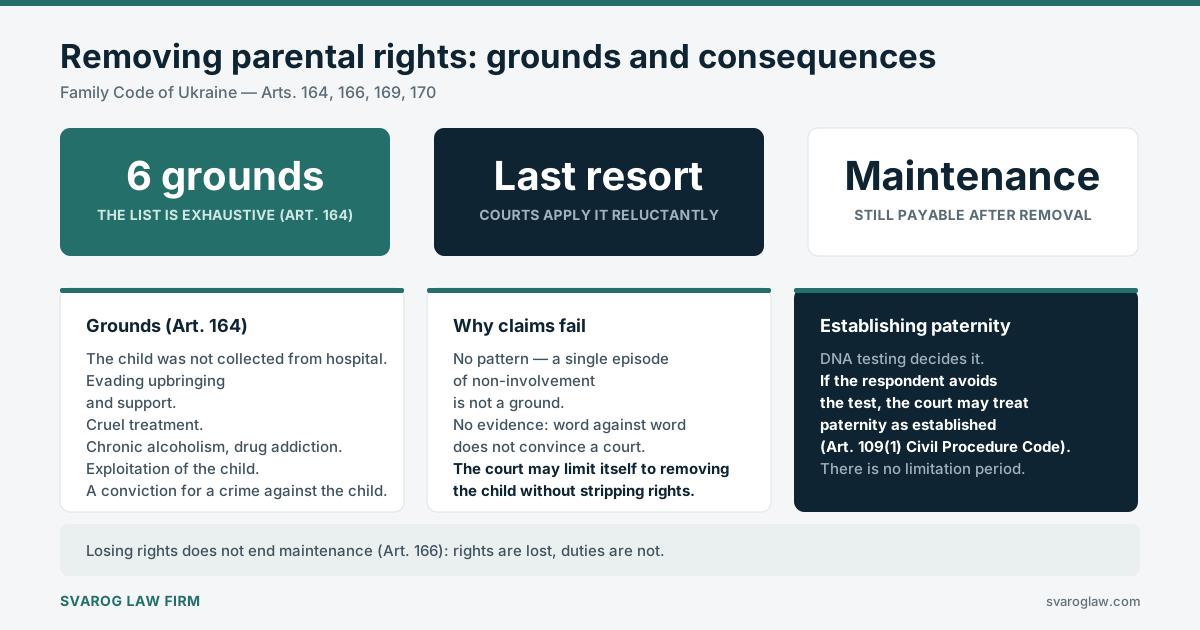
Removing parental rights remains a measure of last resort. Courts apply it reluctantly, and “he takes no part in raising the child” is not a ground in itself: you have to prove systematic, culpable failure to perform parental duties. Establishing paternity, by contrast, has strong prospects: forensic genetic testing gives an almost unambiguous answer, and a respondent who avoids it damages his own case.
Establishing paternity through the courts
If the parents were not married and the father did not acknowledge the child voluntarily, paternity is established by the court Art. 128 FC.
A claim may be brought by the mother, a guardian or custodian, a person who supports and raises the child, the child themselves once they reach adulthood, or a man who believes he is the father.
Any information confirming the child’s origin counts as evidence: living together, correspondence, photographs, witness testimony, contributions to the child’s upkeep. Forensic genetic (DNA) testing is almost always decisive.
The key point: if the respondent avoids testing, the court may treat paternity as established Art. 109(1) CPC. Most successful cases are built on this, because the “I simply will not go” position leads to defeat.
No limitation period applies: a claim can be brought at any time before the child reaches adulthood, and by the child themselves afterwards.
A one-year period runs from the day the person learned, or could have learned, that they are not the child’s father Art. 129 FC — and this is the deadline most often missed.
Establishing paternity gives the child the right to maintenance, to inherit on intestacy and to a survivor’s pension, and gives the father the duty to take part in the child’s upbringing. Maintenance is recovered from the date the claim is filed Art. 191(1) FC.
Removal of parental rights: the grounds
The list in Art. 164 of the Family Code is exhaustive; there are no other grounds:
- The parents did not collect the child from the maternity hospital without good reason and showed no parental care for six months.
- They fail to perform their duties to raise and support the child.
- They treat the child cruelly.
- They are chronic alcoholics or drug addicts.
- They exploit the child in any form, or force the child into begging or vagrancy.
- They have been convicted of a deliberate criminal offence against the child.
Removal of parental rights does not end the duty to support the child Art. 166 FC. A father who loses his rights still pays maintenance, but loses the right to raise and see the child, to inherit from the child and to be supported by them in old age. Most people who come to a first consultation do not know this.
Why courts refuse
Removal of rights is an exceptional measure, so the court looks for a way to avoid it. The usual reasons for refusal:
- No pattern: a one-off absence from the child’s upbringing is not a ground; sustained and culpable conduct is required.
- No evidence: the mother’s word against the father’s does not convince a court. What works is the bailiff’s calculation of maintenance arrears, reports on living conditions, the guardianship authority’s opinion, references from the school and nursery, witness testimony and police records.
- The respondent “reformed” after the claim was filed: he started paying maintenance and visiting the child. That counts in his favour.
- The court issues a warning instead. When dismissing a claim, the court may warn the respondent to change his attitude to the child’s upbringing Art. 164(2) FC.
- The court chooses a milder measure. Where leaving the child is unsafe, the child is removed without terminating parental rights under Art. 170 of the Family Code, and the parents’ rights formally remain.
That is why we assess the prospects from the available documents before filing. If there is not enough evidence, it is wiser first to have the maintenance arrears formally calculated and to gather materials: after a dismissal it is harder to come back, because the court will see the earlier judgment.
Who takes part in the case
The guardianship authority always takes part in cases about removing parental rights: it inspects the child’s living conditions and prepares a written opinion Art. 19(4), (5) FC. A prosecutor may bring a claim to remove parental rights Art. 165 FC, but the law does not require their participation in every such case.
The court weighs the guardianship authority’s opinion together with the other evidence and may disagree with it, giving reasons in the judgment. In practice, though, judgments often follow the opinion, so we start working with the authority long before the first hearing: we attend the inspection of the home and submit documents and explanations in writing.
Restoring parental rights
Removal of rights is not permanent. A person who has lost parental rights may ask the court to restore them if their conduct and way of life have changed Art. 169 FC. Restoration is impossible if the child has already been adopted or has reached adulthood by the time of the hearing.
This matters to both sides: to the person filing the claim today, and to the person it is brought against.
A case from our practice
In 2025 a mother of two came to us: the father had not seen the children for more than three years and paid no maintenance, even though a court order existed. We advised against filing to remove his rights straight away, because there was not a single document confirming the arrears. First we opened enforcement proceedings, obtained the bailiff’s calculation of arrears covering more than two years, collected school references and a certificate that the father had never once contacted the school, and attended the guardianship authority’s inspection of the home. We filed five months later, together with the authority’s opinion in the mother’s favour, and the court granted the claim at first instance. The father’s maintenance obligation remained (details changed).
How we work
- We assess the prospects from the available documents: whether there is enough evidence to remove parental rights, or whether it has to be gathered first.
- We build the evidence: the calculation of maintenance arrears, lawyer’s requests, references, witnesses.
- We work with the guardianship authority and attend the inspection of living conditions.
- We apply for DNA testing and rely on the respondent’s avoidance of it as evidence.
- We run the case in court, including on appeal.
- We deal with the consequences: recovering maintenance, changing the child’s surname, arranging travel abroad without the other parent’s consent.
Cost of services
Court fees in 2026: a claim to establish paternity or to remove parental rights costs 0.4 of the subsistence minimum, that is 1,331.20 UAH; through the Electronic Court, 1,064.96 UAH. An application to establish the fact of paternity in separate proceedings is charged at 0.2 of the subsistence minimum — 665.60 UAH. Claimants in maintenance cases are exempt from the court fee. Forensic genetic testing is paid for separately at the expert institution’s rates.
Questions and answers (Parental rights)
How much does DNA testing cost and who pays for it?
The cost depends on the expert institution and the number of people tested; when ordering the test, the court decides at once who pays. The costs are usually placed on the party who applied for it, and after judgment they are allocated between the parties in proportion to the claims granted.
Can both parents be deprived of parental rights?
Yes, the law does not prohibit it, and in such cases particular attention goes to who the child will live with. The child’s placement is decided alongside the claim: transfer to relatives, appointment of a guardian, or placement in an institution with the children’s service involved.
Can paternity be established after the man’s death?
Yes. The fact of paternity is established in separate proceedings under Art. 130 of the Family Code. The ruling is needed to claim an inheritance and a survivor’s pension; the application is made without a respondent, so the court fee is lower than for a claim.
Can the case proceed if the respondent is abroad?
Yes, the case is heard in the respondent’s absence provided he was properly notified. The court scrutinises that notification especially closely: proof of service at the registered address is needed, and sometimes notification through diplomatic channels. An error at this stage is the most common reason judgments are overturned on appeal.
What if the child has already been adopted by a stepfather?
After an adoption, the biological father’s rights cannot be restored, and he loses both rights and duties towards the child, including maintenance. If the adoption was carried out unlawfully, the only route left is to challenge the adoption decision itself.
How long does a case take?
Establishing paternity with DNA testing usually takes four to eight months, most of which is the testing itself. Removing parental rights takes longer: from six months, and with an appeal a year or more, because the court waits for the guardianship authority’s opinion and examines the respondent’s conduct over a long period.
Contact Svarog about establishing paternity or removing parental rights
Describe the situation at a consultation and bring whatever documents you already have. We will tell you whether there is enough evidence to remove parental rights now or whether it has to be gathered first, and exactly what is needed. A lost case makes a second attempt harder, so haste costs more here than a few months of preparation.