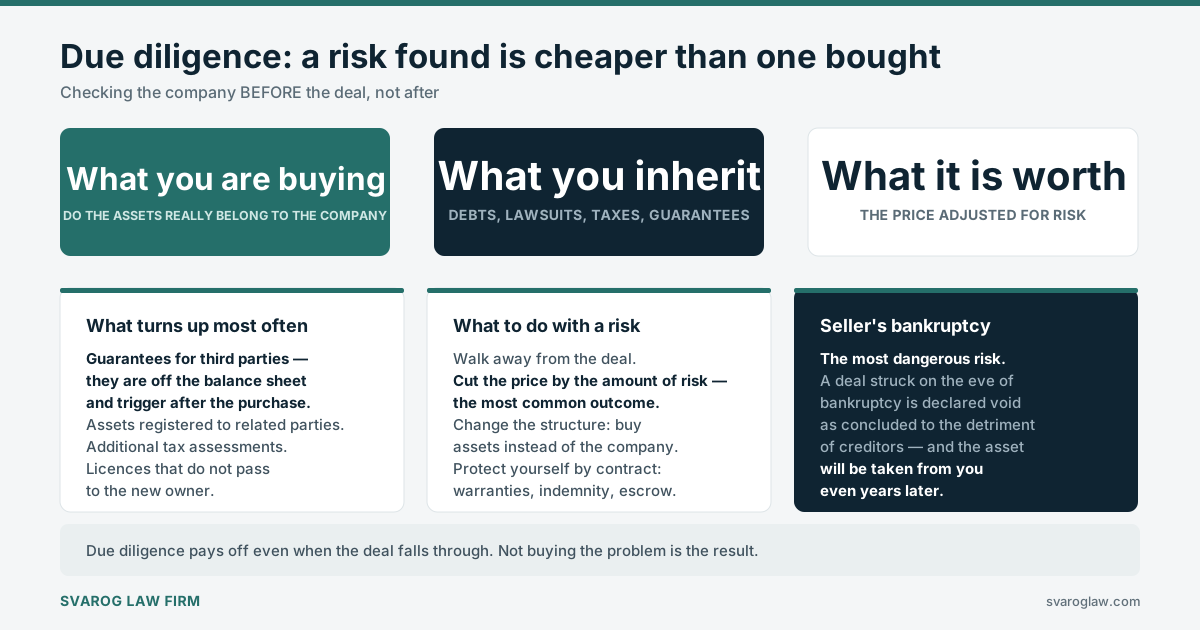
Legal due diligence is a check of a company or an asset before a deal. Its purpose is to answer three questions. What you are really buying, what obligations come with it and what it should cost once the risks found are taken into account.
Legal due diligence pays for itself even when the deal falls through: a buyer who walked away from a company with a hidden multi-million guarantee because of our report paid tens of times less for the check than they would have lost.
We carry out legal due diligence for the purchase of a business, an equity investment, a merger, an asset purchase, and before lending secured on a company’s assets.
What we check
Corporate structure
Who the real owners are (including the ultimate beneficial owner), whether the shares were lawfully acquired, whether there are shareholder disputes, and whether the director has authority to sign. A contract signed by someone without authority can be set aside.
Assets
Whether they actually belong to the company, whether title is registered, and whether there are encumbrances: mortgage, pledge, tax lien, attachments. It often turns out that the company’s main asset is leased or held by a related party.
Liabilities
Loans, suretyships, guarantees, leasing. We look separately for suretyships and guarantees given for third parties: they are not always on the balance sheet, and they are triggered precisely once the company has been bought.
Litigation
Current and potential: the Unified State Register of Court Decisions, the Unified Register of Debtors, enforcement proceedings. We check the company, its counterparties and its founders.
Tax risks
Additional assessments, audits, tax notices under appeal, “risky taxpayer” status, blocked tax invoices. When corporate rights are bought, tax debt comes with the company.
Insolvency
Proceedings against the company, its counterparties or its owners. A transaction entered into on the eve of insolvency can be declared invalid under Art. 42 of the Bankruptcy Code, and the asset will be taken back from you.
Contracts
Termination terms, change of control clauses, penalties, exclusivity, long-term unfavourable commitments.
Employment
Wage arrears, disputes, undocumented staff, obligations under the collective agreement.
Licences and permits
Whether they are valid and whether they survive a change of owner. Often the licence is the real value of the business, and in an asset deal it does not transfer.
Sanctions risk
Whether the company, its owners or its counterparties appear on the sanctions lists of Ukraine, the EU, the USA or the United Kingdom.
Two deal structures, two different risks
Buying corporate rights. You buy the company with everything it has: assets, debts, court cases, tax risks, including those you do not know about. Cheaper and faster, but risky.
Buying assets. You buy specific property, and the company’s debts do not follow you (other than encumbrances on the asset itself). Slower and more expensive: VAT on the property, re-registration of every item. But far safer.
The choice of structure is the main decision of the deal, and it is made on the strength of the due diligence. More on this: Purchase of a company’s assets.
What to do with the risks found
Finding a risk is half the job. After that there are four options:
- Walk away from the deal if the risk is critical.
- Reduce the price by the amount of the risk identified. This is the commonest outcome: the due diligence report becomes an argument in the negotiations, and the discount is usually several times the cost of the check.
- Change the structure of the deal: buy assets instead of corporate rights.
- Protect yourself in the contract: seller’s warranties, indemnity, escrow of part of the price until the risk is resolved, conditions precedent.
The last point is missing from standard template contracts, and it is exactly the one that saves you when the risk materialises.
What we find most often
- suretyships for loans of related companies that are not on the balance sheet;
- equipment and vehicles pledged to a bank or held under a lease, so not owned by the seller;
- real estate registered to the director or their relatives, with the company merely a tenant;
- tax notices-decisions whose appeal deadline is already running out;
- contracts with a change of control clause: once the owner changes, the counterparty may terminate;
- shares sold in breach of the other members’ pre-emption right;
- staff without employment contracts, and wage arrears.
A case from our practice
In 2024 an investor commissioned legal due diligence on a manufacturing business in the Kyiv region before buying a 100 % holding for 22 million UAH. The seller supplied the balance sheet, the articles and register extracts, but refused to show the loan agreements, citing banking secrecy. We recorded the refusal in writing and checked the register of encumbrances: the production line, which accounted for half the value of the business, was pledged to a bank for a related firm’s loan. In addition, the court register showed a claim by a former member to invalidate the decision to increase the share capital. We produced a 30-page report in three weeks. The investor did not walk away: the price was cut by 5 million UAH, 3 million UAH was placed in escrow until the pledge was released and the corporate dispute closed, and an indemnity for pre-deal tax periods was written into the contract (details changed).
How we work
- We define the scope: full due diligence or a targeted one (assets only, tax only, litigation only). This drives the timing and the price.
- We request documents from the seller and record what they did not provide. A refusal to hand over a document is itself an indicator.
- We check the registers: the court decisions register, the Unified Register of Debtors, the State Register of Encumbrances over Movable Property, the State Register of Property Rights to Immovable Property, sanctions lists, and the companies register.
- We prepare the report as a list of risks with an assessment of the consequences and recommendations, split into critical, material and minor.
- We structure the deal and build the protection into the contract.
- We see the deal through to completion.
Cost of services
The cost depends on the scope of the check, the size of the company and the number of assets. We quote a firm price once the scope is agreed. If a risk you found does have to be litigated, the court fee in the commercial court in 2026 for a company is 1.5 % of the value of the claim (from 3,328 to 1,164,800 UAH), 3,328 UAH for a non-monetary claim, and 20 % less through the Electronic Court.
Calculate the court fee for a dispute over a risk
A non-monetary claim costs a flat 3,328 UAH.
Questions and answers (Legal due diligence)
Can due diligence be commissioned remotely if the company is in another city?
Yes. We check the registers online, receive the seller’s documents through secure file exchange, and deliver the report and the consultation by video. A site visit is needed only to inspect property in person, where the deal requires it.
Is the seller’s consent needed for the check?
Public registers we check without their involvement. Internal documents require consent, and it is usually formalised in a non-disclosure agreement listing the documents and the period of access. If the seller refuses to provide something, we record the request in writing, note in the report that the document was not provided, and price that risk in.
How long does a seller give for the check, and what if it is not enough?
The parties usually agree on 2–4 weeks. If the seller is pressing you to “sign tomorrow”, we offer a targeted review in 3–5 days covering the costliest risks (encumbrances, litigation, insolvency, authority) and escrow for the rest.
Can a due diligence report be used in court against the seller?
The report itself is not evidence of a breach. But if, on the strength of it, the contract includes the seller’s warranties and an indemnity, the concealment of a risk — recorded in the report and in the correspondence — becomes the basis for a damages claim.
Does the check need repeating if the deal drags on?
Yes, if more than 1–2 months have passed between the report and signing. New attachments, claims or changes in the companies register may have appeared. A register update takes us 1–2 days.
Do you carry out due diligence when buying property from an individual?
Yes, in a shortened form: title, encumbrances, litigation, the seller’s marital status and the spouse’s consent, signs of insolvency, registered occupants. That takes 2–3 days.
Contact a Svarog lawyer about due diligence
Send us the details of the company you are buying: we will run a preliminary check of the public registers in 1–2 days and tell you whether there is anything there that means the deal should be structured differently. A risk you find is always cheaper than a risk you buy.