In 2025 the owner of a house in Hatne came to us: 180 m², the work finished, and nobody had ever filed the notification of the start of construction. Instead of registering title in a month it took nine months of legalisation, a technical report, fresh documentation and a fine. A building erected without the right to carry out construction works is unauthorised construction Art. 376 of the Civil Code: it will not be commissioned or registered, it cannot be sold, and a court may order it demolished.
Yet a building permit is not always needed. For an individual house a notification of the start of works is enough: a different and far simpler procedure. Confusion between “notification” and “permit” remains the main reason people lose time.
We file documents through the Unified State Electronic System in Construction and challenge refusals by the State Inspectorate of Architecture and Urban Planning.
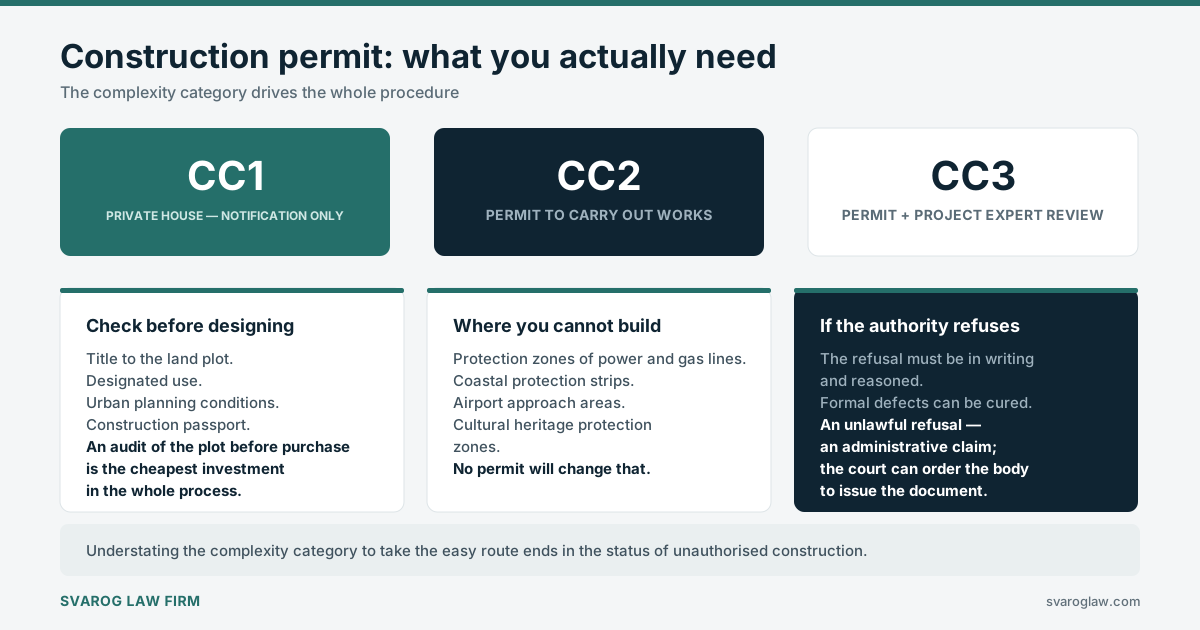
Notification or permit: the consequence class decides
The class determines which document you need, whether an expert appraisal of the design is mandatory, and how long the procedure takes.
| Class | What it usually covers | Document to start work | Document on completion |
|---|---|---|---|
| CC1 — minor consequences | Individual houses, outbuildings, small structures | Notification of the start of construction works | Declaration of readiness for use |
| CC2 — medium consequences | Apartment buildings, most commercial properties | Permit to carry out construction works | Commissioning certificate |
| CC3 — major consequences | Complex and potentially hazardous structures | Permit to carry out construction works | Commissioning certificate |
The class is determined by the designer from the building’s characteristics, not by the developer’s eye. Understating the class to take the easier route ends with the documents being annulled and the building treated as unauthorised.
What you need before filing
These are checked first, and they are where most applications stumble:
A right to the plot
Ownership, lease or superficies, registered in the State Register of Property Rights. Construction without a right to the land cannot be documented at all.
Designated use
On a plot “for gardening” you build a garden house. It can be converted into a dwelling under the procedure approved by Cabinet Resolution No. 321 of 29 April 2015 if it meets the building standards, and a residence can then be registered there. If the plot is agricultural land for a smallholding, the designated use has to be changed first — a separate procedure taking several months.
Planning conditions and restrictions
For buildings that require them. Issued by the planning authority; a refusal can be challenged.
A building passport for individual housing
The core document setting the parameters of the future house; the planning authority issues it within 10 working days.
Design documentation
And for CC2 and CC3 an expert appraisal of the design as well.
Technical supervision
Required where a contractor carries out the works; the designer provides author’s supervision on buildings constructed to a design.
Restrictions people learn about too late
- Protection zones for power lines, gas and water mains. Building in them is not allowed, and no permit will change that.
- Coastal protection strips: the classic trap for waterside plots.
- Airport approach areas: a separate approval regime that can block the project entirely.
- Heritage sites and their protection zones: additional approvals are needed.
- Distances from neighbouring boundaries: breaching the standards here means a future dispute with the neighbour and a refusal to commission.
A legal audit of the plot before you buy and before you commission a design costs 5,000 UAH. Demolition of an unauthorised building by court order costs from 200,000 UAH out of your own pocket, plus the value of the house itself.
If the inspectorate refuses
The refusal must be in writing and reasoned. After that:
Where the reason is formal: an incomplete file, errors in the documents.
Where the refusal is unlawful. That is an administrative claim; the court can order the authority to register the notification or issue the permit.
Inaction (documents filed, the deadline passed, no decision) is challenged the same way. The deadline for an administrative claim is six months from the day you learned of the refusal Art. 122 of the Code of Administrative Procedure.
Separately: a stop notice from the inspectorate and a fine. Speed matters here: challenging the notice while curing any breaches that are real.
A case from our practice
In 2025 an individual developer in the Bucha district was refused registration of a notification of works for a CC1 house: the inspectorate cited a mismatch between the building passport and the plot, although the passport had been issued by the same planning authority under the current plan. We filed an administrative claim attaching the passport, the cadastre extract and the correspondence, in which the inspectorate had not identified a single specific discrepancy. Seven months later the court held the refusal unlawful and ordered the notification registered; the inspectorate did not appeal. Our fee was 30,000 UAH and the court fee 1,331.20 UAH. (details changed)
Timing: how long it takes and what stretches it
The notification of the start of works itself is registered in the electronic system within one working day. The time goes on what comes before filing: the building passport (up to 10 working days), the design (from several weeks), the land title extracts. For CC2 and CC3 add the planning conditions, the expert appraisal of the design and the review of the permit application; realistically that is several months.
Three things stretch the timeline: changing the plot’s designated use (3–6 months), approvals in protection zones or an airport approach area (the time depends on the approving body), and challenging a refusal in court (6–9 months at first instance). So the first thing we do when someone comes to us about a building permit is check whether the plot falls into one of these.
How we work
- A legal audit of the plot: title, designated use, restrictions, protection zones. Before the design, not after.
- We establish the procedure: notification or permit, and whether planning conditions or a building passport are needed.
- We handle the filing through the electronic system.
- We challenge the inspectorate’s refusals and notices in the administrative court.
- We run disputes with neighbours and local councils.
- We see the project through to commissioning and registration of title.
Cost of services
Paid separately: design documentation, the expert appraisal of the design, technical supervision, register extracts, and the court fee.
Court fees in 2026: an individual’s administrative claim to have the inspectorate’s refusal declared unlawful is 1,331.20 UAH, a company’s 3,328 UAH; challenging a fine under Art. 96 of the Code of Administrative Offences is 665.60 UAH. Filing through the Electronic Court multiplies the rate by 0.8.
Full price list · Regularising houses
Questions and answers (Building permit)
What is the fine for building without a notification or permit?
For companies and sole traders the fines are set by the Law “On Liability for Offences in Urban Planning”; they are calculated in minimum wages (8,647 UAH in 2026) and for CC2 and CC3 buildings run into millions. For private individuals Art. 96 of the Code of Administrative Offences applies. We calculate the exact figure for your building at the consultation from its class and the type of breach; a fine does not legalise the construction, and the documents still have to be obtained.
Can the notification be filed through a representative and remotely?
Yes. The notification and the permit application are filed through the electronic system with the electronic signature of the client or their lawyer. No attendance in person is required, so we act for developers from other regions and from abroad.
A neighbour is challenging my permit. What should I do?
The neighbour has to show that the document infringes their own rights: the distance from the boundary, daylight, access. We prepare a defence with the design, the building passport and, where needed, an expert report confirming compliance with the standards. If the distances really are breached, it is cheaper to agree compensation or adjust the design than to lose the case and demolish part of the house.
How long is there to challenge the inspectorate’s refusal?
Six months from the day you learned of it (Art. 122 of the Code of Administrative Procedure). If that is missed, the court restores it only for good reason, so bring the refusal to us straight away.
Is a permit needed for a garage, a sauna or an extension?
Outbuildings on a house plot are class CC1: a notification is enough, and the dimensions must match the building passport. An extension to a house is reconstruction, and needs the same document as a new house of the same class.
I bought a plot with an unfinished building and no documents. What now?
First we check whether title to the land is registered in your name and whether the plot falls within any protection zones. If there are no restrictions, the unfinished building is documented through a notification of works (for CC1), or legalised as unauthorised construction where part of the work is already done; the second route is longer and more expensive.
Contact a Svarog advocate about a building permit
Send us the plot’s cadastral number: we will check whether you can build on it, what restrictions apply, and which procedure you need — a notification or a permit. A check before work starts costs 5,000 UAH and takes up to five working days; legalisation afterwards takes months and costs several times as much.