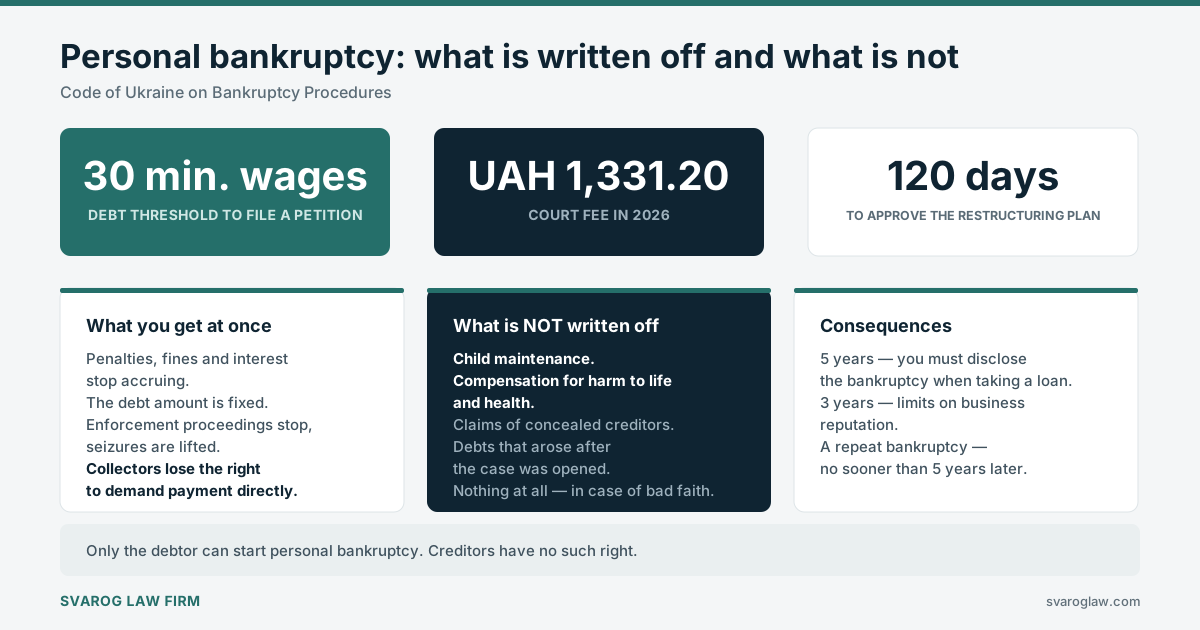
Personal bankruptcy is not a clever way of avoiding payment but a court procedure with its own price and its own consequences. It does allow debts to banks, microfinance lenders and debt collectors to be written off, but it does not write off child maintenance or compensation for harm to life and health. For five years afterwards you must disclose your status to banks when applying for credit, and for three years you are not regarded as a person of impeccable business reputation, which closes off certain senior positions.
So at the consultation we start not with “how to file” but with the arithmetic: what the procedure will cost, what will be written off, what will remain and what you will lose. Sometimes restructuring works out cheaper, sometimes the debt itself can be challenged, and sometimes personal bankruptcy really is the only way out.
Who can file
Handling a personal bankruptcy starts with checking the grounds set out in the Code of Ukraine on Bankruptcy Procedures. Any one of them is enough:
Grounds for applying
- the debt is at least 30 minimum wages;
- the debtor has stopped repaying loans or other scheduled payments amounting to more than 50 % of the monthly payments for two months or longer;
- a state or private bailiff has certified that the debtor has no assets that can be seized;
- there are other circumstances confirming a threat of insolvency.
The case is heard by a commercial court, and only the debtor can initiate personal bankruptcy: creditors have no such right (Art. 115(1) of the Bankruptcy Code).
What opening the proceedings achieves
This takes effect immediately, before anything is written off:
Effect from day one
- fines, penalties and interest stop accruing;
- the amount of the debt is fixed as at the date the proceedings open;
- enforcement proceedings are stayed and account freezes are lifted;
- collectors and banks lose the right to demand payment directly: every claim goes through the court;
- a moratorium applies to satisfying creditors’ claims.
For someone whose wages are being deducted and who is called by collectors every day, that often matters more than the write-off itself.
The two procedures the court chooses between
The insolvency practitioner and the creditors agree a plan: deferral, reduced payments, partial write-off of penalties and interest. The plan must be approved within 120 days of the proceedings opening (Art. 124 of the Bankruptcy Code). If it is approved, you pay under the new schedule and keep your property.
That is, being declared bankrupt. If no plan is approved, the court declares the debtor bankrupt. Property other than assets exempt from seizure is sold, the proceeds are distributed among the creditors, and the remaining debt is written off.
What is not written off
- child maintenance;
- compensation for harm to life and health;
- claims the debtor failed to disclose in the application (hidden creditors);
- debts arising after the proceedings opened.
Debts are also not written off if the court finds the debtor acted in bad faith: concealed assets, false statements in the application, or loans taken deliberately with no intention of repaying.
Consequences to weigh up
- for five years you must disclose the bankruptcy whenever you apply for credit;
- for three years you are not regarded as a person of impeccable business reputation, which restricts senior positions and certain activities (Art. 135 of the Bankruptcy Code);
- property is sold, apart from everyday items and other assets exempt from seizure;
- mortgaged housing has a special regime, and its fate depends on the currency and terms of the loan;
- you cannot start bankruptcy again for five years.
The law does not ban you from working, running a business or borrowing: what it imposes is the duty to disclose your status and reputational restrictions.
What it actually costs
Applications usually stall not because the case is complex but because the budget was miscalculated:
What the budget consists of
- there is no court fee. An individual debtor pays no court fee to apply for insolvency proceedings: the Law “On Court Fees” sets a rate only for a creditor’s application and for a corporate debtor;
- advance payment of the insolvency practitioner’s fee for three months is the main expense. Evidence of that advance must be attached to the application (Art. 116 of the Bankruptcy Code); without it the application is left without movement and then returned. The practitioner’s monthly fee in an individual’s case is tied to the subsistence minimum for able-bodied persons (Art. 30), so the advance runs to tens of thousands of hryvnias; we calculate the exact figure at the consultation from the current wording;
- the lawyer’s fee for preparing the application and handling the procedure;
- the cost of valuing and selling assets, if the case moves into the discharge procedure.
Technical errors also stall a case: an advance paid into the wrong account, or an incomplete document pack, cost months of waiting.
A case from our practice
In 2025 a man came to us with total debts of about 600,000 UAH: a consumer loan, two credit cards and several microloans on which the interest already exceeded the principal. Bailiffs were deducting half his wages and collectors called every day. We first checked the debts themselves: on two microloans the charges turned out to be inflated, and those amounts were reduced before any court hearing. We then costed the procedure and showed the client how much would be left to write off. He chose bankruptcy. Once the proceedings opened, interest stopped, the account freezes were lifted, and the case ended with a declaration of bankruptcy and a write-off of the balance: apart from everyday items the client had no assets. About eighteen months passed from his first approach to the case being closed. (details changed)
When bankruptcy is not worth it
- the debt is small: the cost of the procedure will swallow the benefit;
- the main debt is maintenance, which is not written off at all;
- there are valuable assets you are not prepared to lose;
- the debt can be challenged: unlawful microfinance interest, an expired limitation period, an invalid guarantee. Winning that case is often cheaper than going bankrupt;
- the bank is willing to restructure: that is usually cheaper and carries no reputational consequences.
Bankruptcy is justified where the debt is large, there is objectively no income to repay it, and pressure from creditors makes normal life impossible.
How we work
- We assess whether it is worth it: how much will be written off, what the procedure will cost, what you will lose.
- We check the debt: part of the charges may be unlawful, or the limitation period may have expired.
- We prepare the application with the full document pack and proof that the practitioner’s fee has been advanced.
- We handle the procedure: dealing with the insolvency practitioner and creditors, creditors’ meetings, the restructuring plan.
- We protect assets within the law, using the list of property exempt from seizure.
- We see it through to the write-off and the closing of the proceedings.
Cost of services
Paid separately: the advance of the insolvency practitioner’s fee for three months, and the cost of valuing and selling assets. An individual debtor pays no court fee, so the figure you see in the budget is almost entirely the practitioner’s advance. For comparison: had you instead sued the creditor in ordinary proceedings, the court fee would have been 1 % of the value of the claim, from 1,331.20 to 16,640 UAH.
Questions and answers (personal bankruptcy)
How long does it take from filing to the proceedings opening?
With a complete document pack the court decides whether to open proceedings within a few weeks. The delay is usually not the court’s: the application is left without movement because there is no proof of the advance or the list of creditors is incomplete, which adds another month to put right.
What happens to a mortgaged home?
For foreign-currency loans secured by a mortgage over a sole home, the Bankruptcy Code lays down special restructuring rules (Art. 133): the obligation is converted into hryvnia and the creditor’s claim is tied to the valuation of the home. Otherwise the mortgaged property satisfies the secured creditor’s claim in the usual way, so a decision to go bankrupt while a mortgage is live is taken only after a separate calculation.
Will bankruptcy affect my spouse’s property?
Property acquired during the marriage is joint matrimonial property, so the debtor’s share goes into the estate: in practice that means separating the share or selling the asset and paying the other spouse their part. The non-debtor spouse’s personal property, including anything acquired before the marriage or inherited, is not touched.
Can I file if I have no assets at all?
Yes, and a bailiff’s certificate that there are no assets is itself a ground for applying. But having no assets does not remove the requirement to advance the practitioner’s fee, so that money still has to be found before filing. This is where the procedure most often stalls.
What happens to the debt of a creditor who did not lodge a claim in the case?
Claims not lodged within the period set after the opening is announced are treated as discharged. There is an important exception: if you yourself failed to list a creditor in the application, that debt is not written off and they can recover it once the procedure ends. So we cross-check the list of creditors against your credit history and the registers.
Can I work and keep a sole trader registration during the procedure?
Yes. Neither the opening of proceedings nor a declaration of bankruptcy removes the right to work or to be a sole trader. The restrictions concern dealing with property (significant transactions are agreed with the practitioner) and positions requiring an impeccable business reputation.
Contact Svarog about personal bankruptcy
Send us a list of the debts and the documents for your property: we will calculate how much would actually be written off, what the procedure would cost and what you would lose. If the figures show that bankruptcy is not in your interest, we will propose an alternative — restructuring or challenging the debt itself.