Where a road accident leaves people with moderate or serious injuries, or kills them, the case stops being an administrative one and becomes criminal: it is investigated under Article 286 of the Criminal Code of Ukraine. A driver needs a lawyer from the very first investigative step. What they say at the scene examination and at the first interview determines which paragraph of the article is applied and whether there is any offence at all. Mistakes made in those first hours are almost impossible to undo at trial.
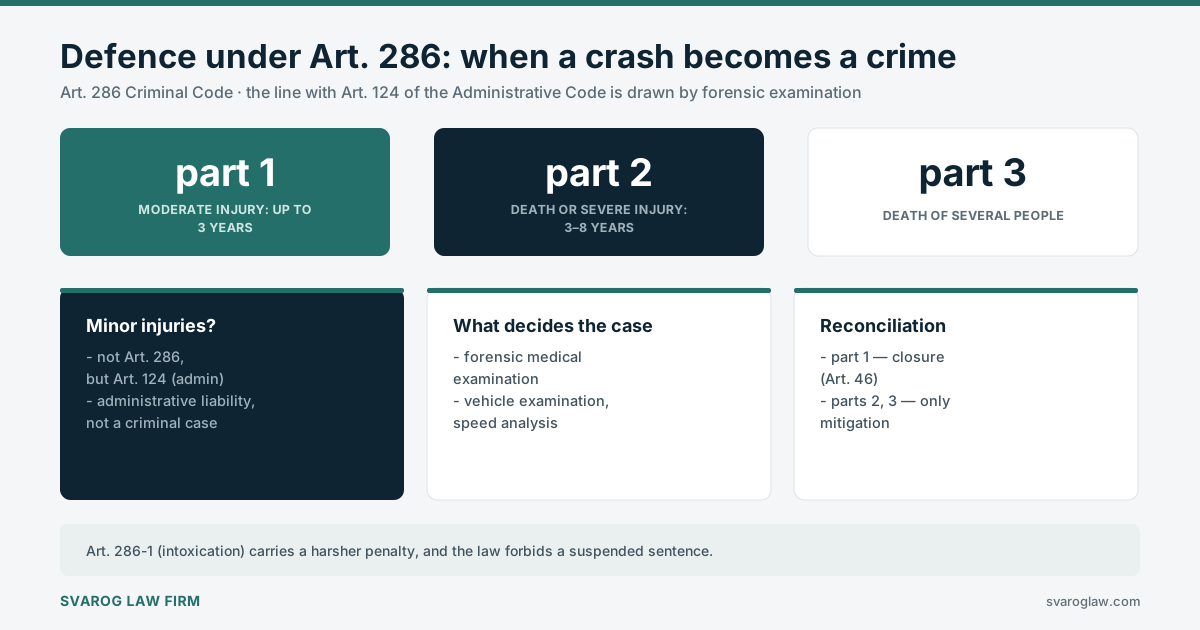
The line between administrative and criminal liability is drawn by the forensic medical report on the severity of the injuries. Minor injuries carry no criminal liability: the driver answers only under Art. 124 of the Code of Administrative Offences for the damaged property, and the victim recovers for their health by civil claim. Moderate or serious injuries, or a death, mean criminal proceedings with interviews, expert reports and the risk of imprisonment. So the defence’s first task is to test the investigation’s classification rather than accept it.
We come into the case from the first call: we prepare the driver for the investigative steps, keep watch on the classification and the expert reports, and build a strategy running from closure of the case to reconciliation with the victim. We act for drivers and, where needed, for victims.
The three paragraphs of Article 286 and their penalties
Which paragraph is applied determines both whether the case can be closed and the sentence:
Penalties by paragraph
- Paragraph 1: a breach of the road rules causing a victim moderate bodily harm. Penalty: a fine of 3,000 to 5,000 tax-free minimums (51,000–85,000 UAH), corrective labour up to 2 years, detention up to 6 months, or restriction of liberty up to 3 years, with or without a driving ban of up to 3 years. Imprisonment is not available under paragraph 1.
- Paragraph 2: the same conduct causing the victim’s death or serious bodily harm. Penalty: 3 to 8 years’ imprisonment, with or without a driving ban of up to 3 years.
- Paragraph 3: conduct causing the death of several people. Penalty: 5 to 10 years’ imprisonment with a driving ban of up to 3 years.
Article 286-1 stands apart: the same breaches committed while intoxicated. The penalty is heavier, the driving ban longer, and Art. 75(1) of the Criminal Code expressly forbids a suspended sentence, so there will be no “suspended term” in such a case. That is why in 286-1 cases the lawfulness of the intoxication testing (the referral procedure, the device, the medical facility, the video) is the first thing examined.
The investigation: what happens in the first days
Proceedings begin with the case being entered in the register: the investigator must do so within 24 hours of the report (Art. 214 of the Criminal Procedure Code). Then come the scene examination, the plan, the seizure of dashcams, and the expert reports. In the first days the drivers are interviewed as witnesses, because nobody has yet been identified as at fault. Suspect status arises only when a notice of suspicion is served, and it is before that moment that drivers most often damage their own case: “I didn’t see the pedestrian” or “I was going a bit over” later become part of the charge. The defence lawyer prepares the client for interview, watches every document signed and records procedural breaches.
The outcome is largely decided by the expert reports. The forensic medical report establishes the severity of the injuries, and hence the paragraph of the article. The vehicle expert report establishes the mechanics of the crash, the speed, the moment the danger arose, and whether the driver had any technical possibility of avoiding it. Wrong input data (a visibility distance taken from the victim’s account, say), a flawed method, or a contradiction between reports become grounds for reclassification to a lighter paragraph or for closing the case. We check every input parameter and, where needed, apply for a repeat or supplementary report. How the defence is built at this stage is set out on the page about defence during the pre-trial investigation.
Reconciliation with the victim and mitigation
Under paragraph 1 a first-time offender can be released from criminal liability on reconciliation with the victim (Art. 46 of the Criminal Code). The conditions: the harm has been made good, the victim confirms the reconciliation, and the court closes the case with no conviction recorded. Paragraphs 2 and 3 are serious offences, so reconciliation cannot close the case. But genuine remorse and voluntary compensation are expressly listed in Art. 66(1) as mitigating circumstances, and the reconciliation itself is taken into account under Art. 66(2). In practice, harm made good before sentencing and the victim’s position often allow a sentence within the range where a suspended sentence becomes possible. The arrangement with the victim is documented; how that looks is shown on the page about a reconciliation agreement in criminal proceedings.
The boundary with Article 124: when the case is only administrative
If there are no injuries, or the forensic report finds only minor ones, there will be no criminal case. The driver is charged under Article 124 for the damage to vehicles or other property, and the victim recovers for treatment and non-pecuniary damage by civil claim. The logic of the defence there is different: deadlines, a fine and a court decision, rather than a suspicion and a verdict.
The reverse also happens: the investigation classifies the case under paragraph 2 although the finding on severity is arguable or was reached without a full medical examination. We then press for a repeat forensic report, and its outcome decides whether the case remains criminal at all. If a preventive measure has been imposed in parallel, we work on lifting or varying it.
How we run the case
- we join the case from the first investigative steps, prepare the client for interview and keep watch on the classification;
- we test the forensic medical and vehicle expert reports and apply for repeats where needed;
- we choose the strategy: closure for want of an offence, reclassification to a lighter paragraph, or reconciliation with the victim;
- we make applications, challenge procedural breaches, preventive measures and temporary driving restrictions;
- we represent the client at first instance and on appeal;
- where the client is the victim, we press for the right classification and for compensation within the criminal proceedings.
Typical mistakes drivers make in the first days
The most expensive mistake is made at the first interview. A driver who is a witness, with no lawyer, tells the story as he remembers it — and under stress he remembers badly: he says his speed was “about 70” when he was doing 55, or that he “glanced at his phone” when he was looking in the mirror. Those words go into the record, and the vehicle expert then calculates the moment the danger arose from them. Evidence can be changed later, but the court will ask why the account changed.
The second mistake is treating the expert reports as final. A vehicle expert works with the input data the investigator supplied, and if the visibility distance, the road condition or the pedestrian’s speed are stated inaccurately, a conclusion that the driver “had the technical possibility to avoid” turns into its opposite once a repeat report uses the right figures. The third is missing the window for reconciliation under paragraph 1. If the harm is not made good before the case goes to court and contact with the victim is lost, a conviction appears where the case could have been closed. And the fourth, in 286-1 cases: failing to check whether the intoxication testing was lawful, when that check often decides whether the sentence is a real one.
A case from our practice
In 2025 a driver from Kyiv came to us two days after hitting a pedestrian on an unlit crossing at night: the victim suffered serious injuries and the investigation opened a case under Art. 286(2). At the first interview the client had already said that he “saw the person too late”. We secured a vehicle expert report with corrected input data (the actual lighting on that stretch, the pedestrian’s dark clothing, the visibility distance from the dashcam), and it showed that there had been no technical possibility of stopping. In parallel the client voluntarily paid the treatment costs. Nine months later the case was closed for want of an offence; the client’s outlay on the defence and the report came to about 90,000 UAH (details changed).
Cost of services
There is no court fee in criminal proceedings, and a victim’s civil claim for harm caused by injury or death is exempt from the fee under Art. 5 of the Law “On Court Fees”. If property damage above the insurance payout is recovered by a separate civil claim, the fee in 2026 is 1 % of its value, from 1,331.20 to 16,640 UAH for an individual, or 20 % less through the Electronic Court. The forensic medical and vehicle expert reports are paid for separately. Recovering loss from the driver at fault is covered on the page about compensation after a road accident.
Calculate the fee for a separate civil claim
A claim for harm to health or arising from a death carries no court fee.
Questions and answers (Article 286 cases)
Can I drive while the investigation is going on?
Only a court can impose a driving ban, in its verdict. But on the investigator’s application the investigating judge may temporarily restrict the use of a special right (Arts. 148–153 of the Criminal Procedure Code): the licence is taken for up to two months, with the possibility of extension. Such an application can be challenged, and the court must consider whether driving is how you earn your living.
Do I have to compensate the victim before the verdict?
There is no obligation, but compensation is a condition of release from liability under Art. 46, and voluntary compensation before sentencing is expressly taken into account in mitigation under Art. 66. The sums are recorded in a receipt or agreement so they cannot later be disputed. Treatment costs within the policy limit may be covered by the motor insurer, and that is worth factoring into the arrangement.
How long does an Article 286 case take?
The investigation usually takes from a few months to a year: most of the time goes on the forensic medical and vehicle expert reports, each of which can take weeks or months. The trial adds several months more, and an appeal extends it. Cases that end in reconciliation under paragraph 1 close sooner.
I have been recognised as a victim, but the investigation is dragging. What can I do?
A victim may inspect the file, apply for expert reports and challenge the investigator’s inaction before the investigating judge. It is often a victim’s application for a repeat forensic report that turns an administrative case into a criminal one. A civil claim for the harm is brought within the same proceedings, with no separate court fee.
Can I have a consultation remotely if the accident was not in Kyiv?
Yes. We review the material, prepare you for interview and produce the legal opinion online from scanned documents. Attendance at investigative actions and hearings requires the lawyer to be there in person, and we then agree on travel or on how the work will be handled in that region.
What should I do in the first hours after an accident with injuries?
Do not leave the scene, call the police and an ambulance, and if you can, preserve the dashcam recording and the witnesses’ contact details. Do not sign statements or records before speaking to a lawyer: a witness is entitled to a lawyer’s assistance during an interview (Art. 66 of the Criminal Procedure Code), and you do not have to wait for a notice of suspicion.
Contact a Svarog lawyer about an Article 286 case
Send us the documents: the register entry, the accident plan, the expert reports, and the notice of suspicion if there is one. We will assess whether the case has been classified correctly and tell you which defence strategy is realistic in your situation. Criminal defence is run by our criminal law practice, and everything else after a crash — from the insurer to the civil claim — is closed off by our road accident lawyer.