

Олександр Сич
27 July 2026
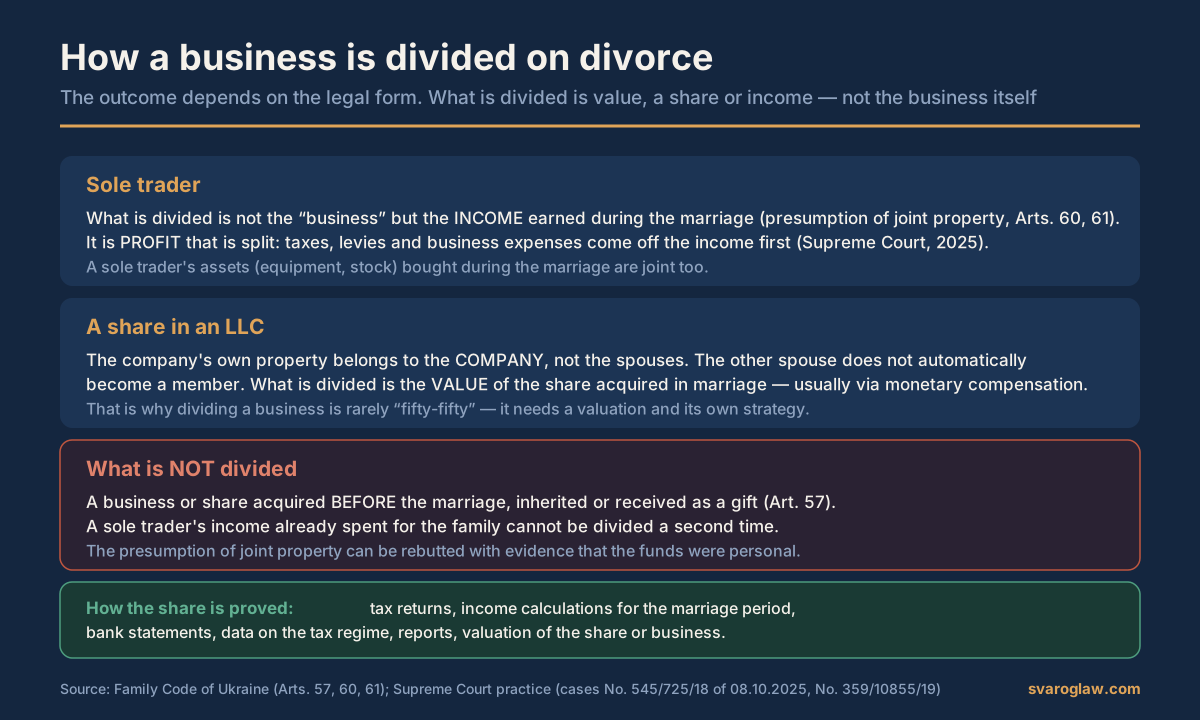
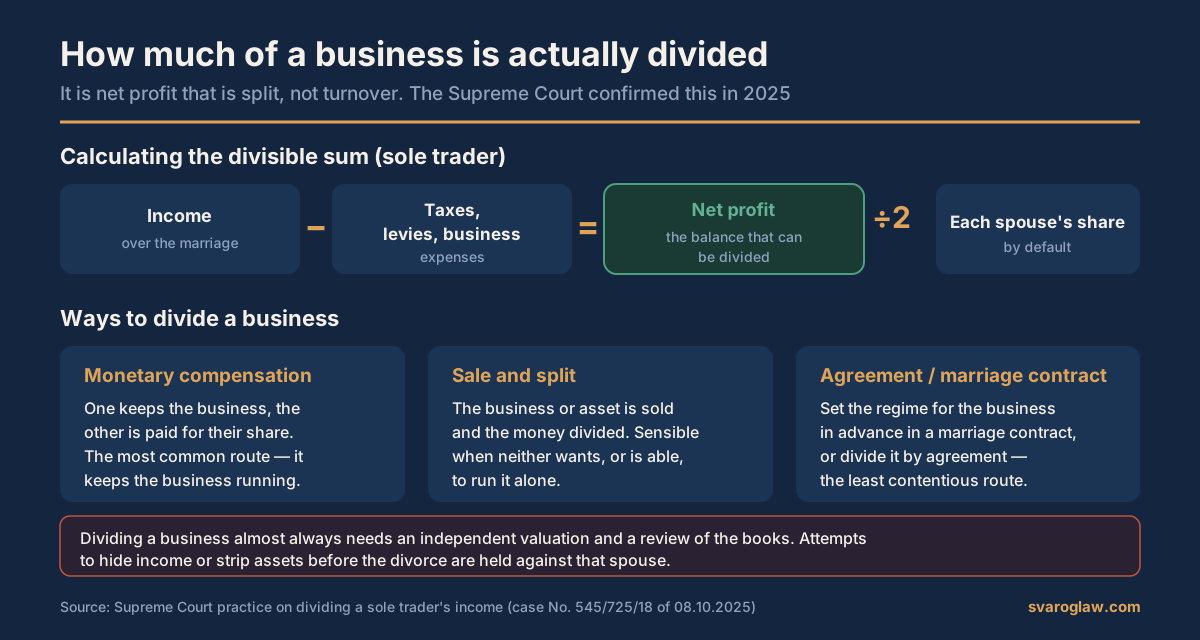
A business created or acquired during a marriage is divisible, but what is divided is its value and its income, not the business itself. From a sole trader’s income you first deduct taxes, duties and the costs of the business, and only the net profit becomes divisible (Supreme Court judgment of 8 October 2025 in case No. 545/725/18). A shareholding in a limited company is usually compensated in money.
Article 60 of the Family Code lays down a presumption: everything spouses acquire during a marriage belongs to them jointly, and registering a sole trader business or a shareholding in one spouse’s name does not rebut it. Shares are presumed equal under Article 70 until one side establishes grounds to depart from that.
What makes dividing a business difficult is that family law here meets company and tax law. The other side often believes they are entitled to half the equipment, the accounts and the company’s property, while the owner believes their spouse “has nothing to do with my business”. Both beliefs are wrong, and the difference between them runs into hundreds of thousands of hryvnia.
Is a business divisible on divorce
The general rule is the same as for a flat or a car: a business created or acquired during the marriage forms part of the joint property whatever the paperwork says. The right to divide arises under Article 69 of the Family Code and does not depend on whether the marriage has been dissolved.
Not divisible is a business acquired before the marriage, or received by one spouse by inheritance or gift (Article 57). The presumption can be rebutted either way, but the burden lies on whoever asserts: documents are needed on the date of acquisition and the source of the money — statements, contracts, the certificate of the right to inherit. General explanations without paper do not persuade a court. More on the rules of division is on the page of our property division lawyer.
Sole traders: the profit is divided, not the turnover
A sole trader is not a separate company but a status held by the person. So “dividing the business” is impossible: there is no share in the register to transfer. What is divided is something else — the income from the business earned during the marriage, and the assets bought for it with joint funds: equipment, stock, vehicles, commercial premises.
The Supreme Court has confirmed that the presumption of joint property extends to a sole trader’s income earned during the marriage. But in its judgment of 8 October 2025 in case No. 545/725/18 it stressed the arithmetic: to arrive at the profit you must deduct from the income the taxes, duties and the costs of production and of buying goods and services, and only what is left can be divided. In retail or haulage the gap between turnover and profit easily reaches 80–90% of the sum, and that is exactly where claims filed by guesswork fail.
A second line of authority concerns money already spent: income that went on the family’s needs during the marriage cannot be divided a second time. If money from the business account paid for renovating the shared flat, half of that sum cannot also be claimed.
A shareholding in a limited company and corporate rights
Here lies the commonest mistake. A limited company’s property (premises, equipment, money in its accounts) belongs to the company, not to its members. The other spouse does not claim the company’s assets directly and does not automatically become a member: the membership changes under the Law “On Limited and Additional Liability Companies” No. 2275-VIII, not by a decision dividing matrimonial property.
What is divided is the value of the shareholding, if it was acquired during the marriage. Most often the question is settled in money: one spouse keeps the shareholding and control, the other receives a sum equal to half its value. A private enterprise is a separate case: in its decision of 19 September 2012, No. 17-rp/2012, the Constitutional Court interpreted Article 61(1) of the Family Code as meaning that the charter capital and the property of a private enterprise are jointly owned by the spouses. Corporate disputes of that scale are run together with our commercial disputes lawyer.
What exactly is divided, by form of business
| Form of business | What is divisible | What is not | Usual way of dividing |
|---|---|---|---|
| Sole trader | the net profit during the marriage, and assets bought for the business with joint funds | the trader status itself, the turnover, and what was spent on the family | a money payment of half the profit, division of equipment in kind |
| A shareholding in a limited company | the value of the shareholding acquired during the marriage | the company’s own premises, accounts and equipment | compensation of half the value on a valuer’s report |
| A private enterprise | the charter capital and the enterprise’s property (Constitutional Court No. 17-rp/2012) | property contributed to the charter capital from personal funds | compensation, or division of the enterprise’s property |
| Shares and securities | securities bought during the marriage and the dividends on them | securities received by inheritance or gift | dividing the holding or compensation at market value |
| A business predating the marriage, inherited or gifted | the increase in value attributable to joint funds or the other spouse’s work | the business itself, as personal private property | compensation for what was contributed, where contribution is proved |
What dividing a business costs
The compensation is fixed by an independent valuation taking account of assets, liabilities, profitability and market value. For a sole trader the calculation is built on the tax returns and primary records for the period of the marriage, adjusted for the tax regime, so such cases almost always involve a court-appointed financial expert.
A claim to divide property is a monetary one, so an individual pays a court fee of 1% of its value, but not less than 1,331.20 and not more than 16,640 UAH in 2026. Filing through the Electronic Court reduces it by 20%. Our fees are on the page of legal service prices: pre-action settlement from 5,000 UAH, procedural documents from 5,000 UAH, one hearing from 3,000 UAH, comprehensive handling of a civil case from 25,000 UAH.
Step by step, with timescales
- Fix the period of the marriage and the dates the business was acquired: the marriage certificate, an extract from the companies and sole traders register, the articles as they stood when the shareholding was acquired. The register extract is generated online the same day.
- Gather the financial base: tax returns for every year of the marriage, income ledgers, bank statements, contracts with counterparties. A lawyer’s request to an authority or a bank is answered within 5 working days.
- Calculate the net profit on the formula from case No. 545/725/18, marking separately the sums spent on the family’s needs. That calculation becomes the core of the claim.
- Commission an independent valuation of the business or the shareholding. A valuer usually takes 2–4 weeks, and without the report the court has nothing to base compensation on.
- Try to close the matter by agreement. A notarised division agreement settles it in one visit, whereas litigation takes months; the options and the risks are worked through at the stage of pre-action settlement of civil disputes.
- If no agreement is reached, file the claim. Mind the deadline: a division claim brought after the marriage is dissolved is subject to a three-year limitation period running from the day the person learned or could have learned of the breach (Article 72). While the marriage subsists, limitation does not apply.
Typical mistakes
- Claiming half the turnover. The court calculates profit after taxes and costs, and an inflated claim means only a larger court fee and a partial dismissal.
- Claiming the company’s assets. “Give me half the company warehouse” is doomed: the warehouse belongs to the company, and what is divisible is the value of the shareholding.
- Waiting for time to pass. Three years after the dissolution go quickly, and limitation, suspended from 2 April 2020, started running again on 4 September 2025 under Law No. 4434-IX.
- Not recording the stripping of assets. If the shareholding was signed over to a relative on the eve of the divorce, or equipment was “sold” for a nominal sum, that must be evidenced at once, not raised on appeal.
- Mixing personal and business accounts. It stops the owner proving that money was personal, and stops the other spouse separating family spending from business spending.
When you do not need a lawyer
If the business is small, the parties are talking calmly and agree on the figure, a notary is enough: a division agreement between spouses is made out of court, and for property the notarial form is mandatory. Nor is representation needed by someone whose business was registered before the marriage and who holds a complete set of documents on where the money came from. A lawyer becomes essential where there is a shareholding in a company, several connected businesses, concealed income, business debts, or where one side demands to be given control; in such cases the outcome rests on the calculation and the valuation. Handling the dissolution itself is described on the page of our divorce lawyer.
Questions and answers
Does my spouse have a right to my sole trader business?
Not to the trader status itself — that cannot be divided or transferred. The right arises over the net profit earned during the marriage and the business assets bought with joint funds.
Is all the income divided, or only the profit?
Only the profit. Taxes, duties and the costs of the business are deducted from the income, and what remains is divisible — as formulated in the Supreme Court’s judgment of 8 October 2025 in case No. 545/725/18.
Can my wife become a co-owner of my company after the divorce?
Not automatically. The division concerns the value of the shareholding, not the company’s membership, which changes under Law No. 2275-VIII. In practice the question is settled in money.
Is a business created before the marriage divisible?
The business itself remains personal property under Article 57. The other spouse may claim compensation if they establish that its value rose substantially thanks to joint funds or their own work.
How is a business valued for division?
Through an independent valuer’s report taking account of assets, debts and profitability, and for a sole trader on the basis of the tax returns for the period of the marriage. In contested cases the court appoints a financial expert.
What if my husband is concealing the business income?
Apply for the returns and bank statements to be produced, gather indirect evidence of the standard of spending, and bring in an expert. Deliberate concealment is weighed by the court against the party responsible for it.
What is the court fee on a claim to divide a business?
1% of the value of the claim, but not less than 1,331.20 and not more than 16,640 UAH for an individual in 2026. Through the Electronic Court it is 20% less.
How long is there to divide property after a divorce?
Three years from the day the person learned or could have learned of the breach (Article 72). While the marriage subsists, limitation does not apply to a division claim.
Can a business be divided without going to court?
Yes, by a division agreement between spouses or by a marriage contract. An agreement concerning property is notarised, and it is the quickest way to keep the business running.
How can a business be protected from division in advance?
By a marriage contract under Articles 92–103 of the Family Code, notarised; by keeping personal and business spending in separate accounts; and by keeping the documents showing where the start-up capital came from.
Sources
- Family Code of Ukraine, Arts. 57, 60, 61, 69, 70, 71, 72, 92–103 — zakon.rada.gov.ua/laws/show/2947-14
- Decision of the Constitutional Court of Ukraine of 19 September 2012 No. 17-rp/2012 — zakon.rada.gov.ua/laws/show/v017p710-12
- Law of Ukraine “On Limited and Additional Liability Companies” No. 2275-VIII — zakon.rada.gov.ua/laws/show/2275-19
- Law of Ukraine “On Court Fees” No. 3674-VI — zakon.rada.gov.ua/laws/show/3674-17
- Supreme Court judgment of 8 October 2025 in case No. 545/725/18 (division of a sole trader’s income)
Dividing a business with Svarog
Send us the form of the business, the dates of registration and of the marriage, and the returns for the years in dispute — we will calculate what is genuinely divisible, prepare the agreement or the claim, and defend the position in court, whether you own the business or are claiming a share. Related services: property division, family law, full price list.
+38 095 554-54-24 · Kyiv, 7 Khoriva Street (Podil) · Mon–Fri 9.00–18.00