A court hearing a challenge to a military medical board’s finding does not make a diagnosis and does not determine fitness. It reviews the procedure of the examination: whether the board was properly constituted, whether the examinations required by Regulation No. 402 were carried out, whether the discharge summaries and specialist opinions you submitted were taken into account, and whether the certificate or illness record was drawn up correctly.
So in this category of case what wins is evidence of procedural breaches, not a description of how you feel. The typical ground for setting a finding aside is that the examination was incomplete — without the mandatory laboratory and imaging investigations, or without a relevant specialist, although the diagnosis required one.
A medical board lawyer turns your medical records into procedural arguments, and does so within deadlines counted in months and sometimes in days.
The findings the board issues now
The status “fit with limitations” has been abolished by Law No. 3621-IX (from 4 May 2024). The board now issues one of the following findings:
Four categories
- fit for military service, including in combat units;
- fit for service in support units: rear services, logistics, signals, training centres, recruitment centres, medical units (this is what replaced “fit with limitations”);
- temporarily unfit: requires treatment followed by a re-examination;
- unfit for military service with removal from the register: not subject to mobilisation.
Those who held the old status “unfit in peacetime, fit with limitations in wartime” were required to undergo a re-examination. If you have not done so, that is a separate risk, and we assess it together with the medical board question.
When a board’s decision is worth challenging
If the examination was complete, all the documents were taken into account, and the finding matches the Schedule of Diseases, a challenge has no prospect. We say so at the consultation, after comparing the board’s certificate with your medical records.
There is a prospect where:
- the examination was incomplete: the mandatory investigations (MRI, CT, laboratory tests) required by Regulation No. 402 were not carried out;
- no relevant specialist was present: you have a heart condition and there was no cardiologist on the board;
- your medical records were ignored: discharge summaries, specialists’ opinions, test results;
- the wrong article of the Schedule of Diseases was applied;
- the causal link was wrongly established: a combat injury recorded as “domestic” or as an “illness unconnected with service”. Pay and status depend on it;
- there are errors in the documents: in the personal details, the dates, the wording of the category, the date of re-examination;
- no copy of the finding was issued, or you were not allowed to record objections.
Challenges run in both directions: where someone with a serious illness has been found fit, and where someone fit has been found unfit, which blocks the decision you need (discharge, transfer, return to service).
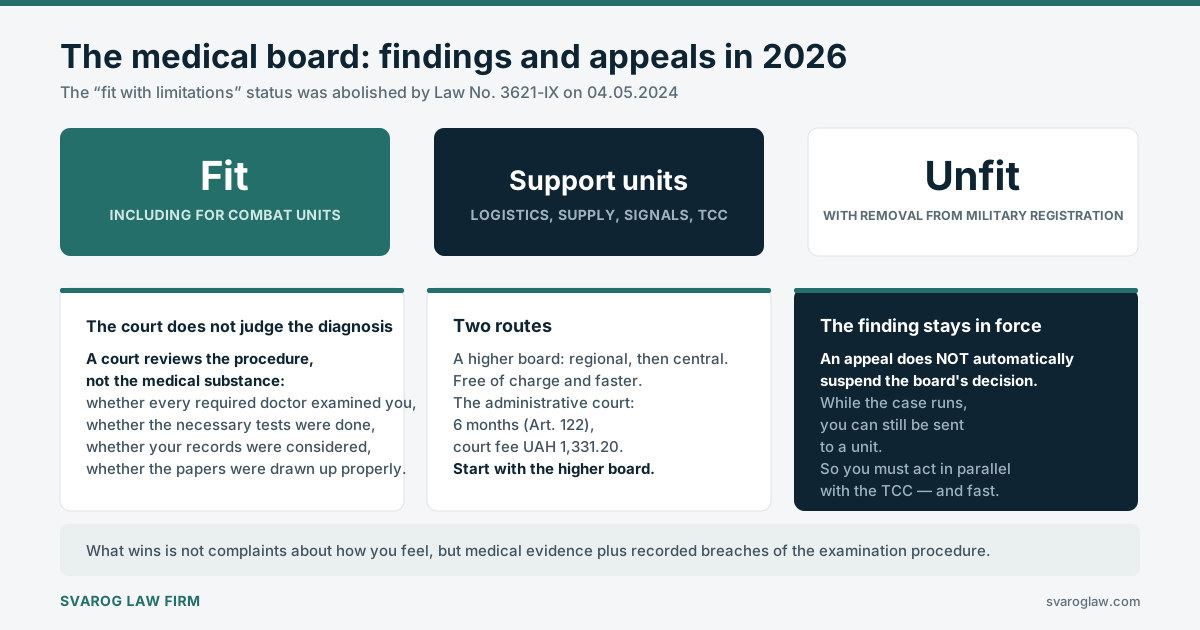
Two routes of challenge
Out of court: to the superior board
about a monthThe complaint goes to the board at the next level up: against a decision of the board at a district or city recruitment centre, to the regional board; against a regional board’s decision, to the Central Medical Board.
The complaint encloses a copy of the finding challenged, all the medical records, and a copy of your registration document. It is submitted in person or by insured post with an inventory of the contents.
In court: an administrative claim
from 3 monthsA medical board exercises public authority, so its decisions are challenged under the Code of Administrative Procedure.
- Deadline: 6 months from the day the person learned of the breach of their right (Art. 122 CAP). If you first complained to the superior board, the deadline is different: 3 months from service of the decision on the complaint (Art. 122(4) CAP).
- Court fee: 0.4 of the subsistence minimum, that is 1,331.20 UAH in 2026; 1,064.96 UAH through the Electronic Court.
- What the court reviews: the lawfulness of the procedure, not the medical substance of the finding.
What decides the case
The court assesses documents:
The evidence
- discharge summaries, MRI and CT results, test results;
- opinions of independent specialists;
- breaches recorded in writing during the examination: an argument in the room has no legal effect;
- a copy of the board’s certificate or the illness record: ask for it immediately, it is your key document;
- evidence that your documents were not taken into account.
The first thing we advise: get a copy of the finding and put everything in writing before you even come to a lawyer.
Deadlines that are not restored without good reason
Medical board cases are most often lost on the calendar rather than on the medicine. Three deadlines we check at the first meeting:
Three deadlines
- 6 months for an administrative claim from the day you saw the finding. The court restores the deadline only for valid reasons (inpatient treatment, being in a combat zone), and each must be evidenced.
- 3 months for a claim after the superior board answers your complaint. Many people wait for “one more letter” and miss it.
- The date of re-examination in a “temporarily unfit” finding. Failing to attend without a documented reason has its own consequences for your registration.
We also watch the date of service: time runs from when you saw the document, so the receipt for the copy of the finding must be dated.
A case from our practice
At the end of 2025 a man of 42 came to us whom the board at the district recruitment centre had found fit for service, although he had a documented cardiac condition with two hospital admissions in the previous year. There was no cardiologist on the board, no ECG or echocardiogram was performed, and the hospital discharge summaries never reached the certificate. We obtained a copy of the finding by lawyer’s request, prepared a complaint to the regional board enclosing the summaries and an independent cardiologist’s opinion, and at the same time notified the recruitment centre in writing that the decision was under challenge. The regional board set the finding aside and ordered a re-examination, after which he was found fit for service in support units. About two and a half months passed from the first approach to the new finding; the client’s costs were the fees for the consultation, the complaint and attendance at the examination, and the case never reached court (details changed).
How we work
- We analyse the finding and the medical records, looking for the gap between your condition and the board’s wording.
- We record the procedural breaches: the composition of the board, the scope of the examination, whether documents were considered.
- We prepare the complaint to the superior board, as the quicker route.
- We attend the repeat or control examination.
- We prepare the administrative claim if the out-of-court route fails.
- We work in parallel to make sure you are not sent to a unit while the challenge is pending.
Cost of services
Court fees in 2026: a claim in the administrative court to set aside a board’s finding costs 0.4 of the subsistence minimum, that is 1,331.20 UAH, or 1,064.96 UAH through the Electronic Court. A complaint to the superior board is free. If the claim succeeds, the fee is recovered from the defendant.
Questions and answers (medical board lawyer)
Can a board’s finding be challenged once I am already with a unit?
Yes. Being posted to a unit does not remove the right to complain to the superior board or to go to court. The complaint can be sent by post or through a representative under a power of attorney, and a serving member additionally has the right to a re-examination on a report through their commander.
What if the six months for a claim have already passed?
The claim is filed together with an application to restore the deadline, supported by evidence of a valid reason: inpatient treatment, being on position, late service of the copy of the finding. Without documents the court will not restore it. If it cannot be restored, the remaining route is a re-examination on fresh medical evidence, and the new finding can then be challenged from the beginning.
Should I undergo new investigations before challenging?
Preferably. Fresh MRI or CT results, or a specialist’s opinion dated after the board’s examination, show that your condition does not match the finding and are grounds for a control examination. Older summaries are also taken into account, but they are easier to dismiss as out of date.
Can the case be handled remotely?
Yes. You send the documents by messenger or email, we send the complaint to the board by insured post, we file the claim through the Electronic Court, and hearings in administrative courts are mostly held by video. You need to attend in person only for the control examination.
How long does a challenge take?
A complaint to the superior board is usually decided within a month, and the control examination takes a few weeks more to arrange and attend. The court route is longer: first instance in the district administrative court takes from three months, depending on the court’s workload and whether further documents are called for.
Can I complain to the superior board and sue at the same time?
The law does not formally prohibit it, but the court may stay the case pending the out-of-court decision, and the superior board’s decision will change the subject matter of the dispute. It is more practical to start with the complaint and prepare the claim in parallel, so that it can be filed as soon as the board answers, within the three-month deadline.
Contact a Svarog medical board lawyer
Send us the board’s finding and your medical records. We will compare them, find the procedural breaches, tell you where to complain and what the chances are — and if the examination was properly conducted and the finding is sound, we will tell you that too, so that you do not spend time and money.