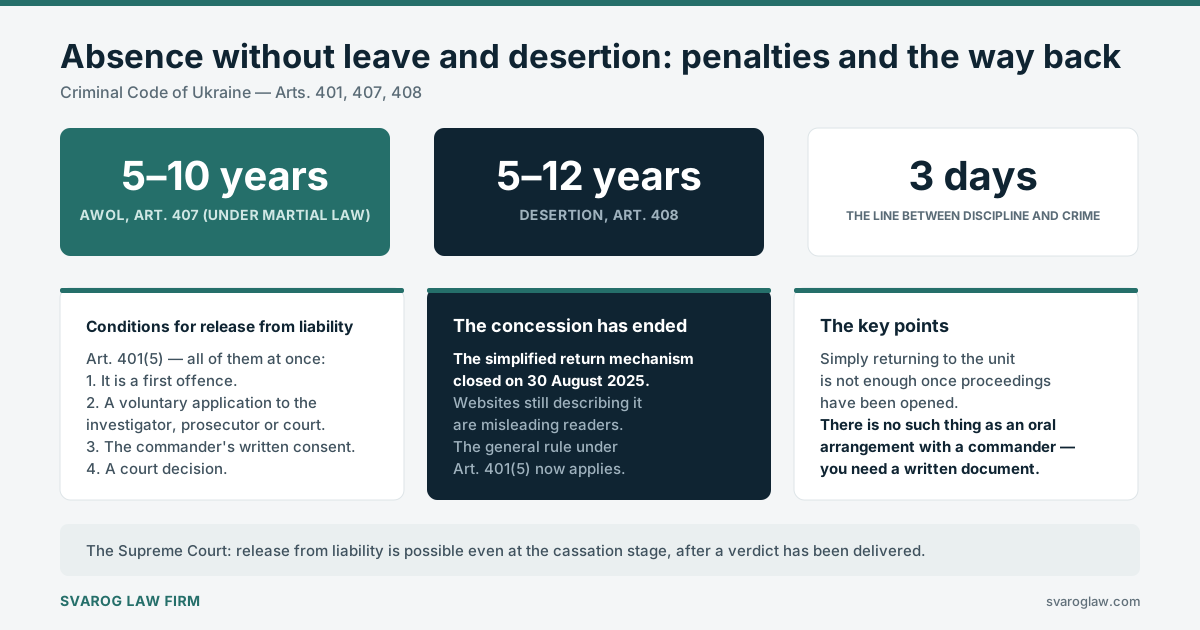
The penalty under Art. 407 of the Criminal Code during martial law is five to ten years’ imprisonment, and under Art. 408 (desertion) five to twelve years. That means actual imprisonment, not a suspended sentence: in cases of absence without leave during martial law the courts impose exactly those penalties, and the scope for a lighter sentence is severely limited.
The lawyer’s task is to assemble those three elements in the right order and the right form: the application, the commander’s letter, the court’s ruling. An oral understanding with a commander has no legal effect; a signed document is required.
What changed in 2025–2026
The simplified route back closed on 30 August 2025. Law No. 4392-IX allowed a service member to report to a designated unit and receive the commander’s decision within 72 hours. That window no longer exists, and sites still describing it are misleading people.
What applies now is the general procedure under Art. 401(5) CC (Law No. 3902-IX, in force since 7 September 2024): a voluntary application → the commander’s written consent → a court ruling releasing the person from criminal liability.
Each successive stage of the case narrows the options: once a search has been declared it is harder to show the return was voluntary, and once a notice of suspicion has been served some commanders refuse consent.
Absence without leave or desertion: the difference
Unauthorised absence from the unit. Temporary avoidance: the service member is absent without valid reason but did not intend to avoid service for good.
Desertion. The difference is the direct intention to avoid military service permanently. The penalty is heavier.
That line is the defence’s main battleground. Showing there was no intention to avoid service permanently — the person was receiving treatment, caring for a relative, looking for a way back, staying in touch with the unit — keeps the case within Art. 407.
Valid reasons (serious illness with hospital admission, the death of a close relative, a natural disaster) can exclude the offence altogether, but only where they are documented: a discharge summary, a death certificate, a certificate about the emergency.
The mechanism for release from liability
The conditions under Art. 401(5) CC, all at once:
- the offence under Art. 407 or 408 CC was committed for the first time;
- a voluntary application to the investigator, the prosecutor or the court stating the intention to return to service;
- the written consent of the commander of a unit — your own or another — to your continuing to serve, the so-called letter of acceptance;
- a court ruling releasing you from criminal liability.
A second absence: the mechanism does not apply. There the defence rests on other things: the classification, mitigating circumstances (Art. 66 CC), work on the length of the sentence.
The Supreme Court has decided cases in which release under Art. 401(5) CC was granted after conviction, on appeal and in cassation. So a conviction does not always mean the end, and we assess each such case separately in the light of current practice.
The route back
- Establish the procedural position: whether criminal proceedings exist, whether a search has been declared, whether a notice of suspicion has been served. That determines whom to apply to and how much time there is.
- Find a unit willing to take you, your own or another, and obtain the commander’s written consent. Without that document the mechanism does not work.
- File the application with the investigator, the prosecutor or the court, stating the intention to continue serving.
- The court hearing: the court verifies that the offence is a first one, that the application is voluntary, and that the commander has consented.
- The ruling releasing you from criminal liability and closing the case.
- Actually reporting to the unit, with pay, status and social guarantees restored.
Simply turning up at the unit is not enough once proceedings have been opened. Reporting in without a procedural application does not remove the criminal risk.
Why delay narrows the options
While a person is “thinking about it”, the case follows its usual course: suspicion → search → preventive measure → indictment → judgment. At each successive stage there are fewer options, and finding a unit and agreeing the commander’s letter usually takes two to six weeks.
Voluntariness is a legal category. It works before the person is found. If a service member has been detained, a “voluntary return” no longer looks voluntary, and the court sees that in the file.
Typical mistakes before people come to us
- Returning “informally” without an application: the person reports to the unit while the case under Art. 407 CC carries on towards trial, because procedurally nobody stopped it.
- An oral consent from the commander. The court accepts only a written letter with a signature and the unit’s stamp; a phone call or a message is not consent.
- Explanations to the investigator without a lawyer. The words “I was not going to come back”, said in the heat of the moment, later become the basis for a charge under Art. 408 CC.
- Lost evidence of a valid reason. Keep discharge summaries, certificates and tickets from the first day of absence.
- Waiting for “a new amnesty”. The simplified route under Law No. 4392-IX ended on 30 August 2025, and no law in force provides for another window.
A case from our practice
In 2025 the wife of a mobilised soldier came to us: after a wound and treatment he had not returned to his unit and had been absent for about six weeks; a case under Art. 407(5) CC was already open, but no search had yet been declared. By lawyer’s request we established the state of the case, gathered the medical records of his rehabilitation, and within three weeks obtained the written consent of the commander of another brigade that needed a specialist in his trade. We filed the application under Art. 401(5) CC with the investigator, and the first-instance court closed the case, releasing him from criminal liability. About two months passed from the first approach to the ruling; the fees covered the consultation, the legal opinion, attendance at investigative actions and court representation, a little over 30,000 UAH in total (details changed).
What the lawyer does
The scope of work
- establishes your position through lawyer’s requests: people often do not know whether a case exists against them;
- keeps the charge within Art. 407 CC, resisting reclassification to Art. 408;
- finds a unit and obtains the commander’s written consent: a separate task, and often the hardest;
- prepares the application under Art. 401(5) CC and appears at the hearing;
- gathers evidence of valid reasons: medical records, witness statements, certificates, a relative’s death certificate;
- defends on a second absence: the classification, mitigating circumstances, the length of the sentence;
- appears on appeal and in cassation, including where a conviction already exists.
Cost of services
Court fees in 2026: no court fee is payable in criminal proceedings for filing an application or an appeal against a judgment. The client’s costs consist of the legal fee and, where needed, expert reports or lawyer’s requests.
Questions and answers (lawyer for unauthorised absence)
Can the case be handled while I am abroad?
Establishing the state of the case, gathering documents and finding a unit willing to take you can all be done remotely, through a lawyer under an engagement and a power of attorney. But release under Art. 401(5) CC requires an actual return to service, so the court will assess how real the intention is, and crossing the border during martial law may itself become a matter for examination.
What if I have been absent for less than three days?
An absence of up to three days without valid reason is usually treated as an administrative offence under Art. 172-11 CAO or as a disciplinary matter, not as a crime. The exception is a repeat absence within a year, which can fall under Art. 407 CC even over a shorter period. Either way, report back at once and document the reason for the absence.
Can I return to a different unit rather than my own?
Yes, Art. 401(5) CC expressly allows the consent of the commander of your own or another unit. In practice it is often another unit, one that needs a specialist in your trade, that agrees, and after the court’s ruling the transfer is effected by order.
Does a ruling releasing me from liability affect my criminal record and my pay?
Release from criminal liability is not a conviction, so no criminal record arises. Pay is not calculated for the period of absence, and once you report to the unit pay, status and social guarantees resume from the date of the actual return to service.
What should I do if I have already been detained?
Give no explanations without a lawyer, and tell your family to instruct one. Voluntariness is harder to establish, but the chance of keeping the charge under Art. 407 CC and obtaining the commander’s consent remains, and the preventive measure can be challenged.
How long does the Art. 401(5) procedure take?
The longest stage is finding a unit and obtaining the commander’s written consent, usually two to six weeks. The hearing of the application at first instance takes a few weeks more, depending on the stage of the case and the court’s workload; in all, expect one to three months.
Contact Svarog about unauthorised absence
Tell us what happened. We will establish your procedural position, assess whether the release mechanism is available, and start with the hardest part: finding a unit and obtaining the commander’s written consent. Every week of delay leaves fewer options.