A financial services and disputes lawyer works where the cost of a mistake is measured not in a fine but in the right to stay in business: failing the requirements on capital, ownership structure or managers’ business reputation gives the National Bank grounds to apply enforcement measures up to withdrawal of the licence under the Law “On Financial Services and Finance Companies” (No. 1953-IX).
We act for companies that provide financial services and for businesses that buy those services or structure transactions on the financial market, and we run the disputes: debt recovery, challenges to assignment agreements, conflicts with a factor and with the regulator. The Law “On Factoring” No. 4466-IX took effect on 30 July 2026, so existing agreements and finance companies’ internal documents are now assessed against it.
Areas of work
Finance companies
- Registration of a factoring company: requirements on capital, ownership structure and managers’ reputation;
- obtaining licences and permits, handling dealings with the regulator;
- bringing operations into line with Law No. 1953-IX and the Factoring Law No. 4466-IX.
Factoring
- Bank factoring;
- Factoring with recourse;
- structuring factoring agreements, assessing the risks for both sides.
Deals and investment
- Legal review of a company (due diligence) before a deal;
- Purchase of a company’s assets: structuring the deal, protecting the buyer;
- support for an investor entering the capital, shareholders’ agreements.
Debts and claims
- Purchase of debts and assignment of claims;
- Debt recovery;
- Insolvency of a legal entity.
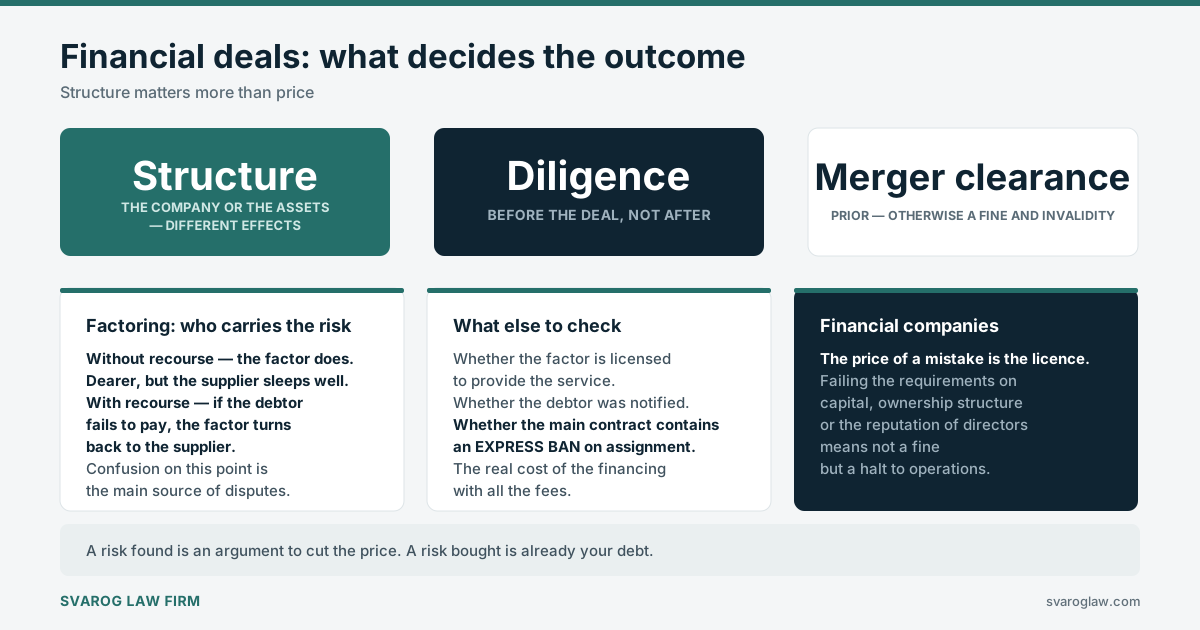
What decides the outcome in financial transactions
Structure matters more than price
Buying a company with its debts and buying its assets are two different deals with different consequences, and that difference often exceeds the price of the deal itself. In the first case tax assessments, litigation and obligations to creditors pass to the buyer; in the second, only the property does.
Checking before signing
A risk you find becomes an argument for a lower price; a risk you buy becomes the buyer’s debt.
Antitrust clearance
A concentration needs prior clearance if the combined value of assets or turnover of the parties for the last financial year exceeds 30 million euro and at least two of them each exceed 4 million euro of those figures in Ukraine (Art. 24 of the Law “On Protection of Economic Competition”). A deal without clearance brings a fine and the risk of being declared invalid.
Protection in the contract
Template contracts usually leave the buyer without three things: the seller’s warranties on tax liabilities and the absence of hidden debts, an indemnity for breach of those warranties, and retention of part of the price until agreed conditions are met. Conditions precedent also work, where payment is made only once encumbrances are released or the regulator’s clearance is obtained.
Factoring: what to check in the agreement
Factoring is financing against the assignment of a monetary claim: the supplier receives the money at once, without waiting for the buyer to pay.
The key question is who bears the risk of non-payment:
The risk is the factor’s, the financing costs more, but the supplier keeps the money for good.
Factoring with recourse: if the debtor does not pay, the factor turns back to the supplier, so the cheaper rate is offset by the risk retained.
Confusion on exactly this point produces most of the disputes, so we read the agreement starting from the recourse section.
We also check whether the factor is entitled to provide the service according to the National Bank register, whether the debtor has been notified of the assignment, what the financing really costs once all the fees are counted, and how the costs of recovery are allocated.
A ban on assignment in the underlying contract does not block factoring: under Art. 1080 of the Civil Code a factoring agreement is valid even where the client and the debtor have agreed to prohibit or restrict assignment. The client remains liable to the debtor for breaching that term, so the risk stays contractual and does not destroy the deal itself.
Financial disputes
Disputes in this category rarely look like “simple debt recovery”. More often they concern the validity of an assignment agreement, the scope of the claim assigned, the fees and penalties charged by a factor, or a challenge to the regulator’s decisions on a licence or enforcement measures.
Such cases are heard by the commercial courts, and disputes with the National Bank by the administrative ones. The respondent’s first argument is usually limitation: the general period is three years, shorter for certain claims. Note that limitation, suspended from 2 April 2020, resumed on 4 September 2025, so time is running again on older claims.
When your own in-house lawyer is enough
A standard deal with a known counterparty for a modest sum, on a template contract you have used before, needs no outside support: a check of the counterparty against the public registers will do.
A lawyer is needed when:
- you are buying a business or taking an equity stake;
- you are setting up a finance company or obtaining a licence;
- you are entering a factoring agreement and are not sure who bears the risk of non-payment;
- the deal requires antitrust clearance;
- you are buying a portfolio of debts;
- the counterparty has debts, litigation or signs of insolvency;
- the regulator has applied enforcement measures and the decision has to be challenged.
A case from our practice
In 2025 a manufacturing company came to us intending to buy a competitor together with its legal entity. During the legal review we found in the registers an unresolved tax dispute and several suretyship agreements under which the company answered for the obligations of a related firm. We proposed changing the structure: instead of buying corporate rights, the purchase was documented as an acquisition of production equipment and trade mark rights, with part of the price retained until the encumbrances were released. The deal went ahead, the seller’s debts did not pass to the buyer, and the tax dispute stayed the former owner’s problem. The review and the negotiations took about two months (details changed).
Cost of services
Court fees 2026: a company’s monetary claim in the commercial court — 1.5 % of the value of the claim, but not less than 3,328 and not more than 1,164,800 UAH. A company’s non-monetary claim, in particular to declare a contract invalid or to set aside a regulator’s decision, is charged at one subsistence minimum — 3,328 UAH. Filing through the Electronic Court multiplies the rate by 0.8.
Calculate the court fee for a commercial claim
A company’s non-monetary claim costs a flat 3,328 UAH.
Questions and answers (Financial services and disputes)
Can a finance company start work before it is entered in the National Bank register?
No. Providing financial services without the relevant status and licence brings enforcement measures from the National Bank, and the agreements made become vulnerable to challenge. Until the licence is obtained the company may enter only ordinary commercial contracts.
How long does a review of a company take before a deal?
A focused review of specific risks takes from two weeks; a full review of a group of companies with real estate and licences, several months. We agree the scope and the timing in advance: they determine both the cost and the list of registers and underlying documents.
What if the factor has charged fees that were not in the agreement?
First a written demand with a calculation and a reference to the specific clauses, then a formal claim for the return of what was charged without basis. If the factor stands its ground, the dispute goes to the commercial court, and at that stage the underlying documents decide it: acceptance acts, claim registers, bank statements.
Can an individual’s debt be bought?
Yes, but three things are checked before the purchase: whether the debt exists on the underlying documents, whether limitation has run, and whether the debtor has property or income. An overdue claim against someone with no assets has no real value, however deep the discount.
Can a National Bank decision applying an enforcement measure be challenged?
Yes, in administrative proceedings. The deadline for applying is short, so the decision is analysed as soon as it arrives, and an application for interim relief usually goes in with the claim so that the measure is not enforced before the case is heard.
Did the Factoring Law No. 4466-IX change existing agreements?
Agreements made earlier do not terminate automatically, but from 30 July 2026 a factor’s activity, its disclosure and the procedure for assignment are assessed under the new rules. So internal documents and standard contract forms are worth reviewing even if the portfolio has not changed.
Contact a Svarog financial services and disputes lawyer
Send us the draft contract or the details of the company you plan to deal with. We will check the risks against the public registers and tell you what is worth changing in the structure of the deal before signing. After signing there is far less that can be done, and the cost of putting it right goes up.