
The key thing to understand about appealing against a Medical Examination Commission (VLK) decision is that the court does not assess your diagnosis or determine your fitness for service. It reviews the procedure: whether you were examined by all the required doctors, whether the prescribed tests were carried out, whether the documents were completed correctly, and whether the medical reports you provided were taken into account.
This is precisely why cases are won not by complaints about one’s state of health, but on the basis of procedural irregularities. A telling example: in February 2026, the Mykolaiv District Administrative Court overturned the Medical Examination Commission’s decision because the examination had not been carried out in full — the mandatory laboratory and diagnostic tests required by Regulation No. 402 had not been performed.
You need a specialist lawyer for Medical Examination Commission cases to turn your medical documents into legal arguments — and to do so within the time limits, which are fast approaching.
+38 095 554-54-24 — legal advice
What conclusions does the Medical Examination Commission currently reach?
The status ‘limited fitness’ has been abolished by Law No. 3621-IX (with effect from 4 May 2024). The commission now issues one of the following conclusions:
- fit for military service — including in combat units;
- fit for service in military support units — rear services, logistics, communications, training centres, technical training centres, medical units (this is what has replaced ‘limited fitness’);
- temporarily unfit — requires treatment, followed by a re-examination;
- unfit for military service with removal from military registration — not subject to mobilisation.
Individuals who previously held the status ‘unfit in peacetime, limitedly fit in wartime’ were required to undergo a re-examination. If you have not done so, this constitutes a separate risk and must be assessed alongside the Medical Examination Commission’s decision.
When should a Medical Examination Commission decision be appealed?
Not every decision. To be honest: if the examination was carried out in full, all documents were taken into account, and the conclusion complies with the Schedule of Diseases — there is no point in taking legal action.
An appeal has a chance of success when:
- the examination was not carried out in full — mandatory tests (MRI, CT, blood tests) stipulated by Regulation No. 402 were not performed;
- there was no specialist doctor — you have heart problems, but there was no cardiologist on the panel;
- your medical records were ignored — discharge summaries, doctors’ reports, test results;
- the relevant article of the Schedule of Diseases was incorrectly applied;
- the causal link was incorrectly established — a combat injury was recorded as ‘domestic’ or ‘an illness not related to military service’. This directly affects your benefits and status;
- errors in the documents — in the data, dates, wording of the category, or review periods;
- you were not issued a copy of the report or were not allowed to submit comments.
You can appeal in both directions: both when an unfit person has been deemed fit, and vice versa — when the conclusion prevents the decision you require.
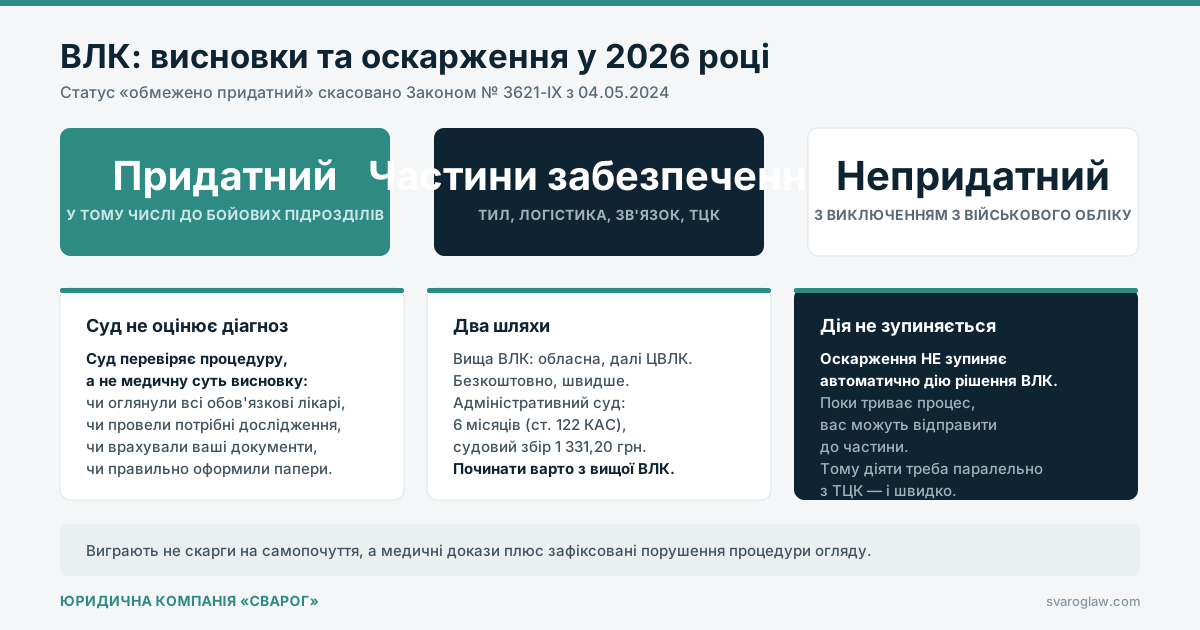
Two avenues of appeal
Pre-trial — to the higher Medical Examination Commission
The appeal is lodged with the higher-level commission: against a decision of the Medical Examination Commission at a district or city Military Registration and Enlistment Office — to the regional Medical Examination Commission, against a decision of the regional commission — to the Central Medical Examination Commission of the Ministry of Defence.
The following must be attached to the appeal: a copy of the contested decision, all medical documents, and a copy of the military registration document. It must be submitted in person or by registered post with a list of contents.
This is the quicker and simpler route, and it is advisable to start with it. The outcome is the overturning of the decision and the scheduling of a repeat (follow-up) examination.
Court proceedings — administrative claim
The Medical Examination Commission is a public authority, so its decisions are appealed under the rules of the Code of Administrative Procedure.
- Time limit — 6 months from the date on which the person became aware of the violation of their right (Article 122 of the Code of Administrative Procedure).
- Court fee — 0.4 times the minimum subsistence level, i.e. 1,331.20 UAH in 2026.
- What the court examines — the legality of the procedure, not the medical substance of the conclusion.
Critically important: an appeal does not automatically suspend the effect of the Medical Examination Commission’s decision. This means that whilst the proceedings are ongoing, you may be sent back to your unit. Therefore, in parallel with the appeal, you must work with the Territorial Medical Commission and, if necessary, apply for interim relief.
What decides the case
Not emotions, but evidence:
- extracts from medical records, MRI and CT scan results, and test results;
- opinions from independent specialist doctors;
- written records of any irregularities observed during the examination — a verbal outburst in the examination room has no legal standing;
- a copy of the Medical Examination Commission’s report or the medical certificate — request this immediately; it is your key document;
- evidence that your documents were not taken into account.
Therefore, our first piece of advice is: obtain a copy of the report and record everything in writing — even before consulting a solicitor.
When a solicitor is not needed
If the examination was carried out thoroughly, all documents were taken into account, and the report accurately reflects your actual condition — there is nothing to challenge. And that is exactly what we will say.
You need a lawyer specialising in medical assessment committees when:
- the report does not correspond to your medical records;
- the examination was carried out in a perfunctory manner — without tests or specialist doctors;
- the causal link between the injury and your service has been incorrectly established;
- you were refused a copy of the report;
- you are a serving member of the armed forces, and your discharge or transfer depends on the report;
- the deadline is approaching, and you do not know where to lodge a complaint.
How we work
- We analyse the report and medical documents — looking for discrepancies between your condition and the commission’s findings.
- We identify procedural irregularities — the composition of the commission, the scope of examinations, and the consideration of documents.
- We prepare an appeal to the higher Medical Examination Commission — this is the quickest route, and we usually start with it.
- We accompany you to a re-examination or follow-up examination.
- We prepare an administrative claim if the pre-trial route has not been successful.
- We provide parallel legal defence — to ensure you are not sent back to your unit whilst your appeal is being considered.
Cost of services
| Service | Price |
|---|---|
| Consultation with analysis of the Medical Examination Commission’s report | from 1,500 UAH |
| Legal opinion: assessment of the prospects of an appeal | from 5,000 UAH |
| Preparation of an appeal to the Higher Medical Examination Commission or the Central Medical Examination Commission | from 5,000 UAH |
| Preparation of a statement of claim and procedural documents | from 5,000 UAH |
| Attendance at one court hearing | from 3,000 UAH |
| Legal representation in court | from 10,000 UAH |
| Comprehensive ‘turnkey’ representation in administrative cases | from 30,000 UAH |
Court fee: 1,331.20 UAH (0.4 times the minimum subsistence level in 2026). Appeals to the Higher Medical Examination Commission are submitted free of charge.
Full price list · Lawyer specialising in mobilisation
Questions and answers (Medical Examination Commission lawyer)
Does the ‘limited fitness’ status still exist?
No, it was abolished by Law No. 3621-IX with effect from 4 May 2024. It has been replaced by the classification ‘fit for service in military support units’ — rear services, logistics, communications and training centres.
Where can I lodge a complaint against a Military Medical Commission decision?
To a higher-level commission: for a decision by the Military Medical Commission (MMC) attached to the Territorial Medical Commission (TMC) — to the regional MMC; for a decision by the regional MMC — to the Central MMC. In parallel with this or afterwards — to the administrative court.
Does an appeal suspend the effect of the MMC’s decision?
No, it does not automatically suspend it. This is crucial: whilst the appeal is ongoing, you may be sent to a military unit. You must therefore act quickly and resolve the issue with the Territorial Medical Commission at the same time.
Does the court assess my diagnosis?
No. The court checks the legality of the procedure: whether you were examined by all the necessary doctors, whether the mandatory tests were carried out, and whether the documents were drawn up correctly.
The court does not re-evaluate the medical substance of the conclusion.
How much does a judicial appeal against the Medical Examination Commission cost?
The court fee is 1,331.20 UAH (2026). Plus the lawyer’s fee. An appeal to the Higher Medical Examination Commission is free of charge.
What is the time limit for a judicial appeal?
Six months from the date on which you became aware of the infringement of your rights (Article 122 of the Code of Administrative Procedure). However, you should not delay: the sooner you act, the better your chances of a successful defence.
What should you do if you are not provided with a copy of the Medical Examination Commission’s report?
Request it in writing. Failure to provide a copy is in itself a breach and an additional ground for appeal. We will submit a solicitor’s request.
Can I appeal the report if I have been deemed fit for service but I have a serious illness?
Yes, and this is the most common type of case. You will need medical evidence: hospital discharge summaries, MRI scans, CT scans, reports from specialist doctors – and proof that the Medical Examination Commission did not take these into account.
What documents should I bring to the consultation?
A copy of the Medical Examination Board’s decision (a medical certificate or statement of illness), all medical documents, your military registration document, the referral to the Medical Examination Board, and any written correspondence with the board.
Contact a lawyer specialising in Medical Examination Board cases at Svarog
Send us the Medical Examination Commission’s report and your medical documents — we will compare them, identify any procedural irregularities and advise you on where to lodge a complaint and what your chances are. If the examination was conducted in accordance with the rules and the report is well-founded, we will tell you that too, without wasting your time or money.
+38 095 554-54-24 · Kyiv, 7 Khoriva Street, Office 2 (Podil) · Mon–Fri 9:00–18:00