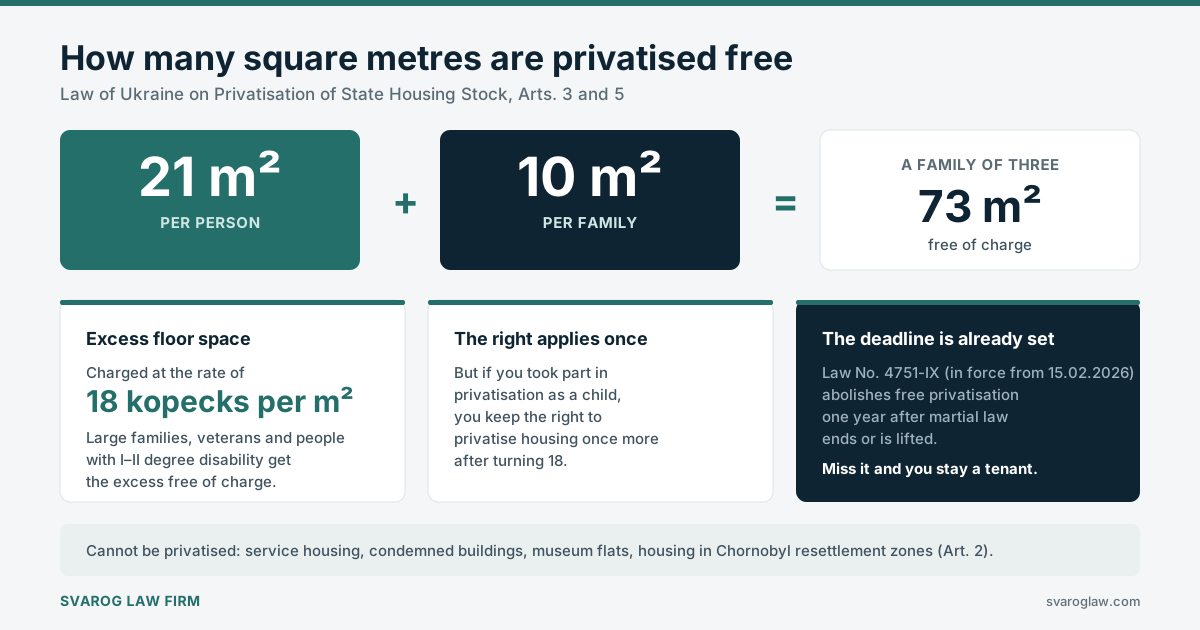
On 15 February 2026 the Law “On the Fundamentals of Housing Policy” (No. 4751-IX) came into force. It repeals the Housing Code of the Ukrainian SSR and the Law “On Privatisation of the State Housing Stock”, under which for more than 30 years people have taken their homes into ownership free of charge. The provisions ending free privatisation take effect one year after martial law ends or is lifted (Chapter IV of Law No. 4751-IX).
What that means in practice: privatising a flat is still free today, but the window is closing. Anyone who does not make it will remain a tenant: the home can be lived in, but not sold, given away or bequeathed. The archives already have queues, because some records are inaccessible or need to be reconstructed.
We handle privatisation end to end: we check the entitlement, recover lost occupancy warrants and technical passports, prepare the file, and if the privatisation office refuses, challenge the refusal in court.
Who is entitled to privatise a home
The right belongs to Ukrainian citizens lawfully and permanently living in state or municipal housing under an occupancy warrant or a tenancy agreement. The right is exercised together with the tenant by every family member registered at the address, including minor children.
If the flat is larger, the excess area is paid for at the rate the privatisation office calculates; in practice the sum is nominal. Privileged categories (large families, veterans, people with disabilities of groups I and II) receive the excess area free of charge.
The right to free privatisation may be used once Art. 5(5) of Law No. 2482-XII. There is an exception for those who took part in a privatisation as minors: they keep the right to privatise a home again after turning 18. It is because of this that people spend years wrongly believing they have already used their right.
What cannot be privatised
Not subject to privatisation Art. 2 of Law No. 2482-XII:
- Museum flats.
- Housing in the zones of unconditional and mandatory resettlement after the Chornobyl accident.
- Service flats: a separate category, and the usual starting point for litigation.
- Housing declared unfit.
- Flats in closed military settlements and on the premises of closed enterprises and institutions.
- Rooms in hostels: they are privatised under a separate law (No. 500-VI), with a different procedure and its own restrictions.
It is worth checking the status of the home before spending money on a technical passport and certificates. That is where we start the consultation.
Situations that stall a privatisation
Where the documents are in order, the warrant survives, all the registered adults agree and nobody has vanished, privatisation can realistically be done yourself through the administrative services centre. Legal help is needed in other cases:
- The warrant is lost or was never in your hands.
- One of the registered occupants withholds consent or has been out of contact for years.
- The home is classed as service housing or sits on an enterprise’s books.
- The documents disagree: the area in the technical passport does not match the register, names are misspelled, the house numbering is old.
- The privatisation office has refused in writing, or in effect, by dragging the matter out.
- The property is a room in a hostel.
- Documents have to be recovered from archives, some of which are inaccessible.
The privatisation procedure
- Checking the entitlement. Whether the home can be privatised, whether the right has been used before, and which registered occupants must take part.
- Assembling the file: the application, passports and tax numbers of all participants, the warrant or tenancy agreement, a household composition certificate, certificates from previous addresses since 1992 confirming the right was not used, and the technical passport.
- Consents. The transfer is made with the written consent of all adult family members, including those temporarily absent who keep a right to the home (Art. 8(2) of Law No. 2482-XII). Those aged 14 to 18 consent with their parents’ or guardians’ agreement. If even one person refuses, the process stops and the question is resolved by negotiation or in court.
- Filing the application with the privatisation office. In Kyiv that is the privatisation departments of the district administrations and the administrative services centres.
- Consideration of the application — up to one month (Art. 8(3)). The decision is taken solely on the documents filed, so an incomplete file means a refusal or endless amendments.
- The ownership certificate and state registration of title in the State Register of Property Rights, through the services centre or a notary. Without this step the privatisation is not legally complete and the home still cannot be dealt with.
With every document in place the real timescale is one to two months. If the warrant has to be recovered or a technical passport obtained, it stretches to two to four months, and challenging a refusal in court adds another four to eight.
Privatisation without the warrant
This is what people come to us with most often. The absence of a warrant does not in itself remove the right to privatise: it only makes it harder to prove that you moved in lawfully.
The right to use the home is evidenced by:
- The tenancy agreement.
- A certificate of registered residence.
- An extract from the household or house register.
- Archive documents of the local council or the asset holder: the decision allocating the home, the warrant counterfoil.
- Records of utility payments over the whole period of occupation.
We send lawyer’s enquiries to archives, the technical inventory bureau and asset holders. If no documents survive at all, the fact of residence is established in court, and the privatisation then proceeds on the judgment.
A refusal: what to do
First insist on a written refusal with reasons. An oral “you have no warrant, come back later” is not a decision and cannot be challenged — while the clock keeps running.
After that there are two routes:
Where the reason is an incomplete file.
Where the refusal is unlawful. That is an administrative claim to the district administrative court, with a court fee of 0.4 of a subsistence minimum — 1,331.20 UAH in 2026.
Inaction by the privatisation office — the application filed, a month gone, no decision — is challenged the same way, and the court can order the office to decide on the merits.
A case from our practice
In 2025 a woman came to us who had lived in a municipal flat in the Podil district for over twenty years. The warrant had been issued to her late father and had not survived, and the privatisation department refused for want of a document showing the basis of occupation. We sent lawyer’s enquiries to the city archive and the asset holder, obtained a copy of the executive committee’s decision allocating the flat and an extract from the house register, commissioned a new technical passport and refiled with a complete package. The second application was granted without court, and the ownership certificate was registered in the State Register of Property Rights. About four months passed from the first consultation to registration of title (details changed).
What we do
- We check each registered occupant’s entitlement, taking account of earlier privatisations and of participation in them as a child.
- We analyse the home: whether it falls into a category that cannot be privatised.
- We recover documents through lawyer’s enquiries to archives, the inventory bureau and asset holders, and commission the technical passport.
- We assemble the file and file the application on the client’s behalf under a power of attorney, so they do not queue.
- We negotiate between relatives where someone withholds consent.
- We challenge the privatisation office’s refusal or inaction in court.
- We register title and hand the client the completed file.
Cost of services
The price depends on whether documents have to be recovered, how many people are registered, whether there is a dispute between relatives, and whether the matter reaches court.
Court fees 2026: an administrative claim to set aside a privatisation office’s refusal is 0.4 of a subsistence minimum — 1,331.20 UAH; through the Electronic Court, 1,064.96 UAH. An application to establish the fact of residence in special proceedings is charged at 0.2 of a subsistence minimum — 665.60 UAH. The technical passport, archive certificates, notarised consents and the administrative fee for registering title are paid separately.
Full price list · Real estate lawyer
Questions and answers (Privatising a flat)
Can a flat be privatised if one of the registered occupants is abroad?
Yes. A temporarily absent person keeps their right to the home, and their written consent or renunciation is essential. Abroad, that document is certified by a consul or a local notary, and then needs an apostille or legalisation plus a translation. It is the longest part of the process, so the consent is the first thing to arrange.
What happens to the flat if we do not make it in time?
The home stays state or municipal property and you remain a tenant: you may live there, but you cannot sell, give or bequeath it. The tenant keeps the right of use and registered family members go on living there, but ownership is no longer attainable.
What if one of the registered occupants objects?
Privatisation is possible only with the written consent of all adult family members. Someone who does not want to be a co-owner signs a notarised renunciation, and the others privatise the home. If a person simply blocks the process and will not engage, what remains is negotiation or court.
I took part in a privatisation as a child. Can I do it again?
Yes. If you were a minor at the time, you keep the right to free privatisation after turning 18. It is a common situation, and the one people most often do not know about.
Can a service flat be privatised?
As a rule no: service housing is excluded. But the service status is sometimes assigned irregularly or has already lapsed — for example long after the employee left. The status is then challenged, and once it is removed privatisation becomes possible.
Can a room in a hostel be privatised?
Yes, but under a separate law, No. 500-VI, and by a different procedure. What decides it is who owns the hostel and whether it has been transferred into municipal ownership: that determines whether the occupant has any right to privatise at all.
Contact a Svarog privatisation lawyer
Describe your situation at the consultation. We will check whether your home can be privatised, whether the right has been used before, what documents are missing and how long it will realistically take. If privatisation is impossible we say so immediately, before you start paying for certificates.