

Олександр Сич
31 August 2026
A court order is set aside on the debtor’s application, filed with the same court within 15 days of service of a copy of the order (Article 170 CPC). The court fee for that application is 0.05 of the subsistence minimum, that is 166.40 UAH in 2026. A default judgment is reviewed on application within 30 days of its pronouncement. Once set aside, the case moves into ordinary proceedings, where the court checks the lender’s calculation.
A letter from the court about a microloan debt is the start of a procedure in which the debtor has more rights than they usually think. Factoring companies buy up portfolios of defaulted microloans and file in bulk, even for sums from 5,000 UAH, counting on inaction: whoever fails to respond in time finds the order taking effect and an enforcement officer freezing their cards.
Responding is cheap. The fee for an application to set the order aside is 166.40 UAH against the 332.80 UAH the lender paid to obtain it, and the application itself requires no proof that you are right. Below we look at three enforcement scenarios and the filters that cut the sum once the case is in ordinary proceedings. We wrote about the charging caps themselves in our article on recalculating a microfinance debt, and individual assistance is on the page of our credit and microloan lawyer.
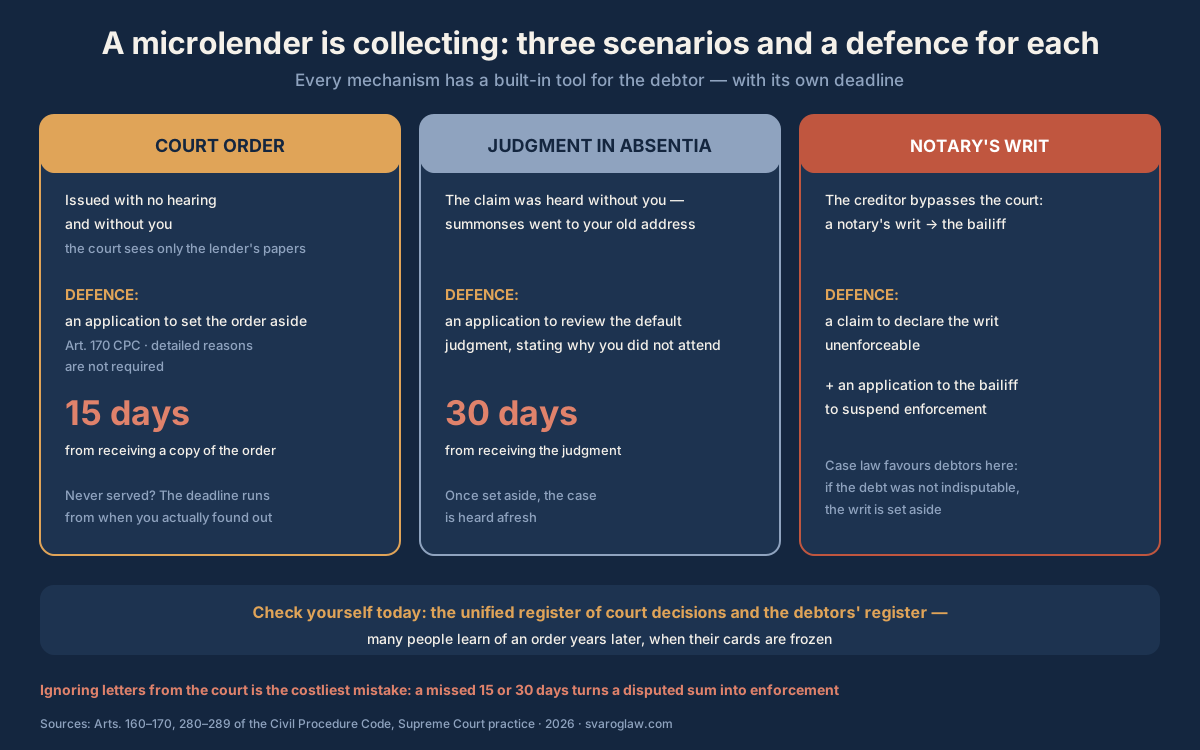
Scenario 1. A court order: 15 days to set it aside
The order is issued without a hearing and without you: the court sees only the lender’s documents. The defence is built into the procedure itself — file with the same court an application to set the order aside within 15 days of the copy of the order and its enclosures being served on you. You need not argue your disagreement in detail; it is enough to state in what respect the claim is wholly or partly unfounded. Proof of payment of the court fee goes with the application.
The practical points that decide such cases:
- time runs from the day of service, so record the date on the envelope; if the order was never served on you (an old registered address), file the application together with a request to restore the deadline and evidence of when you actually learned of it — a bank certificate about the freeze on your account, for instance;
- check yourself in the Unified State Register of Court Decisions and the Unified Register of Debtors today: many people learn of orders years later;
- setting the order aside does not forgive the debt — it moves the dispute into a format where the court must check the calculation.
Scenario 2. A default judgment: 30 days to seek review
If the lender brought a claim and you did not attend because the summonses went to an old address, the court may have given judgment in default. An application to review it is filed within 30 days of the judgment being pronounced (Article 284 CPC). The wording matters: time runs from the pronouncement, not from your receiving the text.
For those not handed the full text on the day of pronouncement, the law gives a separate chance: the deadline is restored where the application is filed within 20 days of service of the full default judgment. It is also restored for other valid reasons. The application explains why you did not attend, encloses evidence of those reasons, and sets out your objections to the lender’s claim. Once it is set aside, the case is heard afresh, this time with your own calculation.
Scenario 3. A notary’s writ of execution
Some lenders bypass the courts by means of a notary’s writ, which goes straight to enforcement. There is a strong formal argument here. The list of documents on which debts may be enforced without dispute is approved by Cabinet of Ministers Resolution No. 1172 of 29 June 1999, and credit agreements are on it only where the transaction was notarised. The provision that temporarily allowed writs on unnotarised credit agreements ceased to have effect in February 2017. A microloan agreement concluded online through a website or an app is not notarised by definition.
The defence takes the form of a claim to have the writ declared unenforceable. In parallel an application goes to the enforcement officer to stay enforcement action. The case law in this category favours debtors precisely because of the formal defects: no notarised agreement, no demand sent to the debtor, no original calculation.
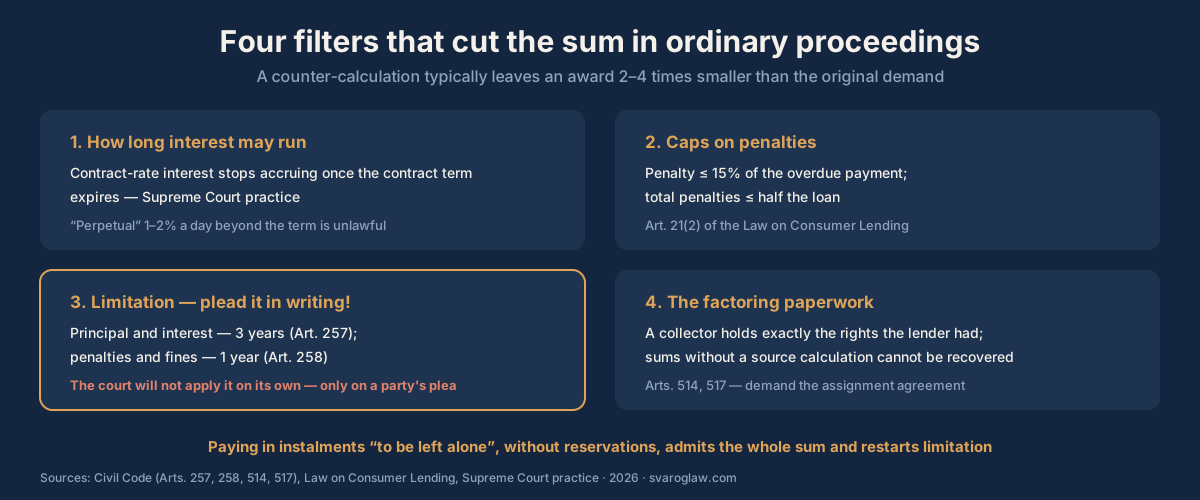
Four filters that cut the sum in ordinary proceedings
| Filter | What it removes | Basis |
|---|---|---|
| The term for interest | Interest at the contract rate charged after the contract term expired | Supreme Court case law, Arts. 1048, 1054 CC |
| Penalty caps | Late-payment charges above 15 % of the overdue instalment and above double the National Bank rate; penalties above half the credit, and for credit up to one minimum wage above twice the sum received; a fine and a late-payment charge for the same breach at once | Article 21(2)–(4) of the Law “On Consumer Lending” |
| Limitation | Principal and interest beyond 3 years; penalties and fines beyond 1 year, allowing for the suspension until 4 September 2025 | Arts. 257, 258 CC; Law No. 4434-IX (must be pleaded by a party) |
| Factoring documents | Sums unsupported by an original calculation and an assignment agreement | Arts. 512, 514, 517 CC |
The court will not raise limitation of its own motion: it must be pleaded in writing before judgment. This is the argument debtors who go to court without a lawyer most often lose.
Why “three years of limitation” is counted differently in 2026
This is debtors’ commonest false hope: “the debt is from 2021, limitation has run out”. Limitation in Ukraine was suspended from 2 April 2020 for the quarantine and then for martial law (paragraphs 12 and 19 of the Final and Transitional Provisions of the Civil Code). Law No. 4434-IX of 14 May 2025 lifted that suspension, and time began running again on 4 September 2025.
What that means for microloans. If the default arose between 2020 and 2025, the three years only began to run on 4 September 2025, so in 2026 they are far from exhausted. If the default arose before 2 April 2020, the period splits in two: what had already run before 2 April 2020, plus the time since 4 September 2025. The calculation is done for each monthly instalment separately, and it is here that a position often turns out stronger or weaker than it first appears.
What to do once the document arrives: step by step
- Record the date. Keep the postmarked envelope or a screenshot from the Electronic Court: the 15 or 30 days run from it.
- Find the document in the register. The text of the order or judgment is in the Unified State Register of Court Decisions, and details of any open enforcement file are in the Unified Register of Debtors.
- File the application to set aside or review in time, paying the 166.40 UAH fee for an application to set aside an order. If the deadline has passed, file it together with a request to restore it and evidence of the reasons.
- Ask the lender for the original calculation and the documents on the assignment of the claim, if the claimant is not the company you borrowed from.
- Draw up your counter-calculation under the four filters and file it together with a written plea of limitation before judgment is given.
Debtors’ typical mistakes
- Ignoring “some letter from the court”. Missing the 15 or 30 days turns a disputable sum into an enforceable one.
- Paying in instalments “to be left alone” without a recalculation. Payment without reservations is read as an acknowledgment of the debt and interrupts limitation.
- Not pleading limitation in writing. The court does not apply it of its own motion, and the strongest argument simply never fires.
- Denying the loan itself where it did exist. The court will check that against the statements; the workable position is a counter-calculation of the sum, not a denial that the money was received.
- Agreeing with collectors orally. Any restructuring is recorded in writing, with the full sum, the schedule and wording confirming that the obligation ends with the final payment.
When you do not need a lawyer
If the order is recent, you are comfortable drafting procedural documents and the sum is small, the application to set it aside can realistically be filed yourself: there are few requirements as to its content, and templates are on the courts’ websites. Help is needed where the deadlines have already been missed and must be restored, where the case has reached enforcement officers and freezes, where there are several lenders, or where the sum is worth fighting for with a counter-calculation. Indicative rates are in the section on legal service prices.
Questions and answers
I have received a court order about a microloan debt. What now?
Within 15 days of service, file an application with the same court to set the order aside (Article 170 CPC), paying the 166.40 UAH court fee. The order will be set aside and the lender will have to prove the sum in an ordinary claim.
I only learned of the order when my card was frozen. Is the deadline lost?
No, if the order was never actually served on you. File the application to set it aside together with a request to restore the deadline, evidencing when you really found out: a bank certificate about the freeze, an extract from the Unified Register of Debtors.
What does it cost to set aside a court order in 2026?
0.05 of the subsistence minimum for working-age people — 166.40 UAH. For comparison, the lender paid 0.1 of the minimum, that is 332.80 UAH, to obtain the order.
How long is there to challenge a default judgment?
Thirty days from the day it was pronounced. If the full text was not handed to you on that day, the deadline is restored provided the application is filed within 20 days of service of the full judgment (Article 284 CPC).
What does setting the order aside achieve if I really did take the loan?
It moves the case into ordinary proceedings, where the court checks the calculation: the period interest was charged for, the penalty caps, limitation, and the factoring documents. That is the only procedure in which the sum can be reduced.
What is the limitation period for microloans in 2026?
Three years for the principal and interest (Article 257 CC) and one year for penalties and fines (Article 258 CC). But time was suspended from 2 April 2020 and started running again only on 4 September 2025 under Law No. 4434-IX, so old debts “expire” much later than debtors expect.
A factoring company is enforcing, not the original lender. Does that change anything?
The new creditor takes exactly the rights the lender had. Ask for the assignment agreement and the original calculation: sums that appeared on resale are not recoverable, and an incomplete set of documents is a ground for dismissing the claim.
Is a notary’s writ of execution lawful for a microloan?
Under the list approved by Cabinet Resolution No. 1172, undisputed enforcement on a credit agreement is possible where the transaction was notarised. An online microloan agreement is not, so the writ is challenged by a claim to have it declared unenforceable.
Can a flat or my wages be taken over a microloan?
The enforcement officer freezes accounts and takes income within the limits the law allows. A sole home is not in practice sold over an unsecured microloan, but property can be frozen — another reason to act within the 15 days.
The lender offers to “close the debt for 50 %”. Should I agree?
Work out the lawful maximum first: a half-price offer can still exceed what the lender would actually recover in court. If the offer is good, record it in writing with wording confirming that the obligation ends in full.
Sources
- Civil Procedure Code of Ukraine, Arts. 160–170 and 280–288 — zakon.rada.gov.ua/laws/show/1618-15
- Civil Code of Ukraine, Arts. 257, 258, 512, 514, 517, 1048, 1054 and the Final and Transitional Provisions — zakon.rada.gov.ua/laws/show/435-15
- Law of Ukraine No. 4434-IX of 14 May 2025 (limitation running again) — zakon.rada.gov.ua/laws/show/4434-20
- Law of Ukraine “On Court Fees” No. 3674-VI, Article 4 — zakon.rada.gov.ua/laws/show/3674-17
- Law of Ukraine “On Consumer Lending” No. 1734-VIII, Articles 8 and 21 — zakon.rada.gov.ua/laws/show/1734-19
- Cabinet of Ministers Resolution No. 1172 of 29 June 1999 (the list of documents for a notary’s writ) — zakon.rada.gov.ua/laws/show/1172-99-п
- Unified State Register of Court Decisions — reyestr.court.gov.ua
Defending a microfinance case with Svarog
Send us a photograph of the order or the claim and the date you received it — we will tell you at once how many days are left, prepare the application to set it aside and a counter-calculation raising all four filters, including the correct limitation count after 4 September 2025. If the case has already reached enforcement, we will halt collection alongside the challenge. Related services: credit and microloan lawyer, debt recovery disputes, court representation, full price list.
+38 095 554-54-24 · Kyiv, 7 Khoriva Street (Podil) · Mon–Fri 9.00–18.00