Article 124 of the Code of Administrative Offences covers a traffic breach causing damage to vehicles, cargo or other property, with no injuries. The penalty has two forms, and drivers often learn of the second only in the courtroom: a fine of 20–25 tax-free minimums (340–425 UAH) or a driving ban of six months to a year.
But even a year without a licence is rarely the most expensive part. An Art. 124 decision formally records your fault in the accident, and every money claim that follows is built on it:
- your motor insurer pays the other party but pays you nothing for your own car, because you are the one at fault;
- where there are grounds for recourse (intoxication, leaving the scene, no licence), the insurer pays the victim and then recovers the money from you;
- everything above the insurer’s cap the victim recovers from you by civil claim: repairs, diminished value, non-pecuniary damage;
- your comprehensive and compulsory premiums may rise next year.
A 425 UAH fine against a 180,000 UAH claim from the other driver: a difference of roughly 420 times. That is why a lawyer is needed while the charge is still being heard, before the decision comes into force and becomes evidence in the civil case.
Three months to impose a penalty: the difference from Art. 130
Under Art. 130 (driving while intoxicated) the period is one year (Art. 38(7)), so advice from forums works quite differently for the two articles. Courts hear Art. 124 cases slowly, and lawful applications within those three months — for the video, for the other driver to be called, for a vehicle expert report — often lead to closure.
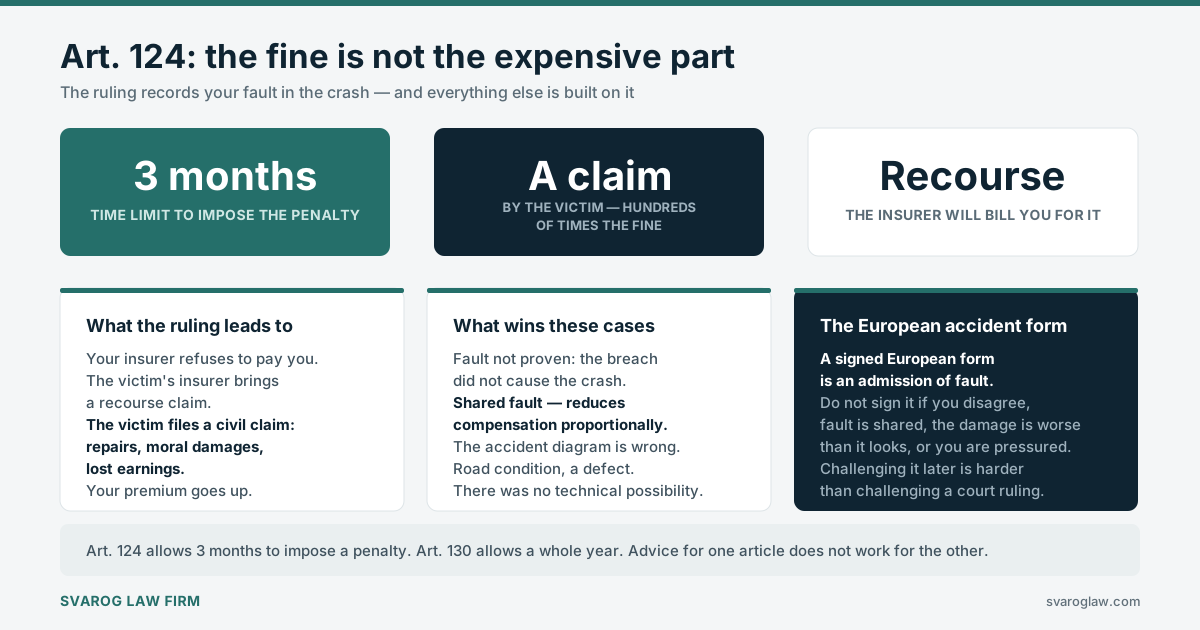
How Art. 124 cases are won
There was a breach, but it did not cause the accident
The breach must be the cause of the collision. A driver may have been 10 km/h over the limit, but if the other party pulled out from a minor road 15 metres in front of them, that is the cause and there is no Art. 124 offence.
Shared fault
Both drivers often breach the rules, and the court may issue a decision against each. Compensation is then reduced in proportion: a 180,000 UAH claim becomes 90,000 UAH on equal fault.
The accident plan is wrong
People sign it “to get away sooner”, and the expert then calculates the trajectories from it. Comments on the plan must be made at the scene; if it was signed as it stands, it is rebutted by video and witnesses.
No technical possibility of avoiding the crash
Where the collision could not have been avoided (the other driver pulled out suddenly, a pedestrian ran out from behind an obstacle), there is no fault even on a formal breach. This is established by a vehicle expert report.
The state of the road
A pothole, missing signs or an unwarned slippery surface are the road authority’s responsibility. Such cases are won where the scene was recorded: photographs of the pothole with landmarks, the police called, an entry in the report.
A defect you did not know about
And could not have known about, shifts responsibility onto the garage that serviced the car.
Procedural breaches
A defective charge sheet, rights not explained, no copy served.
What to do after an accident with no injuries
- Do not leave the scene. That is a separate offence (Art. 122-4) and a ground for the insurer’s recourse.
- Record the scene before the cars are moved: photographs, skid marks, debris, signs and markings.
- Do not sign the plan if you disagree with it, or sign it with comments.
- Find witnesses and take their details at once.
- Save the recordings from your dashcam and nearby cameras: they are overwritten within 3–7 days.
- Do not admit fault at the scene. An emotional “sorry, it was me” ends up in the statement.
- Take advice before the first hearing.
The European accident statement: when it hurts
The European statement is completed without the police where there are no injuries, both drivers agree on who was at fault, and the loss is within the insurer’s limit.
Do not complete it if:
Red flags
- you do not accept that you were at fault;
- fault is shared or unclear;
- the damage is worse than it looks: hidden damage after a bumper impact is routine;
- the other driver is pressing you to sign.
A signed European statement is a written admission of fault, and far harder to challenge than a court decision.
What the court checks in an Art. 124 case
The court checks whether the driver’s conduct breached a specific rule of the road, whether there is a causal link between that breach and the damage, and whether the charge sheet complies with Arts. 254–256. If the sheet says only “lost control” with no rule cited, that is a ground to close the case.
Applications to call the other driver and to obtain the police body-camera footage are made by us: the court does not do it of its own motion.
A case from our practice
In 2025 a driver from Kyiv’s Darnytsia district came to us after a collision at a roundabout: the police had charged him under Art. 124, he had signed the plan without comment, and the other car’s owner had already sent a claim for 214,000 UAH of repairs. We obtained, through the court, footage from a camera on a nearby building showing that the other driver had entered the roundabout without giving way. The proceedings against our client were closed for want of an offence two weeks before the three-month period expired; the other party withdrew the claim, and their insurer paid for the repairs to our client’s car. The work took about three months and cost 18,000 UAH (details changed).
How a lawyer works on an Art. 124 case
- We analyse the material: the plan, the charge sheet, photographs, camera footage, the parties’ statements.
- We check the deadlines: how long is left of the three-month period.
- We contest fault or show that it was shared.
- We apply for a vehicle expert report where the picture is disputed.
- We appear in court. You need not attend in person.
- We defend the civil claim if the other party sues or the insurer brings a recourse claim.
Cost of services
No court fee is payable in an Art. 124 case, including on appeal against the court’s decision. The fee appears in the other party’s civil claim: in 2026 that is 1 % of its value, from 1,331.20 to 16,640 UAH, or 20 % less through the Electronic Court. A vehicle expert report, if the court orders one, is paid for separately.
What the other party's civil claim would cost
The Art. 124 case itself carries no court fee, appeal included.
Questions and answers (Article 124 cases)
What if I just pay the fine and do not go to court?
The court will hear the case without you and issue a decision that comes into force in 10 days. Paying the fine does not change the question of fault: the decision remains evidence in the other party’s civil claim and in any dispute with the insurer. And the court may choose a six- to twelve-month ban instead of a fine.
Can the decision be challenged once the fine has been paid?
Yes; paying the fine is not an admission and does not remove the right to appeal within 10 days of the decision. If the copy was never served or you were not notified of the hearing, the deadline is restored, and the failure to notify is itself a ground to quash. Once the decision is quashed, the fine is refunded on application.
Can I be banned under Art. 124 if the accident was minor?
Yes: the penalty allows a six- to twelve-month ban as an alternative to a fine. In practice courts use it less often, mainly for repeat offences or substantial damage. Arguments about working as a driver and having no previous penalties are put to the court in writing.
Can the case be run remotely if the accident was in another region?
Yes. The case is heard where the accident happened, but the lawyer can attend without you and we file documents through the Electronic Court. The consultation and the drafting are done online.
The insurer has brought a recourse claim after paying the other party. Is that lawful?
Only on the grounds the motor insurance law expressly lists (intoxication, leaving the scene, driving without a licence and a few others). If none applies, the demand is challenged first by letter and then in court; such disputes are covered on the page about insurance disputes.
Contact a Svarog lawyer about an Article 124 charge
Send us the accident plan and the charge sheet: we will check whether a specific rule is cited, whether the causal link is proved, and how much of the three-month period is left. Everything after a crash, from the charge to the insurance payout, is handled by our road accident lawyer.