The insurer assessed 42,000 UAH. An independent valuer, after inspecting the car with parts removed, put it at 97,000 UAH. That gap is where our work begins, because the damage assessment determines everything that follows: what the insurer pays, how much more to claim from the driver at fault, what court fee you pay, and what you end up with.
An assessment made by the insurance company is an interested party’s assessment. It is calculated by the insurer’s method, by the insurer’s appraiser and in the insurer’s interest, so it is almost always lower than what the repair actually costs at a garage.
We do not carry out the valuation ourselves — that is a certified valuer’s job. Our part is to review the report, find its weaknesses, and bring an understated figure up to the real one by demand or through the courts.
Why the insurer’s assessment is low
Depreciation
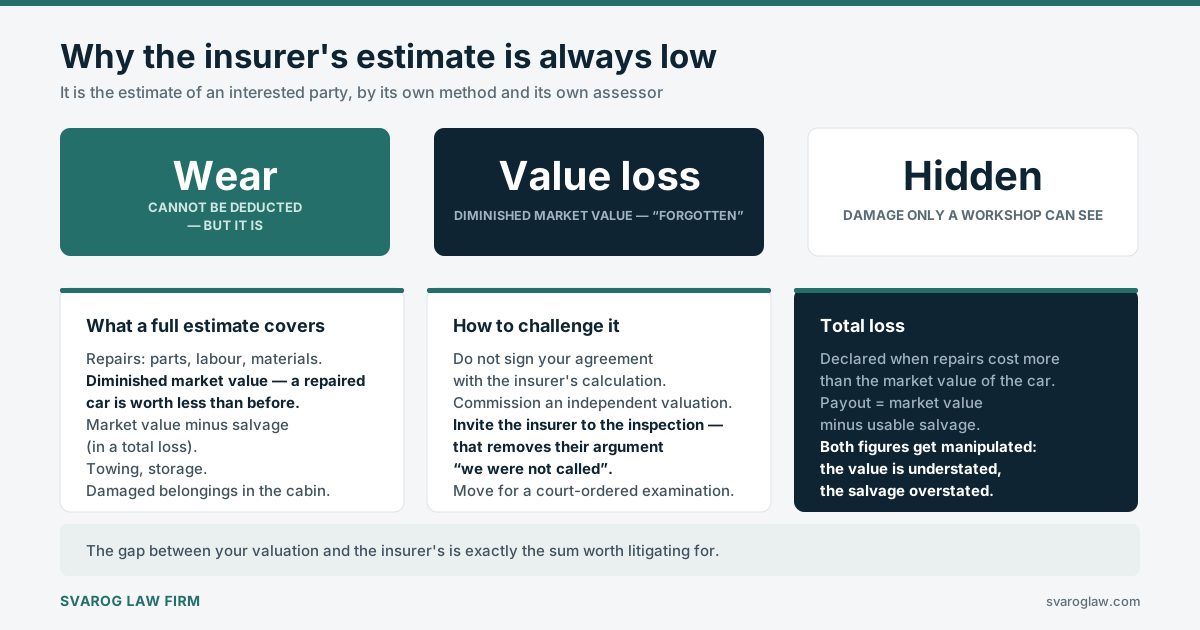
Under the current motor insurance rules (Law No. 3720-IX, from 1 January 2025) depreciation may not be deducted. The old law allowed it, and on older cars it swallowed up to half the payout. If the insurer is still calculating “allowing for wear”, that is a direct ground to challenge.
Diminished value ignored
After a repair a car is worth less than before the accident, however well the work was done. That difference is a real loss and is recoverable, but the insurer’s report usually leaves it out.
Hidden damage
An inspection without dismantling does not reveal deformed chassis rails or damage to the suspension, electronics or running gear. A typical example: a Skoda Octavia struck in the rear bumper, assessed by the insurer at 12,400 UAH for the bumper and paint. At the garage they found a crushed reinforcement bar, broken mountings and two shattered parking sensors behind it, and the bill came to 31,000 UAH. By then the report had been signed, so the extra had to be claimed separately.
Understated labour times and rates
Calculating at “average” regional prices instead of the actual rates of authorised garages.
Non-original parts
Aftermarket parts are built into the calculation instead of originals, although on a car under five years old that is directly contrary to the methodology.
What a full assessment covers
The elements of the loss
- the cost of the repair: parts, labour, materials;
- diminished value;
- the market value of the car and the value of the salvage where repair is uneconomic (a write-off);
- the cost of towing and storage;
- property damaged inside the car.
Treatment costs, lost earnings and non-pecuniary damage sit outside the vehicle assessment: they are calculated under different rules and recovered from the driver at fault, as set out on the page about compensation after a road accident.
How to challenge an understated assessment
- Do not sign your agreement to the insurer’s figure if you disagree with it. A signature makes any later challenge harder.
- Commission an independent valuation from a certified valuer, with the car inspected and, where necessary, partly dismantled to find hidden damage.
- Notify the insurer of the time and place of the inspection by registered post or through its online portal, so its representative can attend. That removes the “we were not invited” argument.
- Send a demand with the calculation and a request for the balance.
- Apply for a court-appointed vehicle valuation if the matter reaches court. A court expert’s report carries more weight than one commissioned by a party.
The gap between your valuation and the insurer’s is the sum worth litigating for. Within the insurer’s cap it is recovered from the insurer together with the penalty for delay; above the cap, from the driver at fault.
When repair is uneconomic
Where the repair costs more than the car is worth, it is a write-off. The payout is then calculated differently: the market value of the car minus the value of the salvage.
There is room for manipulation here too: understating the market value (using the cheapest advertisements) or inflating the salvage value. Both figures can be checked, and both can be challenged.
A case from our practice
In 2024 the owner of a Toyota RAV4 came to us after a side impact. The insurer declared a write-off: it valued the car at 380,000 UAH and the salvage at 190,000 UAH, and offered 190,000 UAH. An independent valuer showed that the repair cost 240,000 UAH — less than the car — so it was not a write-off at all. The insurer rejected our demand, we filed a claim, and the court ordered a vehicle valuation which confirmed our figures. The insurer paid a further 50,000 UAH within the cap along with the penalty and reimbursed the valuation costs; about seven months passed from the first approach to the money arriving (details changed).
Typical mistakes before coming to us
- Repairing the car before the independent valuation. There is nothing left to inspect, and the loss has to be proved from garage paperwork the insurer disputes.
- Signing agreement to the figure. Legally it is not fatal, but every subsequent step becomes harder.
- A valuation without dismantling. The hidden damage turns up at the garage once the report is already filed, and a supplementary valuation has to be commissioned.
- Not inviting the insurer to the inspection. That is the insurer’s main argument against an independent report in court.
- Throwing away the replaced parts. Keep them until the dispute ends: the expert may want to see them.
How we work
- We analyse the insurer’s report: the method, the prices, depreciation, whether all the damage was counted.
- We arrange an independent valuation with an inspection and a search for hidden damage, inviting the insurer in writing.
- We calculate the full loss, including diminished value, towing and storage.
- We prepare the demand with the calculation and the request for the balance, and complain to the regulator where needed.
- We apply for a court-appointed valuation once the matter is in court.
- We recover the difference from the insurer or the driver at fault and see the judgment enforced.
Cost of services
The certified valuer’s fee, the court-appointed vehicle valuation and the court fee are paid separately: in 2026 the court fee is 1 % of the value of the claim, from 1,331.20 to 16,640 UAH for an individual, and 20 % less through the Electronic Court. After a win all of these are recovered from the defendant.
Calculate the court fee for recovering the difference
The value of the claim is the gap between the real valuation and the payout, plus the cost of the valuation.
Questions and answers (Assessing accident damage)
What does an independent valuation cost, and is it recovered from the driver at fault?
The cost depends on the extent of the damage and whether dismantling is needed; for a passenger car it is usually a few thousand hryvnia. It forms part of the loss: it goes into the demand to the insurer and into the value of the claim, and after a win it is recovered from the insurer or the driver. Keep the receipt and the contract with the valuer.
How long does a court-appointed vehicle valuation take?
From a few weeks to a few months, depending on the expert institution’s workload and whether a further inspection is needed. The case is stayed while it is carried out, so the application is best made at the first hearing rather than after months of argument.
I have already repaired the car. Can anything still be proved?
Yes, if you kept photographs of the damage, the garage’s inspection record, the work order, invoices for parts and labour, and preferably the replaced parts themselves. A valuer or court expert can work from documents and photographs, though a live inspection is always stronger.
The accident was recorded on a European statement. Can the assessment still be challenged?
Yes. The statement records the circumstances and who was at fault, not the amount of the loss; the insurer sets the payout separately, and it is challenged just as it would be after a police-attended accident.
The insurer wants the car taken to “its” garage for inspection. Is that compulsory?
Inspection by the insurer’s representative is a mandatory stage, but you are entitled to be present, to photograph and to add comments to the inspection record. If some damage is not recorded, demand in writing that it be added: the insurer will later rely on that very record.
How to contact Svarog about an accident damage assessment
Send us the insurer’s calculation. We will check whether depreciation was deducted, whether diminished value was counted and whether the labour rates were understated, and tell you what can realistically be recovered on top and by which route — a demand or the courts.