On 28 August 2025 the Commercial Code of Ukraine ceased to have effect. Relations between companies are now governed by the Civil Code and Law No. 4196-IX. This is not a formality: the six-month cap on charging penalties is gone, the rules on contractual penalties have changed, and many contracts signed “under the old Commercial Code” cite provisions that no longer exist.
At the same time, on 4 September 2025 limitation periods suspended during quarantine and martial law resumed running (Law No. 4434-IX). For debts that arose between 2020 and 2025 the three-year period started from that date. “Old” debts that sat for years in the “we will deal with it later” folder have a deadline again.
This is exactly where a commercial disputes lawyer is needed: to recalculate the claim under the new rules, check the limitation periods and choose the procedure that works fastest. We recover debts from counterparties for companies and sole traders — from the demand letter to money in the account — and we start with an audit of your documents.
The disputes we handle
Categories of case
- debt recovery under contracts: supply, sale, works, services, lease, carriage, storage, distribution;
- having transactions declared invalid, including contracts signed by an unauthorised person or in breach of the articles of association;
- termination and amendment of contracts, disputes over defective performance;
- corporate disputes between LLC members, challenges to shareholder resolutions;
- defence against unfounded claims by a counterparty, reduction of penalties charged;
- insolvency: initiating it, defending the debtor, joining the register of creditors’ claims;
- challenging decisions of the competition authority, public procurement disputes.
What can be recovered besides the principal
The claim is made up of several parts, and each is calculated separately:
- The principal debt under delivery notes, acts and invoices.
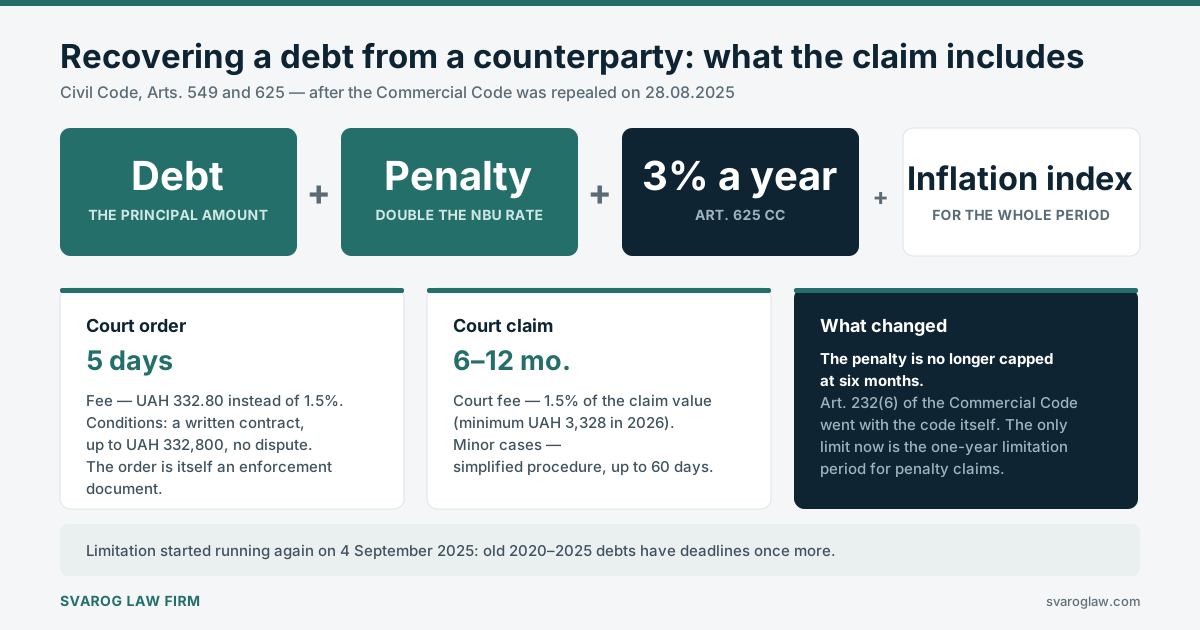
- The penalty. A debtor in default on a monetary obligation pays, at the creditor’s demand, a penalty of twice the National Bank discount rate Art. 549(3) CC — a provision carried over from the repealed Commercial Code. A contract may set a lower rate.
- A contractual fine, where the contract provides for one: it is recovered alongside the penalty.
- 3 % per annum and inflationary losses Art. 625 CC: these accrue for the whole period of default even if the contract says nothing about them.
What changed when the Commercial Code was repealed. Article 232(6) used to cap penalties at six months from the date performance fell due. That provision is gone, and the only remaining limit is the one-year limitation period for penalty claims (Art. 258(2)(1) of the Civil Code). Amounts that used to “burn out” after six months can now be charged for longer.
The second change: under the Civil Code the default rule is that a penalty is punitive — recovered on top of damages (Art. 624) — whereas the Commercial Code treated it as set off against them. That directly affects the size of the claim.
When you need a lawyer and when you do not
If the counterparty admits the debt and asks for time, a signed payment schedule is enough. If the sum is small, the contract is in writing and the debtor is simply silent, a court order is often sufficient: an inexpensive procedure a company can handle with its own accountant and in-house lawyer.
A lawyer is needed when:
- the debtor is moving assets: transferring property, changing directors, “selling” equipment to a related firm;
- the sum is significant and the debtor disputes the debt or files a counterclaim;
- the case involves a dispute about quality, volume or whether delivery happened, and an expert report is needed;
- there is no contract and the relationship is evidenced only by delivery notes and correspondence;
- you are unsure about the limitation periods on old debts;
- a judgment in your favour has produced no money and enforcement has to be made to work.
Three ways to recover a debt
A demand letter and negotiations
2–4 weeksThere is no mandatory pre-action procedure in commercial disputes. But a well-drafted demand with a calculation of the penalty, 3 % per annum and inflationary losses often produces voluntary payment: the debtor sees that the sum will only grow and that the legal costs will fall on them. The demand also evidences good faith for any later proceedings.
A court order: five days and a fee of 332.80 UAH
5 daysThe conditions: the debt arises under a written contract, there is no dispute as to the right, and the sum does not exceed 100 subsistence minimums — 332,800 UAH in 2026 (Art. 148 of the Commercial Procedure Code).
What it gives you:
- the court decides the application within five days, with no hearing and without summoning the parties;
- the court fee is 0.1 of the subsistence minimum — 332.80 UAH instead of 1.5 % of the sum;
- the order is itself an enforcement document, so it goes straight to the bailiff.
A claim in the commercial court
6–12 monthsA claim is filed where there is a dispute or the sum exceeds the limit for court orders. The case is heard where the respondent is located (Art. 27 of the Commercial Procedure Code) unless the contract or the law provides otherwise. Before filing, a copy of the claim with its annexes must be sent to the respondent and proof of sending attached (Art. 172): this formality is the commonest reason claims are left without movement.
Cases worth up to 100 subsistence minimums (332,800 UAH) are treated as minor and heard under the simplified procedure, within 60 days of opening (Art. 248). The rest go through the ordinary procedure: preparatory proceedings of up to 60 days (Art. 177) plus 30 days for the hearing on the merits (Art. 195). In practice first instance takes 6–12 months.
Limitation periods: why 2026 matters
What that means in practice:
- a debt arising between April 2020 and September 2025 has the full three years, expiring in September 2028;
- for debts predating the quarantine, whatever remained of the period as at April 2020 is added on, so in many cases limitation expires as early as 2026–2027;
- penalty and fine claims, with their one-year period, burn out faster still.
A court applies the limitation period only if the respondent raises it, but a debtor’s lawyer almost always does. If old debts are sitting on your balance sheet, the deadlines are worth calculating before any claim is drafted.
Court fees in 2026
The subsistence minimum for able-bodied persons as at 1 January 2026 is 3,328 UAH. The court fee is calculated from it.
| Step | Rate | Amount in 2026 |
|---|---|---|
| Monetary claim (company, sole trader) | 1.5 % of the value of the claim | min. 3,328 UAH, max. 1,164,800 UAH |
| Non-monetary claim | 1 subsistence minimum | 3,328 UAH |
| Application for a court order | 0.1 of the subsistence minimum | 332.80 UAH |
| Appeal | 150 % of the claim rate | — |
| Cassation appeal | 200 % of the claim rate | — |
Calculate the court fee for a commercial claim
The rate for a company or sole trader is 1.5 % of the value of the claim. A debt up to 332,800 UAH can be recovered by court order for 332.80 UAH.
Filing electronically through the Electronic Court applies a coefficient of 0.8 — 20 % cheaper — and that is how we file everything. If you win, the court fee you paid is recovered from the respondent.
What a company risks by litigating without a lawyer
- Assets are moved while the claim is being drafted. The application for interim relief (Art. 136–140 of the Commercial Procedure Code) is filed together with the claim: freezing accounts and assets, banning registration actions. Afterwards there is nothing left to enforce against.
- An error in the calculation. The penalty is not worked out at twice the National Bank rate, inflationary losses and 3 % per annum are forgotten, or the opposite — something the contract does not provide for is charged. The court refuses that part of the claim, and the fee paid on it is not refunded.
- The claim is left without movement. A copy was not sent to the respondent, proof of sending was not attached, the value of the claim was miscalculated — a month or two lost.
- A missed limitation period: the court never reaches the merits, and the fee is not refunded.
- There is a judgment but no money: enforcement stalls because the debtor “has no assets”. Tracing assets and working with the bailiff is a separate stage, planned before the claim is even filed.
A case from our practice
In 2025 a Kyiv supplier came to us: the buyer had not paid for three consignments of equipment and the debt exceeded a million hryvnias. A week before they approached us, the debtor had re-registered a warehouse in the name of a related party. We calculated the full claim including the penalty, 3 % per annum and inflationary losses, filed through the Electronic Court and simultaneously applied for interim relief. The court froze the accounts and banned registration actions over the property the day after filing. Once the freeze was in place the respondent paid the principal voluntarily and the rest was recovered by judgment; about seven months passed from the first approach to money in the account. (details changed)
How we work
- Document audit: we check the contract, delivery notes, acts, invoices and correspondence. If the evidence is thin, our first recommendation will be to record the debt in a reconciliation act rather than to file.
- Calculating the full claim: principal plus penalty, fine, 3 % per annum and inflationary losses, with limitation checked for each element.
- A demand letter and negotiations, where there is a chance of payment without litigation.
- Interim relief: freezing accounts and assets where there are signs of assets being moved.
- Court order or claim: we choose the procedure by the amount and whether there is a genuine dispute.
- Representation in court, including appeal and cassation.
- Enforcement: working with the state or private bailiff, tracing the debtor’s accounts and assets, monitoring receipts.
Cost of services
The “work without an advance payment” line means the minimum value of a dispute for which that arrangement is possible: 100,000 UAH. The fee is then paid after the money is actually recovered and is agreed separately. The court fee follows the table above; the advance payment for opening enforcement proceedings and, where needed, a forensic report are paid on top.
Questions and answers (commercial disputes lawyer)
Can legal costs be recovered from the debtor?
Yes, professional legal costs fall on the losing party (Art. 126 of the Commercial Procedure Code). You file the engagement agreement, a detailed description of the work, an act of acceptance and proof of payment, and give a preliminary estimate of costs at the start of the case. The court may reduce the amount if it finds it disproportionate to the complexity of the dispute, so we prepare the documents with that requirement in mind from the outset.
Insolvency proceedings have been opened against the debtor. Can anything still be recovered?
Yes, but through a different procedure: monetary claims are filed with the commercial court handling the case within 30 days of the official announcement that proceedings have opened. Missing that deadline means your claims rank after those of the ordinary creditors — which in practice usually means nothing at all. So problem counterparties are worth monitoring in the register.
The counterparty is a sole trader who has ceased trading. Can the debt still be recovered?
Yes. A sole trader is liable for their obligations with all their property, and deregistration does not cancel the debt. The claim then goes to a general court where the debtor lives, and enforcement is against their personal property and income.
The contract was signed by a manager with no power of attorney. Can it still be relied on?
A transaction concluded by an unauthorised person binds the company if the company approved it (Art. 241 of the Civil Code). Courts treat as approval the acceptance of goods, part payment, signing a reconciliation act, or correspondence in which the party acknowledges the debt. So in such cases we focus first on evidence of actual performance.
The counterparty is a foreign company. Where do we litigate?
It depends on the contract: if there is an arbitration clause, the named arbitral institution hears the dispute and a state court will leave a claim without consideration. Without a clause, the rules of jurisdiction and Ukraine’s international treaties apply. An international arbitral award is recognised and enforced in Ukraine through the courts under the New York Convention, so the wording of the clause is worth checking at the signing stage.
Contact a commercial disputes lawyer at Svarog
Send us the contract and the documents on the debt: we will calculate the full claim including the penalty, 3 % per annum and inflationary losses, check the limitation periods and choose the procedure — a demand letter, a court order or a claim. If recovery has no prospects, you will hear that at the consultation, before any court fee is paid.