A claimant in a child maintenance case is exempt from the court fee Art. 5(1)(3) of the Law “On Court Fees”, and no limitation period applies: you can file at any time until the child turns 18. So the real loss in maintenance cases is measured in months of delay: maintenance is awarded from the date the claim is filed, and for every month before that the money has to be recovered separately under Art. 191(2) of the Family Code, by proving that you tried to obtain it.
Most of our maintenance cases look the same: a payer declaring the minimum wage, a sole trader filing a nil return, or someone officially unemployed who nonetheless has a new car and holidays abroad. In such cases a maintenance lawyer works mainly with evidence of income and standard of living, and that evidence decides whether the child receives 1,756 UAH or 12,000 UAH a month.
How much maintenance is payable in 2026
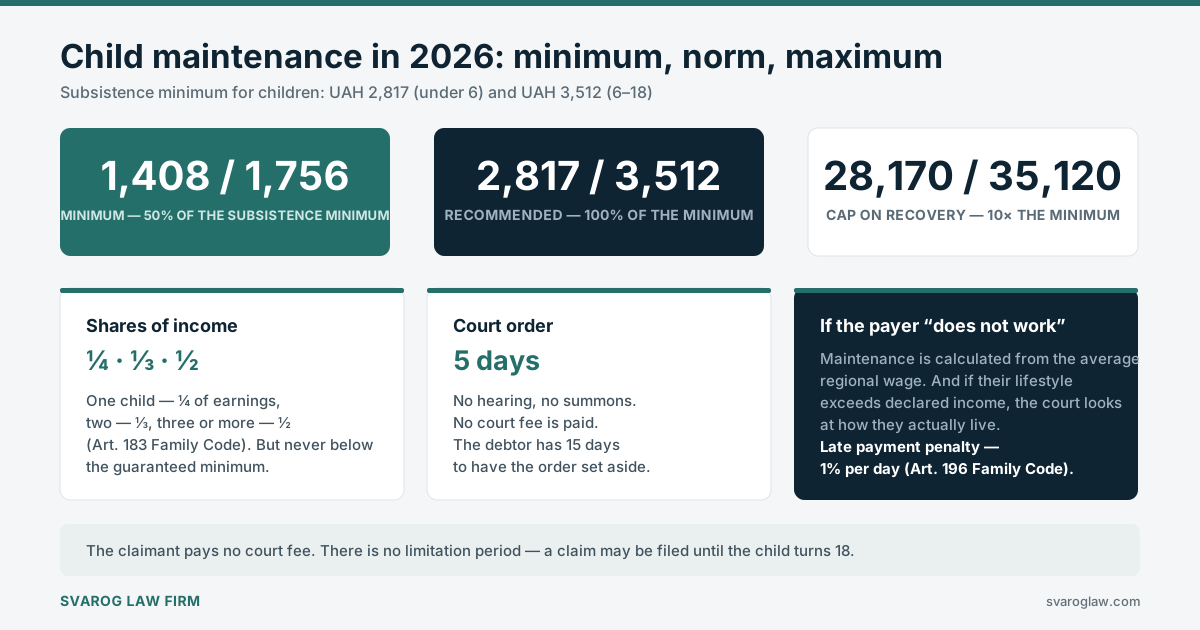
The subsistence minimum for children in 2026: 2,817 UAH (under 6) and 3,512 UAH (from 6 to 18).
| Figure | Under 6 | From 6 to 18 |
|---|---|---|
| Guaranteed minimum (50 % of the subsistence minimum, Art. 182(2) FC) | 1,408.50 UAH | 1,756 UAH |
| Recommended minimum (100 % of the subsistence minimum) | 2,817 UAH | 3,512 UAH |
| Maximum on enforced recovery (10 subsistence minimums, Art. 182(5) FC) | 28,170 UAH | 35,120 UAH |
The guaranteed minimum is an absolute floor: the court cannot award less, even if the payer has no job. Having no income does not release anyone from the duty to support a child.
Shares of income Art. 183(5) FC: one quarter for one child, one third for two, one half for three or more. The amount cannot fall below the guaranteed minimum or exceed ten subsistence minimums per child. Instead of a share, the court may award a fixed sum Art. 184 FC, which is indexed annually.
Three ways to obtain maintenance
A court order: issued in five days
issued in 5 daysThe fastest route. An application for a court order is made for recovery as a share of income: a quarter, a third or a half Art. 183(5) FC, Art. 161 CPC.
- The court decides the application without a hearing and without summoning the parties, within five days Art. 167 CPC.
- The order is itself an enforcement document — we take it straight to the bailiff.
- No court fee is payable.
The limitation: the debtor may apply to set the order aside within 15 days of receiving it (Art. 170 CPC). If they do, a full claim has to be filed. So an order works where the payer has declared income and no reason to argue.
A claim: when there is something to prove
2–4 monthsYou need one when:
- You want a fixed sum instead of a share of income.
- The payer conceals income or declares the minimum wage.
- Additional costs of treatment, development or education have to be recovered Art. 185 FC.
- Other claims are brought at the same time: divorce, the child’s place of residence.
It takes two to four months. The claimant pays no court fee.
A notarised agreement
from 1 dayIf the payer agrees, this is the cheapest and fastest option. A maintenance agreement Art. 189 FC is notarised and has the force of an enforcement document: if the payer stops paying, the bailiff enforces it without going to court.
When the payer “earns nothing”
Two stages have to be distinguished here: the court setting the amount, and the bailiff calculating the arrears.
- A sole trader filing a nil return, or someone officially unemployed. In that case the court awards a fixed sum Art. 184 FC, taking into account the payer’s health and means, whether they have other children and the other circumstances in Art. 182(1). But once arrears build up under an award expressed as a share of income, the bailiff calculates them from the average wage for the area (Art. 71 of the Law “On Enforcement Proceedings”).
- Officially the minimum wage, in reality a car and property. The court may set maintenance on the basis of the payer’s actual standard of living rather than an income certificate Art. 182(1) FC. We prove this with property and vehicle registry extracts, border-crossing records, social media posts and bank transactions obtained through lawyer’s requests and court orders for disclosure.
Arrears, interest and points of leverage
Late maintenance payments attract interest of 1 % of the unpaid amount for each day of delay, but in total no more than 100 % of the arrears (Art. 196(1) of the Family Code). So after a little over three months of non-payment the debt effectively doubles, and after that the interest stops growing.
What a debtor with more than four months of arrears faces Art. 71-1 of the Law “On Enforcement Proceedings”, besides frozen accounts and seized assets:
- A temporary ban on leaving the country.
- Temporary suspension of the right to drive.
- Restrictions on hunting rights and the use of firearms.
- Entry in the Unified Register of Debtors, which blocks loans and the disposal of property.
- Community service under Art. 183-1 of the Code of Administrative Offences: the bailiff draws up the report and the court imposes the penalty.
If the arrears exceed three months in total and the payer is concealing income or changing their address or job, criminal liability for wilful evasion of maintenance may follow Art. 164 CC. The prospect of proceedings often makes a payer settle faster than seizure of assets does.
Timing and what affects it
Court order: five days to issue, plus time to serve it on the debtor and 15 days for a possible application to set it aside — so the enforcement document is in hand in three to five weeks. A claim for a fixed sum: two to four months, longer if the court orders disclosure of income or the payer fails to attend. Enforcement: the first deductions from declared wages start about a month after proceedings open, while tracing undeclared income and assets can take six months.
The payer changing their registered address, failures to appear, a counterclaim to reduce maintenance.
Filing through the Electronic Court, a complete evidence pack on the payer’s assets at the time of filing, and timely applications for disclosure from the tax authority and banks.
A case from our practice
In March 2025 a mother of two children (aged 5 and 9) from Kyiv came to us. The children’s father, a sole trader on the simplified system, declared no income and offered to pay “when he could”. We obtained registry extracts (a 2022 car, a flat bought in 2023) and had the court order disclosure of his border crossings and account movements. The court awarded a fixed sum of 12,000 UAH a month for both children, indexed annually, and also recovered arrears for the past from the date our client sent a written demand. The case took four months, our client paid no court fee, and the cost fell within court representation. (details changed)
How we work
- We calculate the realistic amount: as a share of income, as a fixed sum, or from the payer’s actual standard of living.
- We choose the route: a court order, a claim or a notarised agreement.
- We trace income and assets: lawyer’s requests to registries, applications for disclosure from banks and the tax authority.
- We prepare the documents and run the case, including by video link.
- We calculate arrears and interest and claim them separately.
- We handle enforcement through to money actually arriving, with all the restrictions available against the debtor.
Cost of services (Child maintenance lawyer)
Court fees in 2026: a claimant seeking maintenance, whether by claim or by application for a court order, pays nothing (Art. 5(1)(3) of the Law “On Court Fees”); the same applies to claims to increase maintenance and to recover interest. If the payer brings the claim (to reduce the amount or be released from payment), the fee is 1,331.20 UAH, or 1,064.96 UAH through the Electronic Court. Notarising a maintenance agreement is charged at the notary’s tariff.
Questions and answers (Child maintenance lawyer)
Can maintenance be recovered for past years if I never went to court before?
Yes, but for no more than ten years before the claim is filed (Art. 191(2) of the Family Code) and only if you prove you took steps to obtain maintenance while the payer avoided paying: letters, messenger requests to pay, complaints to the police or the children’s services. Without that evidence, maintenance is awarded only from the date of filing.
The payer has left the country. Is there any point in filing?
Yes. A Ukrainian court will give judgment even in the respondent’s absence, and it is enforced abroad through recognition under the Convention on the Recovery Abroad of Maintenance or bilateral treaties; the application goes through the Ministry of Justice. In parallel, the bailiff recovers the debt from the payer’s assets and accounts in Ukraine.
I am the payer. Can maintenance be reduced if my income has fallen?
Yes. Under Art. 192 of the Family Code the amount is changed on the payer’s claim where their financial or family circumstances change: job loss, disability, the birth of other children. The court fee is 1,331.20 UAH. Until the court rules, you must keep paying under the existing order or judgment, otherwise interest accrues.
The father transfers money to a card without a court order. Will those payments count?
Transfers marked “maintenance” are credited by the court and the bailiff; transfers with no description are later described by the payer as gifts, and the court may accept that. So even with voluntary payments it is worth having a notarised agreement or a court order: then the amount is fixed and the bailiff calculates any arrears.
Can the case be handled remotely if my child and I are abroad?
Yes. The lawyer files the application or claim through the Electronic Court under a power of attorney, and you either join the hearing by video link or do not attend at all. Documents are sent from abroad as scans; the court may ask to see the original birth certificate on camera during the hearing.
Contact a maintenance lawyer at Svarog
Tell us about your situation and the lawyer will work out what you can realistically expect, choose the route to recovery and gather evidence of the payer’s income if it is being concealed. You pay no court fee, and maintenance runs from the date of filing — so every month of delay costs the child at least the guaranteed minimum.