Most refusals in immigration cases come down to documents and deadlines. A missed filing date, a certificate of the wrong form, a translation without notarisation, no proof of lawful grounds for staying: each of these small things produces a refusal after which the whole procedure starts again.
An immigration lawyer is there so the file is accepted first time — and, if a refusal has already come, so that it is challenged in time. The law allows six months to go to the administrative court from the day the person learned of the decision, and only three months if you first appealed to a higher migration service body (Art. 122 of the Code of Administrative Procedure).
We act both for foreign nationals regularising their status in Ukraine and for Ukrainian citizens with problems over documents, registration or travel.
Areas of work
Regularising foreign nationals in Ukraine
- a temporary residence permit: study, work, family reunification, volunteering;
- a permanent residence permit;
- extending the period of stay in Ukraine;
- a work permit for a foreign national;
- registration of residence.
Citizenship
- acquiring Ukrainian citizenship by territorial origin, by naturalisation or by restoration;
- documents for children;
- renouncing citizenship;
- challenging a refusal of citizenship.
Defence
- challenging an entry ban to Ukraine;
- defence against forced return and expulsion;
- setting aside a decision shortening the period of stay;
- challenging a refusal by the migration service of any administrative service;
- refugee status and subsidiary protection.
Ukrainians abroad
- documents for leaving and returning;
- court permission to take a child abroad without the other parent’s consent;
- resolving problems with documents lost or left in occupied territory.
Challenging a migration service refusal
Decisions and inaction of the State Migration Service are challenged in the administrative court.
The procedure:
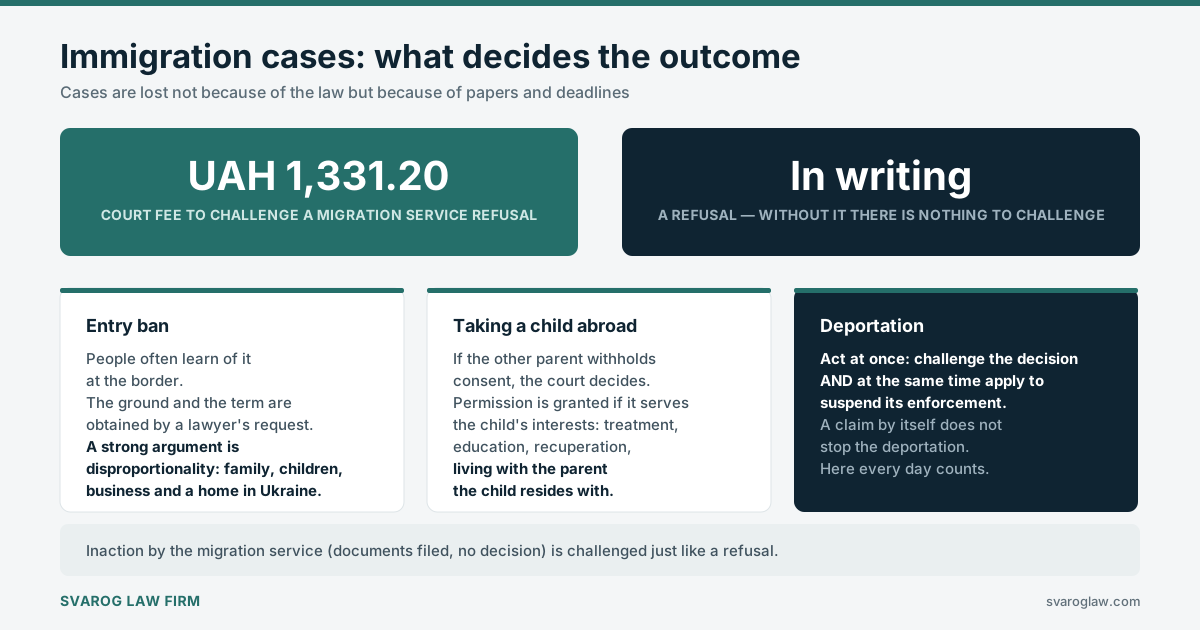
- Obtain a written refusal with reasons. An oral “you are not entitled” is not a decision and cannot be challenged, so insist on the document or a written answer to your application.
- Analyse the reason. Where the refusal is for an incomplete file, supplying the documents is faster. Where the ground is contrived, go to court.
- File an administrative claim within six months of learning of the decision, or three months after an internal appeal (Art. 122). The court fee for an individual’s non-monetary claim is 1,331.20 UAH (2026).
- Obtain an order requiring the service to reconsider the application or provide the service.
Inaction is challenged just as a refusal is: the documents were filed, the deadline passed, there is no decision. In the claim we ask the court to declare the inaction unlawful and to order the service to decide within a specific period.
Entry bans: periods and grounds
An entry ban is imposed by the State Border Guard Service, the migration service or the security service, and the period depends on the ground: three, five or ten years (Art. 13 of the Law “On the Legal Status of Foreigners and Stateless Persons”). People often learn of the decision at the border, when they are turned back.
What we do:
- establish the authority, the ground and the period of the ban through a lawyer’s enquiry, because the refusal of entry itself usually does not state the ground;
- assess the lawfulness of the decision and the procedure by which it was taken;
- challenge it in the administrative court;
- argue that the measure is disproportionate where the person has family, children, a business or a home in Ukraine.
The proportionality argument rests on the right to respect for private and family life (Art. 8 of the Convention for the Protection of Human Rights and Fundamental Freedoms), and the administrative courts take it into account where a ban separates spouses or parents from children.
Two other mechanisms operate separately from an entry ban.
Forced return is decided by the migration service, the border authority or the security service, and such a decision sets a period of up to 30 days for voluntary departure (Art. 26 of the Law).
Forced expulsion is applied only by order of an administrative court on the application of those authorities (Art. 30), so in such a case the defence is built in court rather than in correspondence with a department.
Taking a child abroad
Under martial law a simplified rule applies: a child under 16 travels accompanied by one parent without the other’s notarised consent — as set out in the Rules for Crossing the State Border by Citizens of Ukraine (Cabinet Resolution No. 57).
Court permission is needed in other situations: the child is 16 to 18 and travelling alone or with a third party, a permanent move is planned, there is a dispute over where the child should live, or the border guards refuse because the other parent has objected.
The court grants permission where it is in the child’s interests: medical treatment, education, a holiday, or living with the parent the child lives with. What has to be proved is the purpose of the trip, its length, the guarantees of return or the justification for the move, and the other parent’s position and involvement in the child’s life.
When you do not need a lawyer
Where the ground is clear, the documents are complete and the migration service is working to time, people file the application themselves through an administrative services centre or a local office.
An immigration lawyer is needed when:
- the service has refused or has been silent beyond the statutory period;
- entry to Ukraine is banned;
- a decision on forced return or expulsion has been taken, or the period of stay has been shortened;
- documents have been lost or left in occupied territory;
- court permission to take a child abroad is needed;
- the matter concerns citizenship: the documentary requirements are highest here, and a refusal closes the question for years;
- you are a foreign national and do not know the Ukrainian procedures and deadlines.
A case from our practice
In 2025 a citizen of Azerbaijan came to us — married to a Ukrainian and father of a two-year-old — who, after a trip home, was not let back in because of a three-year entry ban. The refusal gave no reason, so we sent lawyer’s enquiries and established that the ban had been imposed over an overstay several years earlier. In the claim we argued that the measure was disproportionate: the marriage, the small child, the rented home and the taxes paid in Ukraine. The first-instance court set the ban aside, and once the judgment came into force he returned to his family. About eight months passed from the first consultation to his entry; the outlay was the court fee and our fee for comprehensive handling of an administrative case (details changed).
How we work
- We analyse the ground: whether you are in fact entitled to what you are asking for.
- We assemble the file so that there is no pretext for refusal.
- We send lawyer’s enquiries to establish the real reason for the ban or the refusal.
- We challenge the migration service’s decisions and inaction in the administrative court.
- We defend against expulsion, including by applying to suspend enforcement of the decision.
- We see it through to the result: the document in hand, not the application filed.
Cost of services
The court fee for an individual’s non-monetary administrative claim in 2026 is 0.4 of the subsistence minimum for working-age people, that is 1,331.20 UAH; through the Electronic Court the rate is multiplied by 0.8, giving 1,064.96 UAH. A company pays 3,328 UAH for the same claim. If you win, the costs are recovered from the respondent.
Questions and answers (Immigration lawyer)
Can documents be refiled with the migration service while the case is in court?
Yes; filing a claim does not prevent a fresh application, and that is often quicker: if the first refusal was for an incomplete file, a new application with the documents corrected settles the matter before the court rules. We usually run both tracks in parallel and keep the claim alive so the same ground of refusal cannot be used twice.
The ban came from the security service, not the migration service. Where do I go?
The procedure is the same: a decision of a public authority is challenged in the administrative court, only the respondent changes. The difficulty is that the grounds for such decisions are often classified, so we first establish by lawyer’s enquiry which authority imposed the ban and for how long, and only then build the claim.
Does a challenge suspend enforcement of an expulsion decision?
Filing the claim alone does not suspend it, so an application for interim relief asking to suspend the decision goes in together with the claim. It is that application which buys time for the case to be heard, and it must be filed with the claim, not after the first hearing.
We won in court. Will the permit be issued straight away?
Usually not. The administrative court does not replace the authority: in most cases it declares the refusal unlawful and orders the service to reconsider the application without the ground that has been quashed. The service itself takes the decision on the permit, so we also see that reconsideration through, to make sure it does not end in a fresh refusal on another basis.
I am outside Ukraine. Can the case be run without my coming?
Yes. The lawyer acts on a warrant and a power of attorney certified by a consul or a local notary, documents are filed through the Electronic Court, and hearings are held by video. Attendance in person is needed only where the procedure requires biometrics or filing in person.
Contact a Svarog immigration lawyer
Describe the situation: we will tell you whether you have a ground, what documents are needed and what to do if the migration service has already refused. If the matter concerns an entry ban, forced return or expulsion, call at once — the period for voluntary departure can be as little as 30 days, and the law allows six months from the day you learned of the decision to bring a claim.