
Олександр Сич
7 October 2026
An apartment you bought while living together as a family without being married is considered the joint property of you both (Art. 74 of the Family Code), even if it is registered in your partner’s name, unless they prove they paid for it with their personal funds. It is usually divided in half (Art. 70 of the Family Code): at a notary if you both agree, or through a lawsuit within three years of separating. Ten years together do not prove this on their own: the court looks at whether you shared a household and a budget, when the apartment was bought, and whether either of you was married to someone else.
Living together without registering a marriage is colloquially called a “civil marriage”, and many people believe that after a few years together half of everything acquired becomes jointly owned automatically. The law sees it differently. Living together without marriage does not give rise to spousal rights (Art. 21(2) of the Family Code), but Art. 74 of the Family Code extends Chapter 8 of the Code, that is, the same rules that govern spouses’ property, to property acquired while the couple lived together. We covered those rules in our article on how property is divided after divorce. The difference is that spouses show the court a marriage certificate, while unmarried partners first have to prove that they were a family at all. Dividing an apartment without marriage turns on this proof.
Two rulings show how different the outcome can be. In February 2026 the Supreme Court upheld a man’s right to half of two apartments and a car registered in the name of the woman he had lived with for almost 14 years. In 2024, by contrast, the Grand Chamber ruled that an apartment bought three months before the proven start of cohabitation remained personal property.
Why 10 years together still guarantee nothing
The law sets no minimum period of cohabitation. The Supreme Court only notes that living together as a family should by its nature be long-term (ruling of 30 October 2019 in case No. 643/6799/17). In case No. 753/13573/23 the courts established three years of cohabitation, and in case No. 760/20948/16-ц, reviewed by the Grand Chamber, less than a year (from 8 May 2012 to 24 April 2013). So ten years count only when evidence backs them up. Under Art. 74 of the Family Code, the court checks three conditions:
- You lived together specifically as a family. Art. 3(2) of the Family Code defines a family through living together, a shared household and mutual rights and obligations, and these are exactly the features the Grand Chamber requires courts to establish (ruling of 3 July 2019 in case No. 554/8023/15-ц). The Plenum of the Supreme Court of Ukraine adds “settled relations characteristic of spouses” (para. 20 of Resolution No. 11 of 21 December 2007).
- Neither of you was married to someone else. This condition was added by Law No. 524-V of 22 December 2006, and Art. 74 has not changed since.
- The apartment was acquired while you lived together. The court establishes when, with what money and for what purpose it was bought (Supreme Court ruling of 1 April 2026 in case No. 753/13573/23). Alongside Art. 74 of the Family Code, the Supreme Court relies on Art. 368(4) of the Civil Code: property acquired through the joint labour and with the common funds of family members is their joint property.
What evidence the courts accept
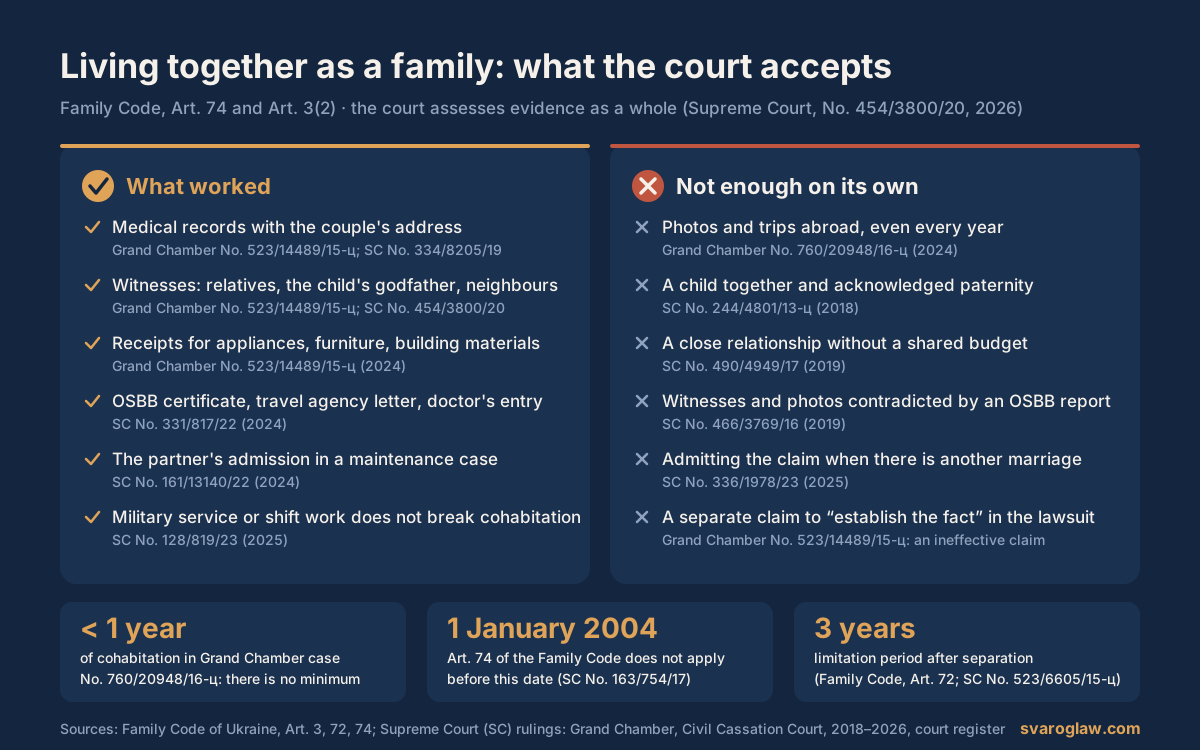
The court assesses the features of a family as a whole. The Supreme Court lists the ways to prove them: witness testimony, documents on registered or actual place of residence, photos of events, fiscal receipts, sale and purchase contracts, bank account and deposit agreements, and other written evidence of shared expenses (ruling of 4 February 2026 in case No. 454/3800/20).
Medical records with your address
The Grand Chamber took into account records from an antenatal clinic, a hospital and a maternity hospital showing the couple’s actual address (case No. 523/14489/15-ц, paras 35.3–35.5). Medical records of the couple’s child worked the same way (Supreme Court, case No. 334/8205/19).
Witnesses from your circle
In the same case, the claimant’s parents and sister, the child’s godfather and the neighbours testified (paras 36.1–36.4). A court cannot reject such testimony without giving reasons: this is why in 2026 the Supreme Court set aside an appellate court ruling (case No. 454/3800/20).
Receipts for furniture, appliances, renovation
The Grand Chamber accepted receipts for household appliances, furniture and building materials as evidence of a shared household (case No. 523/14489/15-ц).
Condominium certificate, travel agency, doctor
Being registered at different addresses does not stop you from proving that you lived together. In case No. 331/817/22 the Supreme Court took into account a certificate from the condominium association (OSBB), a letter from a travel agency about joint trips in 2015–2021 and a doctor’s entry in a medical history reading “Лена — жена” (“Lena, wife”) with a phone number.
Your partner’s own words
In case No. 161/13140/22 the defendant herself admitted in maintenance proceedings that they had lived as one family (para. 91), and in statements to the police she called the claimant her live-in partner and common-law husband.
Military service or shift work does not interrupt cohabitation
A partner’s temporary absence due to military service or rotational shift work does not interrupt living together (Supreme Court ruling of 20 March 2025 in case No. 128/819/23).
What does not prove living together as a family on its own
Courts have rejected each of these types of evidence when there was no shared budget and household behind it:
- Photos and trips abroad: in case No. 760/20948/16-ц the couple travelled several times a year in 2008–2012 to Thailand, the USA, the Dominican Republic, Malaysia, the Czech Republic and Crete. Yet the Grand Chamber agreed that without evidence of a shared household, a common budget and mutual spousal obligations, this does not prove they were a family (para. 39.3).
- A child together and acknowledged paternity do not in themselves mean that the parents lived as one family (Supreme Court, case No. 244/4801/13-ц), although in that case the refusal also rested on one partner’s other marriage.
- A close relationship, even one the defendant admits, does not make property joint without evidence of a shared household, budget and expenses (Supreme Court, case No. 490/4949/17).
- Witnesses and photos contradicted by documents: in case No. 466/3769/16 the courts dismissed the claim: according to a report by the OSBB, the man lived alone, his sister organised the funeral, and he had bought the apartment with money from selling his other apartments. The Supreme Court declined to reassess this evidence.
Apartment registered in your partner’s name: who has to prove what
The fact that only he or she is listed as the owner in the register decides nothing: the presumption of joint ownership (Art. 60 of the Family Code) also applies to unmarried partners through Art. 74(2), and it is up to whoever disagrees with it to rebut it (Supreme Court, case No. 331/817/22). But first you have to prove that you lived as a family at the very time the apartment was bought, and the court must also “rule out the possibility that personal funds of either of them were used” (Supreme Court, case No. 753/13573/23). Courts resolve typical situations as follows:
- In the sale and purchase contract, your partner stated that they did not live with anyone and were paying with personal funds. On its own, this does not prevent division: the notary does not verify such a statement, and the other partner did not sign the contract (case No. 331/817/22). Such a clause carries weight only together with other evidence: in case No. 760/20948/16-ц the Grand Chamber took it into account where the apartment had been bought before cohabitation began.
- Your partner says they bought the apartment with money from selling their own property. This argument works only if the sale and the purchase are linked in time and in amounts. In the same case, the other side relied on the sale of two cars and a share in another apartment, and this did not rebut the presumption.
- The apartment was bought before cohabitation began. It remains personal property, even if the couple later lived in it and married (Grand Chamber of the Supreme Court, case No. 760/20948/16-ц, paras 47, 49). Likewise, Art. 74 does not cover housing that one of you came to own before living together, for example through apartment privatisation. Art. 62 of the Family Code provides an exception: if the value of such an apartment increased significantly during cohabitation thanks to joint financial or labour contributions, or to investments by the other partner, the court may recognise it as joint property.
- An apartment in a new building, with ownership registered later. In case No. 753/13573/23 the contributions to the construction financing fund were paid while the couple lived together without marriage (from August 2014 to July 2017), and ownership was registered only on 15 August 2018, when they were already married. The apartment was recognised as joint property, with equal shares. For an apartment like this, gather the contracts with the fund or the developer and the dated payment receipts.
- You helped pay off your partner’s loan for their apartment. You will most likely not be able to recover half of the payments in cash. In case No. 760/16783/15-ц a man claimed half of the 14,950 Swiss francs that the woman had paid during cohabitation on a consumer loan taken out to pay for her apartment. The Supreme Court refused: money spent on acquiring property is not divided separately when the property itself exists, and “the claimant made no other claims”. If the loan has not been repaid yet, also read how to divide a mortgaged apartment.
- Your partner has already sold the apartment without your consent. The contract will be declared invalid only if both the seller and the buyer acted in bad faith, that is, the buyer knew or, given the circumstances, must have known that the apartment was jointly owned and that there was no consent. Otherwise you are left with compensation for the value of your share (Art. 65 of the Family Code, Art. 369 of the Civil Code; Grand Chamber of the Supreme Court, case No. 523/14489/15-ц, paras 97, 104, 107).
Supreme Court ruling of 4 February 2026 in case No. 454/3800/20
The man claimed he had lived with his partner as one family since 2003. During that time they bought two apartments (in 2015 and 2020) and a Volkswagen Passat B7 (2018), all registered in the woman’s name. The Supreme Court set aside in full the ruling of the Lviv Court of Appeal, which had rejected the witness testimony without giving reasons. The Supreme Court concluded that photos with relatives and friends, witness testimony and written evidence, taken together, proved that the couple had been a family. The defendant did not rebut the presumption of joint ownership, and the man received a 1/2 share in each of the two apartments and in the car.
The Supreme Court found the period of cohabitation shorter than the claimant asserted: from 8 January 2007 to October 2020, because one partner’s marriage had been dissolved by a default judgment that took effect only on 7 January 2007.
How to work out your own period: it starts no earlier than the day you both became free of other marriages and ends when you separated; only property acquired in between is divided. Here, instead of the roughly 17 years claimed, the court recognised 13 years and 9 months.
If one of you is not yet divorced
Art. 74 of the Family Code does not apply while at least one of the partners is “in any other marriage”, and the Supreme Court links this to the principle of monogamy (Art. 25 of the Family Code). What this means for dividing the apartment:
- A marriage that exists only on paper also stands in the way. A woman had been in a registered marriage for 32 years, although from 2014 she lived with another man. The Supreme Court refused to apply Art. 74 and disregarded even the fact that the defendant had admitted the claim (ruling of 12 March 2025 in case No. 336/1978/23).
- Cohabitation is counted from the day the previous marriage ended. A marriage dissolved by a court ends on the day the judgment takes effect, and one dissolved by a civil registry office ends on the day the divorce is registered (Art. 114(1)–(2) of the Family Code). In case No. 161/13140/22 the defendant acknowledged that they had lived together since 2008, but the court applied Art. 74 only from 6 September 2011, after the claimant’s marriage was dissolved.
- An apartment bought before one of you divorced does not become joint property under Art. 74, even if you were already living together then. Before filing a claim, check the divorce date against the dates the apartment was bought and paid for.
Dividing an apartment without marriage through the courts: step by step
You do not need to ask the court separately to establish the fact that you lived as one family. The Grand Chamber considers such a claim ineffective: in its view, this part of the claim should be dismissed, and the court assesses the fact in the reasoning part of the judgment on division (case No. 523/14489/15-ц, paras 40, 43–44). A claim to “recognise the apartment as joint property” is also unnecessary (ibid., para. 70). The Grand Chamber set out this conclusion twice in 2024, and in July of the same year it returned case No. 127/22428/21 to the Civil Cassation Court, whose panel had proposed departing from it: the Grand Chamber saw no reason to state it a third time. That is why it is best to agree the wording of the property division claim with a lawyer before filing.
- Gather evidence with dates. It should show that you lived as a family at the very time the apartment was bought and paid for.
- Work out the limitation period. It does not apply while you live together, and after you separate a three-year period runs (Art. 72 of the Family Code; Supreme Court, case No. 523/6605/15-ц). The Civil Cassation Court of the Supreme Court sometimes counts it from separation (case No. 212/10842/19) and sometimes from the day you learned or could have learned that your right had been violated (case No. 161/13140/22), so it is safer to count from separation.
- File a claim with the court where the apartment is located. Jurisdiction here is exclusive (Art. 30(1) of the Civil Procedure Code). The subject of the claim is division of the apartment with recognition of ownership of your share, and cohabitation is something you prove as the grounds for the claim.
- Ask the court to block the sale of the apartment while the dispute is pending. Together with the claim, file an application for interim measures: an attachment of the apartment or a ban on disposing of it (Art. 150(1)(1)–(2) of the Civil Procedure Code). The court fee for this application is 0.2 of the subsistence minimum, i.e. UAH 665.60, or UAH 532.48 if filed via “Електронний суд” (Electronic Court). If your partner manages to sell the apartment to a good-faith buyer, you will be left with compensation only. The application for interim measures is usually prepared together with the claim as part of court representation in the case.
Since 4 September 2025 the limitation period has been running again. From 17 March 2022 limitation periods were extended for the duration of martial law, from 30 January 2024 they were suspended, and then Law No. 4434-IX removed this rule from the Civil Code. The period of suspension up to 4 September 2025 does not count towards the three years. A separate rule applies to military personnel: while one of you is serving in the Armed Forces of Ukraine or another military formation put on a war footing, the limitation period is suspended (Art. 263(1)(4) of the Civil Code).
How much going to court costs in 2026
The fee is calculated from the subsistence minimum for able-bodied persons as of 1 January 2026, i.e. UAH 3,328. If you file documents via Electronic Court, the rate is 20% lower (Art. 4 of the Law “On Court Fee”).
| What you file | Rate | On paper | Via Electronic Court |
|---|---|---|---|
| Claim for division of an apartment | 1% of the claim value, from 0.4 to 5 subsistence minimums | UAH 1,331.20 to UAH 16,640 | UAH 1,064.96 to UAH 13,312 |
| Application to establish the fact of living together as one family (only if there is no dispute) | 0.2 of the subsistence minimum | UAH 665.60 | UAH 532.48 |
| For comparison: division of property during a divorce (not available to unmarried partners) | 3 subsistence minimums at most | up to UAH 9,984 | up to UAH 7,987.20 |
The claim value is the actual value of the property (Art. 176(1)(9) of the Civil Procedure Code), so the fee reaches the UAH 16,640 cap at a claim value of just UAH 1,664,000. The reduced cap of UAH 9,984 is not available to unmarried partners: the Supreme Court applied the general rate even to spouses who divided property separately from a divorce (order in case No. 750/11996/18-ц). Before paying the fee, discuss with a lawyer whether the claim value should be based on the whole apartment or only on your share.
How the court divides the apartment and when shares are unequal
- 1/2 each: as a general rule, the shares are equal (Art. 70(1) of the Family Code), as in case No. 454/3800/20.
- A larger share for one partner: the court may depart from equal shares, in particular if the other partner did not contribute to the family’s financial support, concealed or destroyed joint property, or spent it against the family’s interests (Art. 70(2) of the Family Code). A larger share may also be awarded to the partner the children live with, if the maintenance paid for them is insufficient (Art. 70(3) of the Family Code).
- The apartment to one, money to the other: compensation instead of a share is awarded only with the consent of the person receiving it, and only after the amount has been paid into the court’s deposit account (Art. 71(4)–(5) of the Family Code).
- Without consent to compensation, the right to a share can be terminated only under Art. 365 of the Civil Code: the share is insignificant and cannot be allocated in kind, or the apartment is indivisible, or joint use is impossible, and termination will not cause significant harm to the interests of the co-owner and members of their family. The value of the share is paid into the court’s deposit account in advance.
You can do without a court if you both agree. An agreement on dividing the apartment is made in writing and certified by a notary (Art. 69(2) of the Family Code, Art. 372(4) of the Civil Code); agree the list of documents with the notary in advance. Do not replace division with a gift of a share: a gift from an unmarried partner is subject to 5% personal income tax and 5% military levy (paragraph 174.6 of the Tax Code; paragraph 16-1 of subsection 10 of Section XX of the Tax Code), while division of joint property is not. While you are still living together, you can agree in writing on a property regime other than joint ownership (Art. 74(1) of the Family Code). If there is no dispute, the fact of cohabitation can be established on application in non-contentious (separate) proceedings (Art. 315(1)(5) of the Civil Procedure Code). But if a dispute about rights is apparent from the application itself, the judge will refuse to open proceedings, and if it emerges during the hearing, the court will leave the application without consideration, and you will have to file a separate claim on general grounds (Art. 315(4) and Art. 294(6) of the Civil Procedure Code).
The legislation and rulings this article relies on
- Family Code of Ukraine, Art. 3, 21, 25, 60, 62, 65, 69–72, 74, 76, 84, 86, 88, 91, 114 — zakon.rada.gov.ua
- Civil Code of Ukraine, Art. 263, 365, 368, 369, 372, 1235, 1241, 1258, 1264 — zakon.rada.gov.ua; Law No. 4434-IX of 14 May 2025 (limitation periods under martial law) — zakon.rada.gov.ua
- Civil Procedure Code of Ukraine, Art. 30, 150, 176, 294, 315 — zakon.rada.gov.ua
- Law “On Court Fee”, Art. 4 — zakon.rada.gov.ua; Law “On the State Budget of Ukraine for 2026” No. 4695-IX, Art. 7 — zakon.rada.gov.ua
- Tax Code of Ukraine, paragraph 174.6, paragraph 16-1 of subsection 10 of Section XX — zakon.rada.gov.ua
- Resolution of the Plenum of the Supreme Court of Ukraine No. 11 of 21 December 2007, para. 20 — zakon.rada.gov.ua
- Grand Chamber of the Supreme Court: No. 554/8023/15-ц, No. 523/14489/15-ц, No. 760/20948/16-ц
- Civil Cassation Court of the Supreme Court: No. 454/3800/20, No. 753/13573/23, No. 331/817/22, No. 336/1978/23, No. 161/13140/22, No. 523/6605/15-ц, No. 212/10842/19, No. 128/819/23, No. 334/8205/19, No. 760/16783/15-ц, No. 163/754/17, No. 466/3769/16, No. 490/4949/17, No. 244/4801/13-ц, order No. 750/11996/18-ц (court register)
- Draft laws No. 9103 “On the Institute of Registered Partnerships” and No. 15150 (the new Civil Code)
Inheritance, maintenance and the years before 2004: special cases
My partner has died. Can I get my share of the apartment?
Yes, if you prove that the apartment was bought while you lived as one family. In case No. 331/817/22 the dispute was heard after the partner’s death, the defendants were his heirs, and the Supreme Court applied the same presumption of joint ownership to them.
Inheriting from your partner without a will is another matter: you can do so only as a fourth-priority heir, and only if you lived with them as one family for at least five years before the inheritance opened (Art. 1264 of the Civil Code). The fourth priority inherits only if there are no heirs of the first three priorities (children, husband or wife, parents, brothers and sisters, grandparents, uncles and aunts), or they have been excluded from inheritance, have not accepted the inheritance or have renounced it (Art. 1258(2) of the Civil Code). If your partner left a will in your favour, the length of cohabitation does not matter (Art. 1235 of the Civil Code). But their minor children, adult children unable to work, parents unable to work and a widow or widower unable to work will still receive a compulsory share (Art. 1241 of the Civil Code).
Can I claim maintenance for myself from a former partner?
Yes, but only in the two cases set out in Art. 91 of the Family Code. The first: you lost your ability to work during a long period of living together, you need financial support, and your former partner is able to provide it (Art. 91(1) and Art. 76(2) of the Family Code). The second: your joint child lives with you, and the other parent is able to provide financial support. In that case maintenance is due until the child turns three, or six if the child has physical or mental developmental disabilities. And if the child has a disability and cannot manage without constant care by others, maintenance continues for as long as you live with the child and care for them. Whether you work and what your financial situation is does not matter here (Art. 91(2) of the Family Code refers to Art. 84(2)–(4), Art. 86 and Art. 88).
We have been together since the 1990s. Do those years count?
Not for Art. 74 of the Family Code: the fact of living as one family can be established only from 1 January 2004, when the Family Code came into force (Supreme Court ruling of 24 April 2019 in case No. 163/754/17). Property acquired earlier can be recognised as joint property of family members under Art. 17(1) of the then-applicable Law “On Property”, but this requires proof that it was acquired through joint labour.
Will there be a law on registered partnerships?
As of 2 October 2026, there is none. Draft Law No. 9103 of 13 March 2023 is still being worked on in the Committee on Legal Policy and has not been considered in the first reading, and on 28 April 2026 the Verkhovna Rada adopted the draft new Civil Code No. 15150 only as a basis. So unmarried couples are covered by Art. 74 of the Family Code, which applies only to a woman and a man.
Your partner denies you were a family?
Then the dispute will be decided by dated evidence and a precisely worded claim, which must be filed within three years of separating (Art. 72 of the Family Code). Bring the purchase contract, payment receipts and anything that shows a shared household to the consultation: on that basis, a property division lawyer for spouses and unmarried partners will determine what period of cohabitation can realistically be proven, calculate the court fee and prepare the claim together with an application to ban the sale of the apartment. If, along with the apartment, you need to claim child support or resolve another family dispute, our family lawyer can help.