People are awarded 5,000 UAH instead of the 500,000 they claimed for one reason: non-pecuniary damage has to be proved. The court does not assess suffering by eye, it assesses evidence: medical records, a psychologist’s report, witness evidence, the consequences for work and family. Compensation for non-pecuniary and pecuniary damage goes to the person who showed what happened, what supports it and what it cost.
Compensation for non-pecuniary damage (Arts. 23, 1167 of the Civil Code) is possible where three things are proved: the damage exists, it was caused by the defendant’s conduct, and there is a causal link between them. “I was very upset”, with nothing to back it, does not persuade a court.
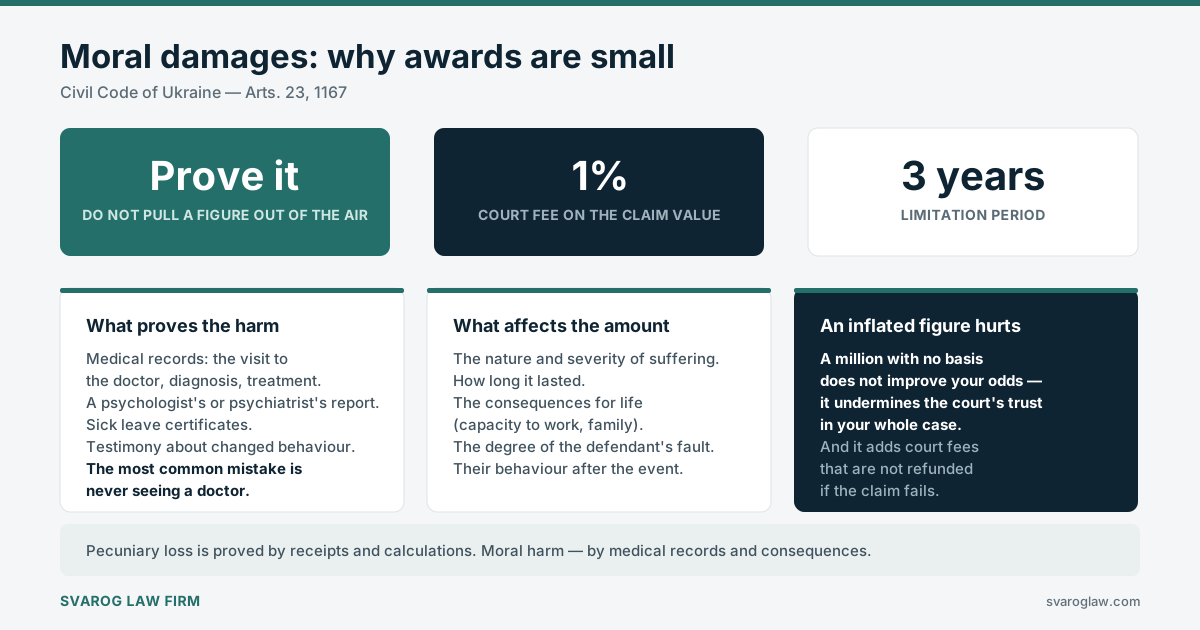
The second common mistake is to claim a fantasy figure. It undermines the court’s confidence in the whole case and increases the court fee, which is not refunded if the claim fails.
When compensation can be claimed
Categories of case
- road accidents — injuries, the death of a close relative;
- injury or harm to health, including from substandard medical care;
- unlawful acts of law enforcement: unlawful detention, search, prosecution;
- breach of employment rights: unlawful dismissal, unpaid wages, discrimination;
- breach of consumer rights: defective goods, a service not provided;
- publication of false information: protection of honour, dignity and business reputation;
- breach of contract, where compensation for non-pecuniary damage is expressly provided for by the contract or by law;
- acts of utility companies and housing services: flooding, accidents, inaction.
What affects the amount
The court takes into account (Art. 23 of the Civil Code):
- the nature and severity of the suffering, physical and mental;
- its duration: a one-off shock or a disorder lasting years;
- the consequences for the person’s life: loss of capacity to work, the break-up of a family, a changed way of living;
- the degree of the defendant’s fault: intention or negligence;
- other circumstances, in particular the defendant’s conduct after the event (whether they apologised and paid, or ignored it).
The Supreme Court consistently holds that the award must be proportionate to the suffering and must not become a source of enrichment. So in the claim we explain what the figure is made of: treatment, the length of the disorder, the opportunities lost.
What proves non-pecuniary damage
This is the main part of the work, and it is where cases are won or lost:
The evidence
- medical records: the visit to the doctor, the diagnosis, the treatment, the medication prescribed. Insomnia, a hypertensive crisis or a flare-up of a chronic illness after the event are recorded in the medical file;
- a psychologist’s or psychiatrist’s report on a stress disorder, depression or PTSD;
- sick notes and certificates of incapacity;
- evidence from relatives, colleagues and friends about changes in behaviour, condition and way of life;
- documents on the consequences: a disability certificate, a change of job, the cost of treatment and rehabilitation;
- proof of publicity where false information was spread (dated screenshots, the reach of the publication, an inspection report of the website).
The commonest mistake victims make is not seeing a doctor straight after the event. A year later there is nothing in court to prove the stress with, and a psychologist’s report produced on the eve of the hearing is viewed critically.
Pecuniary damage: what it covers and how it is evidenced
It is often confused with non-pecuniary damage, though it is calculated quite differently.
Under Arts. 22 and 1166 of the Civil Code it covers actual losses: the cost of repairing a car, of treatment, lost earnings, damaged property, funeral costs, and lost profit where it can be calculated. It is evidenced by receipts, contracts, valuers’ reports and income certificates.
Both claims are made in one action but proved differently: pecuniary damage by documents showing the outlay, non-pecuniary damage by medical reports and evidence of the consequences. The court assesses each part separately.
Deadlines and the court fee
The general limitation period under Art. 257 of the Civil Code. Two situations are shorter: in employment disputes it is one month for dismissal cases and three months for other claims (Art. 233 of the Labour Code), and for retraction of false information it is one year (Art. 258).
The court fee. A damages claim is a monetary one: the fee is 1 % of its value, in 2026 from 1,331.20 to 16,640 UAH for an individual. So an inflated claim also means real money spent for nothing.
Calculate the court fee for a damages claim
Pecuniary and non-pecuniary damage together make up the value of the claim.
Claimants in cases about damage caused by injury, other harm to health or death are among those exempt from the court fee (Art. 5 of the Law “On Court Fees”).
Common mistakes made before going to court
The most expensive mistake is to settle with the wrongdoer orally and see a doctor and a lawyer six months later. By then the camera footage is gone, and there is no medical file linking the state of your health to the event.
The second is to sign a “no further claims” receipt for a small sum on the spot. The court reads it as full compensation, and after that it is nearly impossible to return to the question of non-pecuniary damage.
The third is suing the wrong defendant. In cases against a hospital the defendant is the institution, not the doctor; for the acts of a police officer or investigator the state is liable (Art. 1176 of the Civil Code). The mistake costs several months and a second court fee.
If the defendant is moving assets out (signing the car over to a relative), we file an application for interim relief with the claim (Arts. 149–150 of the Civil Procedure Code): attachment of property or accounts until the case ends.
A case from our practice
In 2025 a woman came to us who had suffered a fracture in a road accident caused by another driver and spent four months off work. The insurer paid only the treatment costs within the policy limit, and the driver did not think an apology necessary. We gathered the medical records, obtained a psychiatrist’s report on an anxiety disorder, called her colleagues and her husband as witnesses, and justified the figure for non-pecuniary damage by the length of the treatment and her having to give up work that involved travel. We claimed 150,000 UAH in non-pecuniary and about 40,000 UAH in pecuniary damage. Nine months later the court awarded 60,000 UAH in non-pecuniary damage and the pecuniary loss in full, and the appeal did not change it. The client was exempt from the court fee as a victim of harm to health (details changed).
How we work
- We assess the prospects: what evidence there is and what a court would realistically award. If there is no evidence, we say so at the first meeting and explain what can still be gathered.
- We build the evidence: medical records, expert reports, witnesses, lawyer’s enquiries.
- We justify the figure with a calculation against each factor in Art. 23. This is what drives the outcome.
- We draft the claim keeping pecuniary and non-pecuniary damage separate.
- We run the case in court, with an expert report where needed.
- We see enforcement through until the money is actually received.
Cost of services
Paid separately: the court fee, expert examinations, specialists’ reports, valuations.
The court fee in 2026 for an individual’s monetary claim is 1 % of its value, but not less than 1,331.20 and not more than 16,640 UAH; filing through the Electronic Court multiplies the rate by 0.8. Victims of injury, other harm to health or the death of a close relative pay no fee.
Questions and answers (Compensation for non-pecuniary damage)
Can non-pecuniary damage be claimed from the insurer after a road accident?
The driver’s insurer is liable within the limits set by the compulsory motor insurance law and the policy. Anything the insurance does not cover, including non-pecuniary damage above those limits, is recovered from the driver directly under Art. 1167 of the Civil Code. At the consultation we look at the policy and work out which part of the claim goes to whom.
Can the case be run remotely if I live in another city?
Yes. Documents are exchanged electronically, the claim is filed through the Electronic Court, and hearings can be attended by video. You need to attend in person only if the court decides to examine you as the claimant.
What if three years have already passed?
First check whether the period really has run: limitation was suspended during the quarantine, so for events in 2020–2023 it is often still running. If the deadline has passed, the court may restore it for a good reason (Art. 267), such as prolonged medical treatment. And claims for harm to health or arising from a death are not subject to limitation at all.
Can non-pecuniary damage be claimed for defective goods?
Yes, the Law “On Protection of Consumer Rights” provides for it. The sums in such cases are usually modest, but consumers are exempt from the court fee in claims to protect their rights, so the cost of the case is minimal.
The court awarded a derisory sum. What now?
File an appeal within 30 days of the full judgment being drawn up (Art. 354 of the Civil Procedure Code). The chances depend on the evidence gathered at first instance: the appeal court admits new evidence only where it could not have been filed earlier for good reason.
Is non-pecuniary damage recovered from an employer for unlawful dismissal?
Yes; Art. 237-1 of the Labour Code expressly provides for it where the breach of the employee’s rights caused mental suffering or required extra effort to reorganise their life. Timing matters: dismissal claims must be brought within one month.
Contact a Svarog lawyer about compensation for non-pecuniary damage
Tell us what happened and show us what documents you have. We will assess what a court would realistically award and what still needs to be gathered. A well-supported claim for 100,000 UAH with medical reports wins in court more often than an unsupported claim for a million.