You cannot defend yourself against a charge whose contents you do not know. Access to the case file is the condition without which there is no defence, and the law makes it the investigator’s and the prosecutor’s duty, not a favour.
Access to a criminal case file comes in two different regimes, and confusing them is expensive:
Under Art. 221 of the Criminal Procedure Code access is limited: the investigator may refuse as to part of the material if disclosure at that stage would harm the investigation.
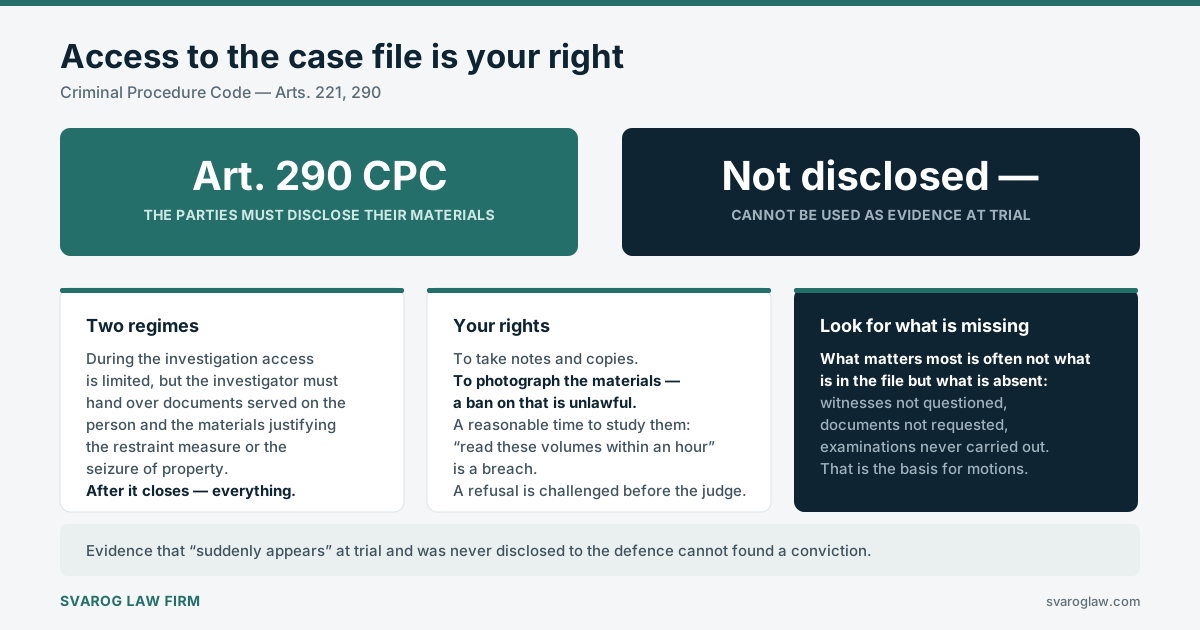
Under Art. 290 the parties must disclose all material to each other. Here the investigator has no choice.
Disclosure: the rule that decides cases
Before sending the indictment to court the prosecutor must give access to all the material in the case, including physical evidence and expert reports (Art. 290(1)–(3)).
That means a piece of evidence that “suddenly appears” at trial and was never disclosed to the defence cannot form the basis of a conviction. Courts grant such applications, and whole counts of an indictment fall apart on this: an expert report, an inspection record or a disc that was not in the file at the time of disclosure no longer works at trial.
So disclosure at this stage is about recording what is in the file at that moment: an inventory of volumes, pages and physical evidence, signed by both sides. The parties confirm disclosure in writing (Art. 290(9)), and how precise that confirmation is determines whether a later “added” item can be blocked.
Access during the investigation
Until the investigation ends the investigator may restrict access in the interests of the investigation, but not to everything. The defence must in any event be given:
The minimum access required
- the procedural documents served on the person: the notice of suspicion, court rulings, records of investigative actions they took part in;
- the material supporting an application for a preventive measure or seizure of property — otherwise there is no way to argue in court;
- documents and items seized from the person themselves;
- publicly available documents: the law expressly forbids refusing access to these (Art. 221).
A refusal or silence from the investigator is challenged before the investigating judge as inaction (Art. 303(1)(1)) within 10 days (Art. 304). Judges’ practice on such complaints is uneven, so we frame the complaint as inaction and attach proof that the application was filed. Often the investigator finds a way to show the material as soon as the complaint is lodged.
What access gives you
An understanding of the charge
What evidence actually exists, and what was the investigator bluffing about at interview.
Finding the breaches
A search without a court order, an interview without a lawyer, a defective expert report. All of this is visible only in the file.
Assessing the prospects
“Is there anything to fight for?” can only be answered after reading the case.
Strategy
Whether to give evidence, whether to challenge the expert report, whether a plea agreement makes sense.
Spotting what is missing
Often the most important thing in a case is what is not in it: witnesses not interviewed, documents not obtained, expert reports not commissioned. Each such gap becomes an application for further investigative steps.
How access works
- An application for access: in writing, with the filing recorded.
- Inspection at the investigating authority’s premises, for a period sufficient to study a file of that size. If the defence drags its feet the prosecutor can ask the investigating judge to fix a deadline (Art. 290(10)), so we work at a pace nobody can call delay.
- Copying. You are entitled to take notes and copies, including photographs (Art. 221). A ban on photographing material you are entitled to see is unlawful.
- Written confirmation of disclosure: it records exactly which volumes, pages and items of physical evidence were seen.
- Applications arising: for further investigative steps, expert reports, interviews.
- A challenge where access was restricted without grounds.
Typical breaches
- not enough time: “take an hour” for volumes of material;
- photographs or copies forbidden;
- not all the material provided: “some of it isn’t bound yet”;
- no disclosure at all before the case goes to court;
- evidence “added” once the trial is under way.
We record each of these in writing: as comments in the confirmation of disclosure, in a separate statement, in a complaint. The consequence for the prosecution ranges from being given a further deadline to being unable to use the evidence at all.
What the court checks when evidence “appears” later
At trial we apply to have such evidence ruled inadmissible (Art. 89, Art. 290(12)). The court checks three things: whether the item existed at the time of disclosure, whether it was on the list of what was disclosed, and whether the defence confirms in writing that it never saw it. That is why we copy every volume in full and keep our own inventory: without it, proving the document was not there is much harder. Material that has reached the court can also be studied after the case is listed (Art. 317), and we check it against the copies made during the investigation.
A case from our practice
In 2025 a businessman charged with fraud (Art. 190(2) of the Criminal Code) came to us. At disclosure we photographed all five volumes in four days and listed every document in the written confirmation. At trial the prosecutor produced a handwriting expert’s report dated before disclosure that had not been in the volumes. We applied to exclude it under Art. 290(12) and filed our own inventory as evidence. The court disregarded the report, and without it the charge on that count did not stand. The trial ran about ten months, and the work on disclosure and the applications cost around 20,000 UAH (details changed).
How we work
- We file the application for access and record that it was filed.
- We challenge a refusal before the investigating judge within 10 days.
- We study the material and look for breaches in how the evidence was obtained.
- We copy everything and keep our own inventory of the volumes.
- We make the applications that follow: what the case is missing.
- We block “added” evidence that was never disclosed to the defence.
Cost of services
No court fee is payable for an application for access, a complaint to the investigating judge or an application to exclude evidence: fees are not charged in criminal proceedings. The outlay is limited to the lawyer’s work and copying the volumes.
Questions and answers (Access to a criminal case file)
Can a victim see the file?
Yes. A victim and their representative are entitled to see material directly concerning the offence committed against them, and after the investigation ends the prosecutor must give them access on the same terms as the defence (Art. 290).
Can the file be inspected remotely?
Material is made available at the investigating authority’s or the court’s premises, so the law does not provide for fully remote inspection. The practical approach is for the lawyer to inspect the volumes on a warrant, photograph them and give the client copies, with the strategy discussed online.
What if disclosure happens the day before the case goes to court?
State in the written confirmation that the time given was insufficient and list what you actually managed to see. The rest is studied at court (Art. 317), and if documents appear there that were never shown, an application to exclude them follows.
Must I attend disclosure in person?
No. The defence lawyer inspects the file on a warrant; the suspect may join if they wish. If the person is in custody, arrangements are made for inspection at the detention centre or the material is brought to them, and the lawyer secures that by a separate application.
How much time counts as sufficient?
The law says only “sufficient time”, and the investigating judge fixes a period if the prosecutor thinks the defence is delaying. In practice courts go by volume: weeks for a few volumes, months for dozens. So we document the pace of inspection and its results day by day.
Contact a Svarog lawyer about access to a criminal case file
We will file the application for access, challenge a refusal within 10 days, study the case and show you what is in it, what is missing, and what can be fought.