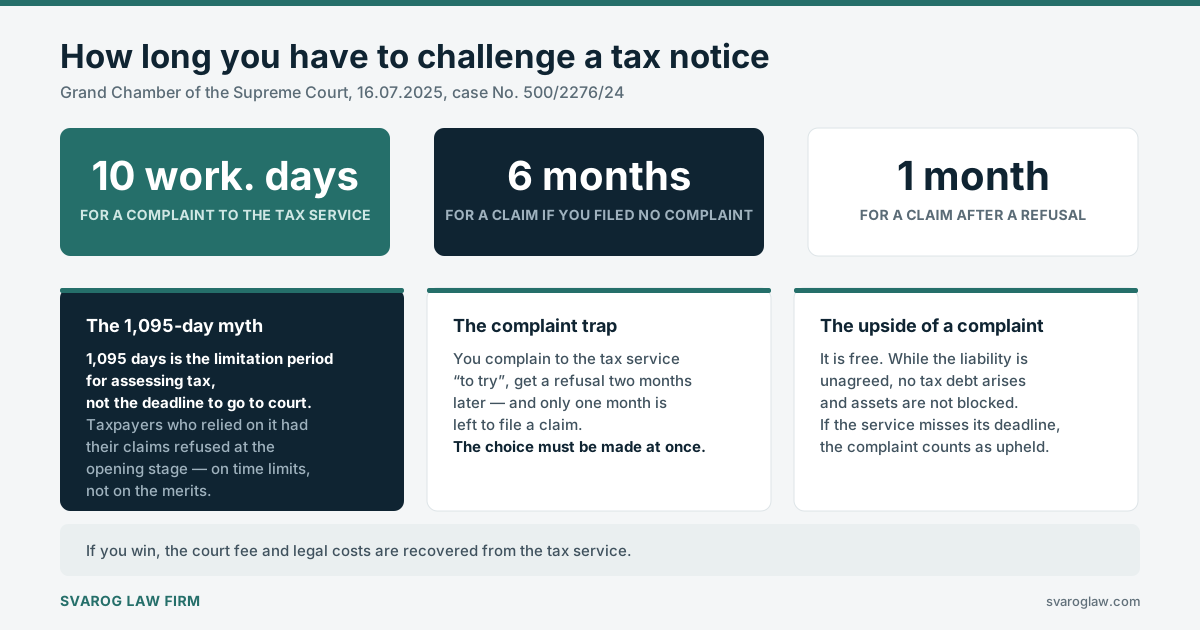
On 16 July 2025 the Grand Chamber of the Supreme Court, in case No. 500/2276/24, settled a long-running argument about deadlines. The rule now is: if you did not complain to the tax service, you have six months from receipt of the tax notice-decision to go to court. If you did complain and the complaint was rejected, only one month remains after the administrative appeal ends.
This matters because dozens of websites, and even some lawyers, still write about “1,095 days”. The Grand Chamber stated plainly: 1,095 days is the period within which the tax authority may assess tax, not the period for going to court. Taxpayers who relied on it had their claims refused on time grounds without ever reaching the merits.
A tax lawyer is needed precisely at this stage: to calculate the deadline correctly, choose the route of challenge and avoid losing the right to a defence through a procedural error.
What we handle
- Challenging tax notices-decisions: assessments of VAT, corporate income tax and personal income tax, and penalties.
- Unblocking tax invoices and removal from the list of risky taxpayers.
- Support during tax audits: desk, documentary and on-site.
- Challenging audit orders and refusing access to an unlawful audit.
- Removing tax debt, challenging a tax lien and the seizure of assets.
- Disputes over VAT refunds from the budget.
- Defence in criminal proceedings under Art. 212 of the Criminal Code (tax evasion).
Two routes of challenge, and why the choice is irreversible
Administrative appeal (a complaint to the tax service)
10 working days to complainThe complaint goes to the higher-level tax authority within 10 working days of receiving the notice-decision Art. 56.3 of the Tax Code. The authority has 20 calendar days to decide it, extendable to 60. If no decision is sent in time, the complaint is treated as decided in the taxpayer’s favour.
The complaint is free, and the monetary obligation stays unagreed — so no tax debt arises and assets are not frozen.
The tax service rarely overturns decisions of its own units, and after a refusal only one month remains to sue.
Challenge in court
6 months or 1 monthThe claim goes to the district administrative court. The deadline depends on whether there was an administrative appeal:
- 6 months from receipt of the notice-decision if you did not complain to the tax service.
- 1 month from the end of the administrative appeal if you did.
This fork is where cases are lost: the taxpayer complains “just to try”, is refused two months later, calmly spends another month preparing a claim — and the deadline has already passed. So the decision whether to approach the tax service is taken immediately on receiving the notice-decision, with both deadlines calculated.
What we check in every notice-decision
Most assessments are annulled not because of sophisticated economic argument but because of the tax authority’s procedural breaches. We check, in order:
- The grounds for the audit: whether the order was lawful, whether the taxpayer was properly notified, whether the grounds in Art. 78 of the Tax Code were met.
- Deadlines: whether the authority went beyond the 1,095-day limitation period Art. 102 of the Tax Code.
- The content of the audit report: whether the findings rest on evidence and cite specific primary documents.
- Whether the transactions were real — the most common basis for assessments. Transport documents, warehouse records, business correspondence and evidence of staff and equipment all work here.
- The calculation of penalties: a typical error is charging the penalty on the VAT-inclusive amount instead of the taxable base, or applying a rate that was not in force on the date of the breach.
- Service of the notice-decision: the whole appeal period runs from the date of service.
Blocked tax invoices
A separate category that businesses meet constantly. The sequence is:
- A receipt suspending registration of the invoice, listing the risk criteria.
- Filing explanations and documents with the regional commission. What decides it is the completeness of the pack: the contract, delivery notes, payment orders, evidence of resources.
- A complaint to the tax service if the commission refuses. The deadline is 10 working days.
- Court if the refusal stands. The decision classifying the taxpayer as risky is challenged at the same time — otherwise the next invoices will be blocked in exactly the same way.
The commonest mistake businesses make is challenging only the blocking of one invoice and leaving the “risky taxpayer” status untouched: the next invoice stops on the same criterion.
When you do not need a lawyer
If the tax authority spotted an arithmetical error in a return and assessed a small amount you agree with, it is cheaper to pay: the court fee, expert report and representation would outweigh the assessment itself.
A lawyer is needed when:
- The amount assessed is comparable to the cost of the defence, or greater.
- The tax authority has treated your transactions as unreal: that also hits counterparties, who will be assessed along the same chain.
- You have been put on the list of risky taxpayers and your invoices are being blocked.
- An audit is under way right now, because what you do in the first days counts for more than objections to the report.
- There is a threat of criminal proceedings under Art. 212 of the Criminal Code.
A case from our practice
In 2025 a trading company came to us with a notice-decision for several million hryvnias: following an unscheduled documentary audit the tax authority had treated purchases from two suppliers as unreal. The deadline for an administrative appeal had already passed, so we went straight to a claim, counting six months from the date the notice-decision was served. The audit report cited no primary documents, and the audit itself had been ordered on a ground the materials did not support. We assembled delivery notes, warehouse records and correspondence with the suppliers, and set out the procedural breaches as a separate section. The court of first instance granted the claim and annulled the notice-decision; the court fee and legal costs were recovered from the tax authority. The case took about nine months (details changed).
Timing and court fees
Preparatory proceedings and the hearing on the merits are, as a rule, up to 60 and up to 30 days respectively, but in practice first instance in a tax dispute takes from six months to a year, and up to two years with appeal and cassation.
The subsistence minimum for able-bodied persons in 2026 is 3,328 UAH, and the court fee is calculated from it:
| Claimant | Rate |
|---|---|
| Company, monetary claim | 1.5 % of the value of the claim, from 3,328 to 33,280 UAH |
| Individual or sole trader, monetary claim | 1 % of the value of the claim, from 1,331.20 to 16,640 UAH |
| Company, non-monetary claim | 1 subsistence minimum — 3,328 UAH |
| Individual, non-monetary claim | 0.4 of the subsistence minimum — 1,331.20 UAH |
| Appeal / cassation | 150 % / 200 % of the claim rate |
Filing through the Electronic Court reduces the rate by 20 %. If you win, the court fee and legal costs are recovered from the tax authority.
How we work
- We audit the notice-decision and the audit report, looking for procedural breaches alongside objections to the amounts themselves.
- We calculate the deadlines and decide whether it is worth approaching the tax service or filing directly.
- We build the evidence: primary documents, proof that the transactions were real, business correspondence.
- We file the complaint or claim and represent the client at every instance.
- We stop collection: while the obligation is unagreed, no debt arises.
- We support the audit itself if you come to us before it ends, because that costs less than challenging the result.
Cost of services
The court fee at the rates in the table above, and a forensic economic report where needed, are paid separately.
Full price list · Challenging tax notices-decisions · Pre-court settlement of tax disputes
Questions and answers (Tax disputes)
Is it worth complaining to the tax service before going to court?
The test is simple. If the dispute turns on procedural defects (the audit was ordered without grounds, service was improper, the penalty was miscalculated), a complaint is worth filing: the higher authority overturns such decisions itself. If the dispute is about whether transactions were real, or about interpreting a provision, the complaint almost always ends in refusal and merely eats into the deadline — so we go straight to court.
What if the notice-decision arrived while the director was abroad?
What counts is the date of service on the taxpayer, not the date the director saw it. If the notice was sent by post and returned, the date is fixed by the rules of the Tax Code. So the first thing we check is the delivery record and the address used: an error there supports both restoring the deadline and annulling the notice-decision itself.
Can the audit report be challenged separately from the notice-decision?
No. The audit report records findings; it is not a decision that creates an obligation. What is challenged is the notice-decision issued on the basis of the report. Objections to the report are still worth filing: they become part of the case file and show the court that the taxpayer stated their position from the outset.
Does filing a claim stop a tax lien and the seizure of assets?
Going to court makes the monetary obligation unagreed, so no new debt — and no lien based on it — arises. If a lien or administrative seizure has already been applied, it is lifted by a separate head of claim or by an application for interim relief.
Can legal costs be recovered from the tax authority?
Yes. If you win, the court awards costs, including professional legal costs, against the respondent. The court checks that the amount is reasonable and proportionate to the complexity of the case, so we prepare the engagement agreement, the act of services and a detailed description of the work in advance.
What happens if the tax authority is refused access to an audit?
Refusing access is possible where the order was issued unlawfully or the taxpayer was not properly notified, but it is a risky step: it gives grounds for administrative seizure of assets under Art. 94.2.3 of the Tax Code, confirmed by a court. We decide on refusal only after analysing the order, and only where the breach is obvious.
Contact a tax lawyer at Svarog
Send us the notice-decision and the audit report. We will check the deadlines, find the procedural breaches and tell you which route of challenge gives the better odds in your situation. If there are no prospects, you will learn that at the consultation, before paying any court fee.