During a search the police often seize things that have nothing to do with the case: family members’ phones, laptops, cash, company documents, a car. Formally “for checking”, but in reality the property sits with the investigator for years, and nobody returns it until the owner starts acting.
Recovering seized property is a procedure with clear deadlines and addressees: the investigator, the prosecutor, the investigating judge. It is started by an application or a complaint, and a lawyer is needed so that every document goes to whoever is obliged to answer it.
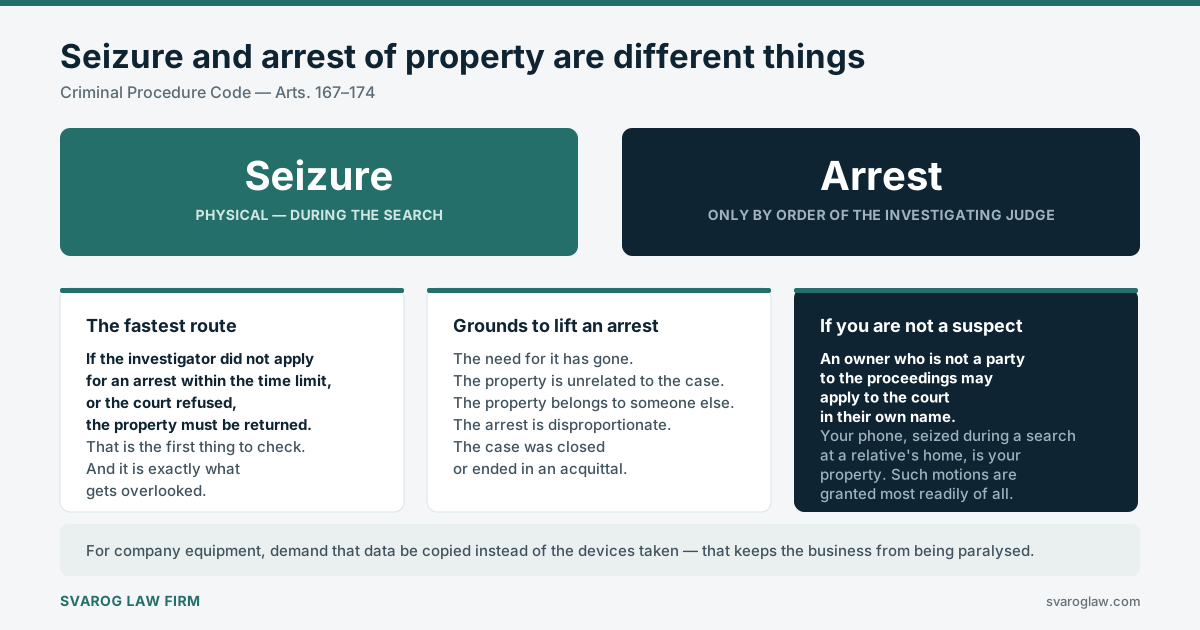
Two different statuses: removal and seizure
Confusing these two costs people months, so we start by establishing which applies.
Actual dispossession during a search or an arrest (Arts. 167, 168). This is not yet a seizure: the investigator must apply to the investigating judge for a seizure order by the next working day.
Imposed by a ruling of the investigating judge. Only then is the property lawfully held, and only from that moment do the grounds for lifting a seizure under Art. 174 apply.
If the seizure application was not filed in time or the court refused it, the property must be returned at once. This is the fastest route and the one most often missed: the owner waits for the investigator’s reply instead of checking at court whether an application was ever made.
Grounds for lifting a seizure
Once a seizure has been imposed it is lifted (Art. 174) where:
When the court lifts a seizure
- the need for it has passed: the investigative steps involving the property are done, the expert report is complete;
- the property is unconnected with the criminal proceedings and was taken along with other things with no bearing on the case;
- the property belongs to someone else who is not a suspect: a relative’s equipment, company assets, a car registered to the wife;
- the seizure was imposed in breach of procedure;
- the seizure is disproportionate: the value of what was taken far exceeds the possible loss or the possible confiscation;
- the proceedings have been closed or an acquittal has been entered.
An application to lift a seizure goes to the investigating judge, who decides it within three days. It can be made by the suspect, the owner of the property, or any other person affected.
What is challenged, and how
The seizure ruling itself is appealed within 5 days (Art. 309(1)(9), Art. 395). A ruling refusing to lift a seizure, however, cannot be appealed: it is not on the list in Art. 309, and the Supreme Court confirms that practice. In that case you file a fresh application on new grounds (the expert report done, the proceedings closed, new ownership documents) or raise the seizure at the preparatory hearing once the case has reached court.
A separate tool: a complaint about the investigator’s inaction where they fail to return temporarily removed property contrary to Art. 169. It goes to the investigating judge (Art. 303(1)(1)), and it is this that works when there is no seizure and the property is simply “sitting there”.
What is taken most often, and what can be recovered
Family members’ phones and laptops
They are not parties to the proceedings and their property has no bearing on the case. The easiest to get back.
A company’s equipment and servers
Everything is often taken indiscriminately, paralysing the business. The law forbids removing computers, servers and phones where copying the information from them is enough (Art. 168(2)), except where the equipment is the instrument or object of the offence. That is the provision our application relies on.
Cash
The lawful origin has to be proved: statements, contracts, declarations.
A car
Particularly painful where it is needed for work or to take a sick relative about. The court takes such circumstances into account when weighing proportionality.
Company documents
Originals of accounting and constitutional documents may not be removed unnecessarily; the company must be given copies.
What to do
- Obtain the inventory of what was taken: it is attached to the search record. Without it the removal is harder to prove.
- Check whether a seizure application was filed and whether the court decided it. If not, or if the court refused, the property must be returned.
- Apply to the investigator or prosecutor for the return of the temporarily removed property.
- Go to the investigating judge with a complaint about inaction if the investigator does not respond or refuses.
- Apply to lift the seizure where one has been imposed, on the grounds in Art. 174.
- Appeal the seizure ruling within 5 days, or file a fresh application on new grounds.
The longer the investigation holds the property, the more “justifications” for holding it appear: another expert report is ordered, it is attached to a different count. So the applications go in at once.
If you are not a suspect
An owner who is not a party to the criminal proceedings may apply to the court in their own right. Your phone, taken during a search of your husband’s or brother’s home, remains your property, and you can demand it back.
People often think that because they have nothing to do with the case they can do nothing. In fact these are the applications most readily granted, provided the owner proves the right with a receipt, a contract or a register entry.
Typical mistakes before coming to us
- Writing only to the investigator and waiting months for a reply, when inaction is challenged before the investigating judge.
- Not checking at court whether a seizure application was ever filed: often there is none.
- Having no documents for the property: without a receipt, contract or statement the court cannot see whose it is.
- Missing the 5 days to appeal the seizure ruling.
A case from our practice
In 2025 the director of a small company came to us after a search connected with proceedings against a counterparty, in which a server, six laptops and the accounting records had been taken. Two weeks later the business was at a standstill and the investigator was promising to “return it after the expert report”. We established at court that the seizure application had been filed a week after the search, in breach of Art. 171(5). We complained about the investigator’s failure to return the property under Art. 169, and the judge ordered the equipment returned. The company got the server and the laptops three weeks after it came to us; our fee was about 12,000 UAH (details changed).
Cost of services
No court fee is payable for an application to recover property, to lift a seizure, or for an appeal against a seizure ruling: fees are not charged in criminal proceedings.
Questions and answers (Recovering seized property)
Can I get a copy of the data from a seized phone or laptop while the investigator has it?
Yes. The owner may ask for the information on the seized device to be copied, and the law in fact prefers copying to removing equipment (Art. 168(2)). The application goes to the investigator, and if refused, to the investigating judge.
How long does recovery take?
If no seizure application was filed or the court refused it, the property can be back in two to four weeks: the time goes on the complaint, its hearing and the physical handover. Lifting a seizure already imposed takes longer, usually one to three months, because you have to wait for the expert report or prove disproportionality.
What if the property comes back damaged or incomplete?
Take it back under a record with your comments: list the missing items, the cracks, the wiped data. On the strength of that record you complain to the prosecutor and bring a damages claim. Without comments in the record, damage is almost impossible to prove.
The proceedings were closed but the property is not being returned. What now?
Once proceedings are closed there is no basis for holding the property: the seizure is lifted and temporarily removed items are returned. You apply to the prosecutor who closed the case, and if there is no response, to the investigating judge.
Contact a Svarog lawyer about recovering seized property
Send us the search record with the inventory of what was taken: we will check whether a seizure was imposed and whether the next-working-day and 72-hour deadlines were kept. It often turns out that the property is being held with no legal basis at all and can be back within a few weeks.