Pre-action settlement of commercial disputes means resolving a conflict between businesses without going to court: through a formal demand, negotiations or mediation. Article 19 of the Commercial Procedure Code provides that the parties take steps to settle a dispute before trial either by agreement between themselves or where such steps are required by law.
On 28 August 2025 the Commercial Code of Ukraine ceased to have effect (Law No. 4196-IX), and with it Article 222, which used to set out what a demand must contain and the one-month period for answering it. The demand procedure now rests on two supports: the terms of your contract and the general rules of the Civil Code on performance of obligations. The law no longer prescribes the contents of a demand, so its requirements are set by business practice and by how a court will assess it.
For business, a formal demand remains the fastest and cheapest way to recover money: it costs a fraction of litigation and does not damage the relationship where the counterparty is willing to pay.
What changed when the Commercial Code was repealed
There is no longer a one-month period to reply
It used to follow from Art. 222 of the Commercial Code. Now the period for answering a demand is set by the contract, and if the contract is silent, Art. 530 of the Civil Code applies: where no time for performance is fixed, the debtor must perform within seven days of the demand being made. That is the period we state in the demand, citing the provision.
There is no mandatory list of required details
But the requirements for a demand as evidence have not gone anywhere: the court has to see exactly what you demanded, when and on what basis, and that the counterparty received it.
Special carriage deadlines are now found in sector legislation
Article 315 of the Commercial Code on three- and six-month demand periods is also gone, so for rail, road and sea carriage we apply the relevant charters and special laws — contract by contract.
Contracts concluded before 28 August 2025 remain in force
The only issue is that references to Commercial Code articles in their texts are now empty, and in the demand we replace them with the applicable Civil Code provisions and the contract’s own terms.
What a demand must contain
For a demand to work both as leverage and as evidence, it states:
Essential elements
- the full name, company code and addresses of the sender and the addressee — exactly as they appear in the Unified State Register;
- the date and number of the demand;
- the circumstances relied on and the evidence supporting them: the contract, delivery notes, acts, payment orders;
- the specific demands, with references to the contract terms and the Civil Code;
- the amount claimed and a full calculation: principal, contractual penalty, fine, damages, inflationary losses, 3 % per annum;
- the deadline for compliance — under the contract or under Art. 530 of the Civil Code;
- payment details and a list of the documents enclosed.
What makes a demand persuasive is the calculation. Inflationary losses and 3 % per annum under Art. 625 of the Civil Code accrue for the whole period of default whether or not the contract provides for them, so the counterparty sees in figures that delay is getting more expensive.
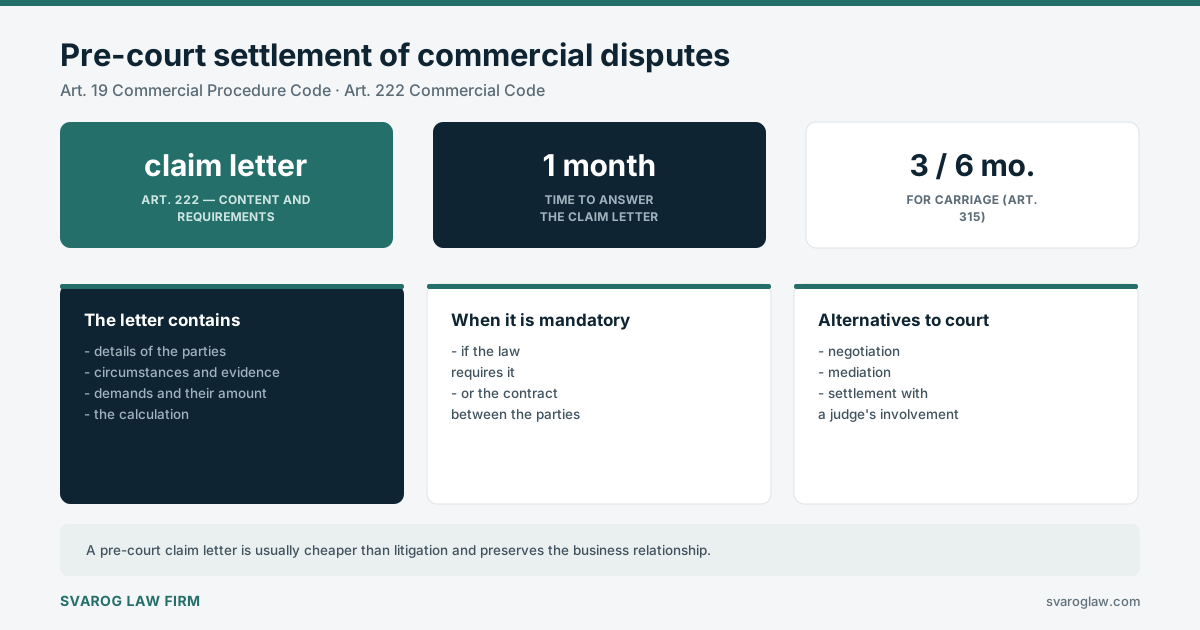
When pre-action settlement is mandatory
As a rule, the demand procedure in commercial disputes is the parties’ right, not their duty. It becomes mandatory only where the law expressly requires it for a particular category of dispute.
A contract clause such as “disputes shall be resolved through negotiations, and failing agreement, after a demand has been sent” does not by itself block the way to court: the grounds for leaving a claim without consideration are listed in Art. 226 of the Commercial Procedure Code and a contractual demand is not among them, while the Constitutional Court held as long ago as 9 July 2002 that mandatory pre-action procedures cannot restrict the right to judicial protection.
Ignoring such a clause is still unwise for practical reasons: the court takes the parties’ conduct into account when allocating costs, and it hands the counterparty a convenient argument about your bad faith. So the first thing we check is the dispute-resolution section of the contract.
When to sue straight away and when to negotiate
Pre-action settlement is not always the right move, and what decides it is not the wish to preserve the relationship but the debtor’s condition.
Where a check on the counterparty shows warning signs: the director or address changed in recent months, open proceedings appear in the Unified Register of Debtors and the enforcement system, insolvency proceedings have begun, assets are being transferred to related parties. In that situation a month spent on a demand works against you, and the right move is a claim together with an application for interim relief: freezing accounts or assets.
Where the counterparty is solvent, the dispute comes down to amount, timing or quality, and the relationship has a future. Here an agreement produces money faster than enforcement.
We calculate the deadlines separately: limitation periods suspended from 2 April 2020 resumed running on 4 September 2025, so for older deliveries the three years for the principal claim and one year for the penalty (Art. 257, 258 of the Civil Code) may expire before negotiations finish.
If the dispute is not commercial but between individuals, different rules apply — we cover them on the page about pre-action settlement of civil disputes.
A case from our practice
In 2025 a supplier company came to us: the buyer had not paid for two consignments worth 480,000 UAH and had spent five months making promises. Before drafting the demand we checked the buyer in the Unified State Register, the register of debtors and the enforcement system: there were no open proceedings and the director had not changed, so there was still a chance of agreement. In the demand we set out the principal, the contractual penalty, inflationary losses and 3 % per annum under Art. 625 of the Civil Code, allowed seven days under Art. 530 and sent it by registered post with a list of contents to the address in the register. Ten days later the buyer came to the table; we signed a supplementary agreement acknowledging the debt with a four-month schedule, secured by the founder’s guarantee. The money arrived on schedule and the matter never reached court. Six weeks passed from the first consultation to signing, and the work cost the client 12,000 UAH — less than the court fee for such a claim alone. (details changed)
The mistakes that cost the most
A demand with no calculation
A letter saying “please settle the debt” reads to a debtor as a request. A demand that breaks the amount down into principal, penalty, inflationary losses and 3 % per annum with dates reads as a forecast of his costs.
No way to prove delivery
A demand sent to a manager’s email or by ordinary post proves nothing in court. You need registered post with a list of contents sent to the address in the Unified State Register; email works only where the contract expressly provides for it.
Lost deadlines
Negotiations drag on for months while the limitation period expires. The one-year period for penalties burns out especially fast.
An acknowledgement of debt that was never recorded
A verbal “we will pay it all” counts for nothing, whereas a written acknowledgement or a reconciliation act interrupts the limitation period (Art. 264 of the Civil Code) and makes later recovery far simpler.
A demand to a debtor who is already moving assets
It merely warns them of the coming claim and gives them time to finish.
How we work
- We analyse the contract, the underlying documents and the dispute-resolution clause.
- We check the counterparty in the state register, the register of debtors, the enforcement system and the property register, to assess whether recovery is realistic.
- We prepare the demand with a full calculation of principal, penalties and 3 % per annum, and send it so that delivery can be proved.
- We negotiate and record what is agreed: a payment schedule, a supplementary agreement, a guarantee, a pledge.
- We prepare the claim and the interim relief application as soon as it becomes clear there is no intention to pay.
- We monitor performance and move to recovery the moment the schedule is broken.
Cost of services
Court fees in 2026 show how much a successful demand saves: a monetary claim by a company in a commercial court costs 1.5 % of the value of the claim, but not less than 3,328 UAH and not more than 1,164,800 UAH; for an individual it is 1 % of the value, from 1,331.20 to 16,640 UAH. A non-monetary claim by a company costs 3,328 UAH, and an interim relief application 1,664 UAH. Filing through the Electronic Court reduces the rate by 20 %.
What a claim would cost instead of a demand
The rate for a company in a commercial court is 1.5 % of the value of the claim.
Court cases are run by our commercial disputes practice, and pre-deal checks on a counterparty by our legal due diligence team.
Questions and answers (Pre-action settlement of commercial disputes)
How should a demand be sent so that receipt can be proved?
By registered post with a list of contents and acknowledgement of receipt, to the counterparty’s address in the Unified State Register. The list records exactly what you sent, and the registered address counts as proper service even if the letter is not collected. Email or messengers work only where the contract expressly provides for that method, preferably with a qualified electronic signature.
The counterparty admits the debt and asks to pay in instalments. How should that be documented?
By a supplementary agreement with a payment schedule and an express statement of the acknowledged amount; it is worth adding security — a founder’s guarantee, a pledge of goods, a direct debit right. A written acknowledgement interrupts the limitation period (Art. 264 of the Civil Code) and time starts again, which favours the creditor. A reconciliation act signed by an authorised person with a company seal serves the same purpose.
Can legal costs for pre-action work be recovered from the debtor?
The court reimburses professional legal costs connected with the case in the amount it considers proportionate. Work on the demand counts if it formed part of preparing that case and is supported by the engagement agreement, a detailed description of the services and an act of acceptance. That is why we document fees from the outset rather than before the final hearing.
How long does pre-action settlement take?
Preparing the demand with a counterparty check takes three to five working days, delivery another week or so, and the compliance period is seven days under Art. 530 of the Civil Code or whatever the contract sets. So you have an answer in about three to four weeks, whereas a commercial dispute at first instance takes from four months.
The debtor is a sole trader or a company with no assets. Is a demand worth sending?
First we check what can actually be recovered: accounts, vehicles, real estate, receivables, shares in other companies. If there are no assets and earlier enforcement proceedings closed with a certificate of no property, a demand will only tip the debtor off. In such cases it is better to file straight away with interim relief, remembering that a sole trader is liable with all their personal property.
Can negotiations and signing be handled remotely?
Yes. Demands and supplementary agreements are signed with a qualified electronic signature, and negotiations are held by video with a written record of what was agreed. A company power of attorney is signed by the director; a sole trader’s must be notarised if the documents go to court.
Contact Svarog about pre-action settlement of commercial disputes
Send us the contract and the underlying documents — we will check the counterparty in the registers, calculate the full amount including penalties, inflationary losses and 3 % per annum, and prepare a demand sent in a way that can be proved. We will take over the negotiations, and if no agreement is reached we move to a claim with interim relief without pausing. For an undisputed monetary obligation, see also debt recovery.