
Олександр Сич
10 October 2026
A car bought during the marriage is presumed to be the spouses’ joint property, even if it is registered only in the husband’s name (Family Code, Art. 60(2)), and divorce does not change that (Family Code, Art. 68). If your husband signed the car over to his brother, you can protect your share in one of two ways: have the contract with the brother declared invalid, or leave the contract alone and recover from your husband half of the car’s market value at the time the case is heard. The court will not grant both claims together (ruling of the Grand Chamber of the Supreme Court in case No. 125/2157/19). So first find out where the car is and choose your route, and if you are going to challenge the contract with the brother, ask the court to ban re-registration of the car even before you file the claim.
The belief that selling a jointly owned car without the wife’s consent is automatically invalid is out of date. Back in 2020 the Supreme Court upheld the invalidation of the sale of a Mercedes-Benz E 200 that had been re-registered to the husband’s mother, noting that the law “does not make challenging a contract dependent on the good faith of the parties to the contract” (case No. 726/1606/17). In 2021 the Grand Chamber of the Supreme Court departed from this approach (case No. 916/2813/18), and in 2022 and 2024 it confirmed the new one. Now a court declares a contract invalid only if it is established that the buyer knew, or in the circumstances could not have failed to know, that the car was joint property and that the other spouse had not consented (cases No. 125/2157/19 and No. 523/14489/15-ц). Your husband’s brother is one of his closest relatives, so in our view this is easier to prove against him than against an outside buyer.
Service centre, Diia or notary: where your husband could have signed the car over to his brother without your consent
Under the law, each spouse entering into a contract is presumed to act with the other’s consent (Family Code, Art. 65(2)). For valuable property the consent must be in writing (Family Code, Art. 65(3)), and the Supreme Court treats a car as a valuable item (ruling of 30 January 2019 in case No. 158/2229/16-ц). However, this consent is not checked everywhere. The Procedure for State Registration of Vehicles (Cabinet of Ministers Resolution No. 1388, paragraph 8) recognises as grounds for re-registration a contract concluded:
- at an MIA service centre, where a car sale and purchase agreement is signed in the presence of an administrator. The service centre does not check spousal consent (paragraph 15 of the Procedure), and the Ministry of Justice acknowledged in its explanation of 16 May 2025 that such consent is not required there;
- at an administrative service centre (TsNAP), where such a contract can also be drawn up;
- electronically in Diia or “Кабінет водія” (Driver’s Cabinet), if the sale is not taxable (the first sale of a passenger car, motorcycle or moped in a year, first indent of paragraph 173.2 of the Tax Code). The system checks whether the car is wanted and whether it has restrictions or encumbrances, but not spousal consent (paragraph 8-1 of the Procedure): re-registering a car via Diia goes through without a single question about whether the seller is married;
- at a notary, the only one who checks consent: a notary will not certify a contract concerning joint property without the other spouse’s notarially certified consent (subparagraph 4.2, paragraph 4, Chapter 1, Section II of the Procedure for Notarial Acts).
Registering the car in the brother’s name does not save the contract: the other spouse can challenge in court any transaction that goes beyond a minor everyday one (Family Code, Art. 65(2); Civil Code, Art. 369(4)).
How to find out whose name the car is registered in now
Car owners are recorded in the Unified State Register of Vehicles kept by the MIA, and any identified person can obtain an extract from it (paragraphs 4 and 8 of the Procedure approved by Cabinet of Ministers Resolution No. 260). The options are:
- By the owner’s full name and date of birth or taxpayer ID (RNOKPP), free of charge (paragraphs 8 and 15 of Procedure No. 260): make, model, year and date of registration. A search using your husband’s details will show whether the car is still in his name, and a search using the brother’s details will show whether it has appeared in his name and when. Bear in mind: by submitting a request, you agree that the car’s owner may be told your full name and what you asked for (paragraph 9 of Procedure No. 260). It is better to prepare the application for interim measures in parallel.
- By VIN: UAH 73.08 for a paper extract and UAH 54.82 for an electronic one (including VAT, according to the MIA Main Service Centre; excluding VAT, UAH 60.90 and UAH 45.68 under paragraph 39-1 of the List of Paid Services, Cabinet of Ministers Resolution No. 795). Among other things, this extract shows the number of owners.
- Through an advocate: access to the Unified State Register of Vehicles under an agreement with the register administrator, or an advocate’s request to a service centre. The reply is given within 5 working days, or within 20 if there is a lot of information (Law “On the Bar and Practice of Law”, Art. 24(2)). The advocate may be refused the brother’s personal data.
- Through the court: once a case has been opened, the court can order a copy of the contract with the brother to be produced (Civil Procedure Code, Art. 84).
There is no full online check: information about attachments and encumbrances is not published in open access (MIA Main Service Centre, 25 February 2026). Do not put off your request: in case No. 760/20240/17 the service centre, as early as 2018, did not provide the documents on the basis of which the car had been re-registered in 2012–2013, because their retention period had expired (Supreme Court ruling of 12 March 2025, paragraph 64). You can check the register yourself, but choosing the route and drafting the claim so that the court does not reject it as an ineffective remedy is best done with a lawyer. A property division lawyer will review your documents and tell you which of the two routes below suits your case.
Two routes: get the car back or take half its value
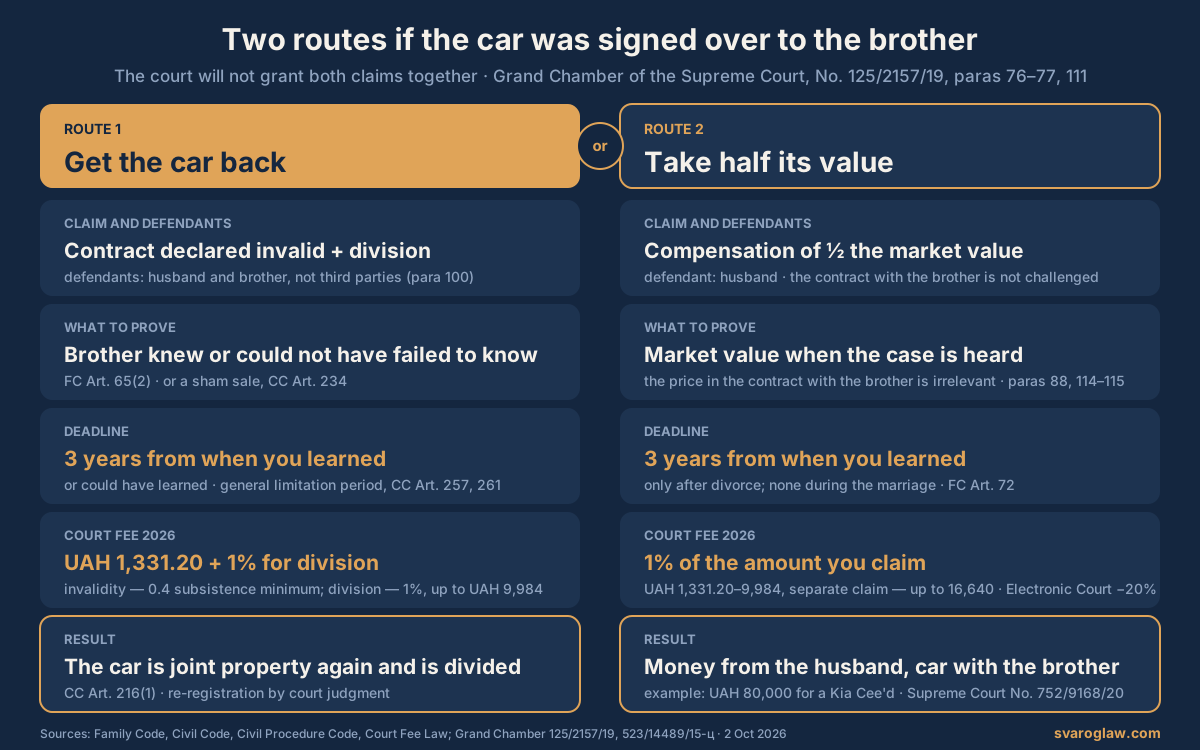
In its ruling of 22 September 2022 in case No. 125/2157/19, the Grand Chamber examined a dispute over a Honda CR-V, a Renault Master and a Mercedes-Benz Sprinter that a husband had sold without his wife’s consent. The wife asked both to have the contracts declared invalid and to recover compensation, while joining the buyers only as third parties, and her claim to invalidate the contracts was rejected on both grounds (paragraphs 100, 110). The Grand Chamber’s conclusion: the remedy is chosen according to the goal, and a contract cannot be declared invalid while compensation is recovered at the same time (paragraphs 76–77, 111).
A claim against your husband and his brother to declare the contract invalid and divide the property. You prove that the brother knew or could not have failed to know that the car was joint property and that you had not consented (Family Code, Art. 65(2)), or that the sale was a sham (Civil Code, Art. 234). The brother returns the car (Civil Code, Art. 216(1)), and the service centre re-registers it on the basis of the court judgment (paragraphs 35 and 40 of Procedure No. 1388).
You do not challenge the contract with the brother; instead, you recover from your husband half of the car’s market value at the time the case is heard (Grand Chamber of the Supreme Court, No. 125/2157/19, paragraphs 114–115). The court does not assess the brother’s conduct, because the contract with him is not being challenged. The car stays with the brother, and you get a judgment ordering your husband to pay you money.
The first route suits you when the car is still with the brother and it is the car itself that you want: in that case the Grand Chamber regards invalidating the contract as an effective remedy (case No. 523/14489/15-ц, paragraph 107.2). The brother is named as a co-defendant in the statement of claim itself, not as a third party. He can be joined later only at your request before the end of the preparatory proceedings (in simplified proceedings, before the start of the first hearing). After that, the court will join him only if you prove that before filing the claim you did not know and could not have known the grounds for doing so (Civil Procedure Code, Art. 51(1), (3)). But you know that the buyer is the brother, so this exception does not help you.
A returned car is divided under Art. 71 of the Family Code: it can be left with your husband while you recover half of its market value. This requires neither a deposit in the court’s account nor your husband’s consent (Grand Chamber of the Supreme Court, ruling of 8 February 2022 in case No. 209/3085/20, paragraphs 45, 50). Shares, debts and deadlines for the rest of the property, from an apartment to loans, are covered in our overview of how property is divided after divorce.
The second route is more realistic when the brother has already resold the car to an outsider: a claim to invalidate the first contract and get the car back may then fail, and you are left with compensation or reclaiming the property (Civil Code, Art. 388). The price in the contract with the brother does not affect the calculation: the Grand Chamber described a sale at an understated price without the other spouse’s consent as a sign of the seller’s bad faith (No. 125/2157/19, paragraph 88). What else in Supreme Court case law works in your favour:
- An average market value calculation from the Ministry of Economy’s website (under the Procedure approved by Cabinet of Ministers Resolution No. 403) is not inadmissible evidence of value (Supreme Court ruling of 20 January 2026 in case No. 759/1837/24).
- Without an expert examination, the valuation is hard to dispute. The husband sold a 2008 Kia Cee’d after the property division case had already been opened and did not ask for an expert examination. The Supreme Court itself ordered him to pay UAH 80,000, half of the UAH 160,000 stated in the claim (ruling of 23 July 2024 in case No. 752/9168/20).
- Spending on the family is for the husband to prove: if he relies on Art. 65(4) of the Family Code, it is he who must show that the money from the sale went on the family’s needs (Supreme Court ruling of 30 January 2019 in case No. 158/2229/16-ц).
- A sale the day before a property division claim points to a conflict between the spouses: an Audi Q7 was sold on 12 August 2021, and the Supreme Court upheld the order for the husband to pay half of its value (No. 127/21002/21).
How to prove that the brother bought the car only for show
A sham transaction (Civil Code, Art. 234) is made without any intention to create legal consequences, and this “for show” element must apply to both parties. If the property was actually handed over under the contract, the contract will not be found to be a sham (Supreme Court ruling of 29 June 2022 in case No. 462/1712/20). If the brother drives the car himself, rely on a different ground: he knew or could not have failed to know that you had not consented. Courts take the following signs into account:
- A buyer from the close circle. The Grand Chamber upheld the invalidation of the sale of an apartment to a close friend, the son’s godmother: she “could not have failed to know” that the property was joint (No. 523/14489/15-ц, paragraphs 103–104).
- The seller keeps driving the car, and the price is below market value according to an independent valuation: case No. 462/1712/20, discussed below, rested on these signs.
- A compulsory motor third-party liability insurance (OSCPV) policy and fines in the husband’s name after the “sale”. We have not found a specific Supreme Court ruling on such evidence; the court will assess it together with the rest of the evidence (Civil Procedure Code, Art. 76–81).
- Witnesses and photographs are admissible to prove the buyer’s bad faith (No. 523/14489/15-ц, paragraph 104.2).
Supreme Court ruling of 29 June 2022 in case No. 462/1712/20: a Peugeot for the brother for UAH 15,000
On 30 July 2019, five months after the husband filed for divorce, two contracts appeared: a BMW 535D went to his mother for UAH 40,000, and a Peugeot Partner went to his brother for UAH 15,000. The Supreme Court agreed that both contracts were shams: on the day of the sale the brother handed the car back to the husband, the Peugeot’s price had been understated, and the mother, an elderly woman, had no driving licence. The Supreme Court dismissed the cassation appeal and called the invalidity claim an effective remedy, because it returns the car to the spouses’ joint property regime.
A sham is proved through the conduct of the parties to the contract. Gather evidence of who drives the car after the sale, how much was paid for it and whether the buyer is able to use it before you go to court: witness statements, photos, a valuer’s report.
Attachment of the car and a ban on re-registration: the application is decided within 2 days
To stop the brother from reselling the car while the case is pending, you file an application for interim measures, and you can do this even before filing the claim itself (Civil Procedure Code, Art. 149(2)). If you are challenging the contract and the brother is a co-defendant, the suitable measures for a car are attachment of the car as the defendant’s property (Civil Procedure Code, Art. 150(1)(1)) and a ban on other persons, such as MIA service centres, carrying out registration actions with the car as the subject of the dispute (Civil Procedure Code, Art. 150(1)(4)). The court will not attach the car of a brother who is not a defendant, even if he has been joined as a third party (Supreme Court ruling of 30 July 2025 in case No. 752/22157/20). On the compensation route, the husband’s property or money is attached instead, up to the amount of the claim.
The court considers the application within two days at the latest, without notifying the husband and the brother (Civil Procedure Code, Art. 153(1)). If the court granted interim measures before the claim was filed, the statement of claim must be filed within 10 days (Civil Procedure Code, Art. 152(4)). Once the attachment or ban has been entered in the Unified State Register of Vehicles, the car cannot be re-registered or removed from the register (paragraph 41 of Procedure No. 1388).
A claim to invalidate a contract is a non-property claim, but attaching the subject of the contract in such a case is permissible, because otherwise a resale would make the judgment pointless (Grand Chamber of the Supreme Court, ruling of 24 April 2024 in case No. 754/5683/22, paragraphs 54–55). In doing so, the court weighs the risk to the protection of your rights, the proportionality of the measure and the real purpose of the application (paragraph 47).
Deadlines and court fees in 2026
The fee is calculated from the subsistence minimum for able-bodied persons, UAH 3,328 (Law on the State Budget for 2026, Art. 7), and when you file via “Електронний суд” (Electronic Court), a coefficient of 0.8 applies (Law “On Court Fee”, Art. 4(3)).
| What you file | Deadline | Fee | Electronic Court |
|---|---|---|---|
| Application for interim measures | Before the claim, together with it or at any stage of the case (Civil Procedure Code, Art. 149(2)); if before the claim, the claim must be filed within 10 days of the court’s order | UAH 665.60 | UAH 532.48 |
| Invalidating the contract with the brother | 3 years from the day you learned or could have learned (Civil Code, Art. 257, 261) | UAH 1,331.20 (non-property claim) | UAH 1,064.96 |
| Division of the car or compensation | No limitation period during the marriage; after divorce, 3 years from the day you learned or could have learned of the violation (Family Code, Art. 72) | 1% of the claim value, UAH 1,331.20–9,984 | UAH 1,064.96–7,987.20 |
This is how the Grand Chamber calculated the fee in case No. 523/14489/15-ц (paragraphs 150, 153, 170). If, however, division is sought separately, years after the divorce, the court may apply the general rate for property claims with a maximum of UAH 16,640: there is no clear Supreme Court position on this. A hypothetical example: the car is worth UAH 400,000, you claim half, and the fee is UAH 2,000, or UAH 1,600 via Electronic Court.
Under Art. 72 of the Family Code, only a claim for division of property made during the marriage is heard without a limitation period. As a general rule, the ordinary three-year period applies to challenging the contract with the brother. So waiting for the divorce is risky: the court will examine not only whether you knew about the sale, but also whether you could have found out about it earlier (Grand Chamber of the Supreme Court, ruling of 11 October 2023 in case No. 756/8056/19). If you learned about the re-registration before September 2025, bear in mind that the limitation period was extended for the duration of quarantine and martial law (Civil Code, Final and Transitional Provisions, paragraphs 12 and 19; paragraph 19 was deleted only as of 4 September 2025 by Law No. 4434-IX), so it is best to calculate the end date of the period with a lawyer.
After divorce, the three years for division run from the day you learned or could have learned of the violation of your right, not from the date of the divorce (Family Code, Art. 72(2); paragraph 15 of Resolution No. 11 of the Plenum of the Supreme Court of Ukraine of 21 December 2007). If the divorce is still in progress or only being planned, discuss the car with a divorce lawyer straight away.
What the spouse who signed the car over to his brother risks
- The car may be divided again: if the court declares the contract invalid, the brother must return the car (Civil Code, Art. 216(1)), and its registration in his name will be cancelled (paragraph 40 of Procedure No. 1388).
- His share may be reduced: the court may depart from equal shares if one spouse has concealed joint property (Family Code, Art. 70(2)).
- The brother becomes a co-defendant if the contract is challenged, and the court can attach the car registered in his name within two days, without even notifying him (Civil Procedure Code, Art. 150, 153).
Primary sources
- Family Code, Art. 60, 65, 68, 70–72 — zakon.rada.gov.ua; Civil Code, Art. 216, 234, 257, 261, 369, 388, paragraphs 12 and 19 of the Final and Transitional Provisions — zakon.rada.gov.ua; Civil Procedure Code, Art. 51, 76–81, 84, 149–153 — zakon.rada.gov.ua
- Law “On Court Fee”, Art. 4 — zakon.rada.gov.ua; Law No. 4824-IX (new wording of the second indent of Art. 65(3) of the Family Code) — zakon.rada.gov.ua; Law No. 4434-IX (deletion of paragraph 19 of the Final and Transitional Provisions of the Civil Code) — zakon.rada.gov.ua
- Procedure for State Registration of Vehicles (Cabinet of Ministers Resolution No. 1388) — zakon.rada.gov.ua; Procedure for Providing Information from the Unified State Register of Vehicles (Cabinet of Ministers Resolution No. 260) — zakon.rada.gov.ua; Procedure for Notarial Acts — zakon.rada.gov.ua; Resolution No. 11 of the Plenum of the Supreme Court of Ukraine — zakon.rada.gov.ua
- Grand Chamber of the Supreme Court: No. 916/2813/18 (court register), No. 125/2157/19 (court register), No. 523/14489/15-ц (court register), No. 209/3085/20 (court register), No. 754/5683/22 (court register), No. 756/8056/19 (court register)
- Civil Cassation Court of the Supreme Court: No. 462/1712/20 (court register), No. 158/2229/16-ц (court register), No. 127/21002/21 (court register), No. 752/9168/20 (court register), No. 759/1837/24 (court register), No. 760/20240/17 (court register), No. 726/1606/17 (court register), No. 752/22157/20 (court register)
- MIA Main Service Centre: cost of an extract from the Unified State Register of Vehicles and news item of 25 February 2026; Ministry of Justice explanation of 16 May 2025
Notarised consent, a sale after divorce and the husband’s “own money”
Was notarised consent needed to sell the car?
The law gives no direct answer. Art. 65(3) of the Family Code requires the consent to be notarised for contracts that need notarial certification or state registration: until 25 May 2026 the consent had to be “notarially attested”, and from that date, under Law No. 4824-IX, “notarially certified”. But at a service centre it is the car that is registered, not the contract, and the Grand Chamber has no position on cars. Either way, a contract made without your consent will be declared invalid only if the brother acted in bad faith or the sale was a sham.
My husband sold the car after the divorce. Does that change anything?
No. After divorce, joint property can be disposed of only by mutual consent (Family Code, Art. 68; Civil Code, Art. 369(2)), so such a sale is challenged in the same way.
My husband says he bought the car with his own money. Who has to prove it?
He does. The presumption of joint ownership must be rebutted by whoever disagrees with it (Family Code, Art. 60(2); Grand Chamber of the Supreme Court, ruling of 11 October 2023 in case No. 756/8056/19).
The car has already been signed over and could be resold
While the car is registered in the brother’s name, a resale can still be stopped: the court considers an application to attach the car and ban registration actions within two days at the latest, without notifying the husband and the brother (Civil Procedure Code, Art. 153(1)). Once the car ends up with an outsider, getting that particular car back will be much harder. Svarog will prepare the application and a claim naming the right defendants, and will take on your court representation.