

Олександр Сич
6 July 2026
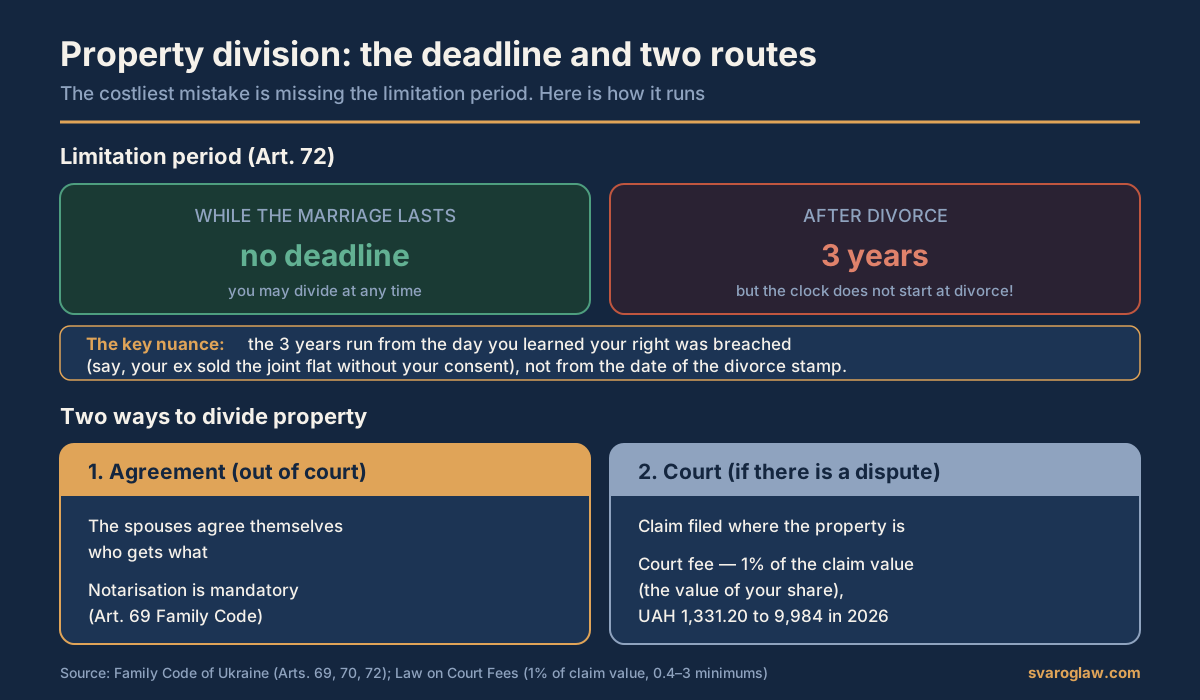
The short answer. All property acquired during a marriage is treated as joint common property and is divided equally by default — whatever the paperwork says and whoever earned more (Arts. 60, 70 of the Family Code). Property bought before the marriage, and inheritances and gifts received even during it, is not divided (Art. 57). Property can be divided by a notarised agreement or through the courts: the fee is 1 % of the value of the claim, from 1,331.20 to 9,984 UAH. After a divorce a three-year limitation period applies.
The court fee on a claim to divide property on the dissolution of a marriage in 2026 is 1 % of the value of the claim, within a range of 1,331.20 to 9,984 UAH, and the period for bringing a claim after the divorce is limited to three years (Art. 72 of the Family Code). Those two figures determine when, and at what cost, it is worth starting; everything else depends on whether the composition of the joint property can be proved.
A flat, a car, loans, a business — all of it has to be divided or settled by compensation. Each class of asset has its own regime: a share in a limited company is counted differently from a deposit, and a mortgage debt differently from a gift from parents. Each situation is set out below with the provision, the deadline and the amount.
What counts as spouses’ joint property
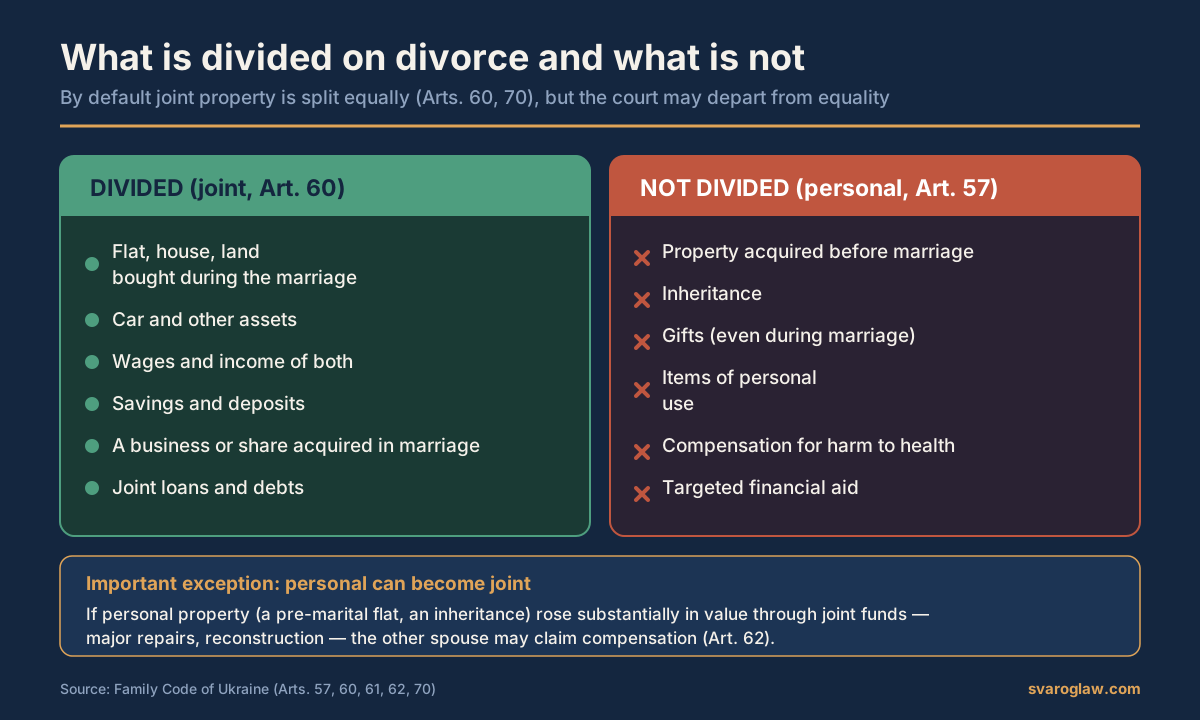
Under Article 60 of the Family Code, everything acquired during the marriage is joint, whichever spouse it is registered to:
- the wages and other income of both;
- a flat, a house, a plot of land;
- a car and other movable property;
- a business or a company shareholding acquired during the marriage;
- savings and bank deposits.
Equality applies regardless of contribution: even where one spouse had no income of their own for a good reason (caring for children, running the household), their contribution counts as equal and the shares as equal (Art. 70). Dissolving the marriage does not by itself end joint ownership (Art. 68): the property stays joint until it is divided by agreement or by a court.
What property is not divided
Personal private property (Art. 57), which stays with one spouse, comprises:
- property acquired before the marriage was registered;
- property received by inheritance or as a gift — even during the marriage;
- items of personal use;
- money received as compensation for injury to health;
- earmarked financial assistance.
| Asset | Treatment on division | Provision and what must be proved |
|---|---|---|
| A flat bought during the marriage | Joint, shares equal | Art. 60; the dated sale contract |
| A flat bought before the marriage | Personal; compensation possible for the increase in value | Arts. 57, 62; valuations before and after the works |
| An inheritance or a gift | Personal property | Art. 57; the certificate of inheritance, the deed of gift |
| A car | Joint, but cannot be split physically: sale or compensation | Art. 71; a valuer’s report |
| A share in a limited company | The member’s share is divided, not the company’s assets | Art. 61; the charter, accounts, a valuation |
| A loan taken for the family’s needs | A joint debt in the same proportion | Art. 65; the loan agreement and what the money was for |
| Property acquired without a registered marriage | Joint if cohabitation and shared funds are proved | Art. 74; receipts, correspondence, witness evidence |
Is property always divided equally
Equal shares are the default rule, not an absolute one. Under parts 2 and 3 of Article 70 the court may depart from equality and increase one spouse’s share where circumstances of substantial significance exist: where the other did not provide for the family, avoided maintaining the children, concealed or destroyed joint property or spent it against the family’s interests. The share may also be increased in favour of the spouse the children live with, where the maintenance for them is insufficient. So “50–50” is the usual outcome but not a guaranteed one: much depends on the evidence and on how the parties argue their case.
Where an item cannot be split physically, monetary compensation is used. Under parts 4 and 5 of Article 71 it is awarded only with the consent of the spouse giving up their share, and on condition that the other has paid the corresponding sum into the court’s deposit account in advance. On registering shares in real property after judgment, see the page of our property lawyer.
Is a flat bought before the marriage divided
No. A flat acquired before the marriage was registered is the personal property of the spouse who bought it and is not divided. Article 62 makes an exception: where during the marriage the value of such a home rose substantially thanks to joint funds or the other spouse’s labour (major repairs, reconstruction, an extension), the court may recognise their right to compensation or to a share. That is reimbursement of what was invested, and the amount is calculated from a valuer’s report, not as half the value of the flat.
How to divide a car
A car cannot be split physically, so one of two routes is used: sell it and divide the proceeds, or leave it with one spouse and pay the other compensation based on an independent valuation. If the car was sold without the other spouse’s consent shortly before the dispute, its value is still counted within the property to be divided.
Is a business divided on divorce
A business is divided where it was created or acquired during the marriage: what is at stake is the shareholding, the corporate rights and the profit received. The share is determined by a valuation taking account of assets, debts and profitability. One point from the case law: a limited company’s property and money belong to the company itself, so what is divided is the member’s share, not the firm’s machinery or bank accounts.
How a loan is divided after a divorce
Loans taken during the marriage for the family’s needs can be recognised as the spouses’ joint debts — that covers mortgages, consumer loans and borrowings for family purposes. Where the loan is in one person’s name, the court examines whether the money was used in the family’s interests and whether the other spouse benefited. Debts are divided in the same proportion as the property bought with that money. Bear in mind separately that a judgment dividing property does not change the terms of the contract with the bank: the lender still demands payment from whoever signed it, and the settling up between the former spouses happens separately. Ways out of a debt deadlock are described on the page of our loans lawyer.
How long you have to divide property: the limitation period
Article 72 lays down two different rules:
- While the marriage subsists — no limitation period applies. Joint property can be divided at any time.
- After the marriage is dissolved — a three-year limitation period applies.
The three years run not from the date of the divorce but from the day the person learned, or could have learned, that their right had been infringed. If a former husband sold the joint flat without your consent five years after the divorce, time starts running from the moment you found out. One further factor: the running of limitation, suspended from 2 April 2020 for the duration of the quarantine and martial law, resumed on 4 September 2025 under Law No. 4434-IX, so deadlines in older cases must be calculated with that period in mind.
How to divide property without going to court
Where the spouses are not in dispute, property is divided voluntarily by an agreement on division. It sets out who takes what, the compensation payable and how the property is handed over. In respect of real property such an agreement must be notarised (Art. 69). This is the cheapest and quickest route, and it also reduces the risk of future disputes. Spouses who have not yet divorced can settle the question in advance by a marriage contract (Chapter 10, Arts. 92–103).
Division through the courts: step by step
- Record what the property consists of (1–2 weeks): extracts from the Register of Real Property Rights, vehicle records, bank statements, company-share data from the Unified State Register.
- Order a valuation (3–10 days): it determines the value of the claim and the court fee.
- Send a written proposal for division (2–4 weeks for a reply). The correspondence will later show that you tried to settle the dispute.
- File the claim: for real property, at the court where it is located. The fee is 1 % of the value of the claim, from 1,331.20 to 9,984 UAH; filing through the Electronic Court multiplies the sum by 0.8.
- Apply for interim relief if there is a risk of disposal: an attachment stops the flat or the car being transferred to third parties while the case runs.
- Register your title once the judgment takes effect (30 days without an appeal): until the entry is made in the register, the share cannot be dealt with.
Where the claim for division is brought separately, after the divorce has already been registered, the court may apply the general rate for a property claim with a ceiling of five subsistence minimums — up to 16,640 UAH. Indicative figures for a lawyer’s work are in the service prices section.
Typical mistakes in dividing property
- Oral arrangements. A promise to “leave you the flat if you don’t claim the car” has no force without an agreement, and a year later the other side brings the claim anyway.
- Division without a valuation. A value of the claim estimated by eye leads to the application being stayed, or to topping up the fee once the claim is clarified.
- Forgotten debts. A party divides the flat without raising the mortgage and ends up with the asset and the whole of the borrowing.
- Getting company property wrong. A demand to “divide the firm’s equipment” will not do: what is divided is the member’s share, and otherwise the claim is dismissed.
- Delay. Three years after a divorce pass quickly, and the court restores the period only for valid reasons supported by documents.
When you do not need a lawyer
Where the spouses agree on what the property is and what the shares are, the agreement on division can simply be drawn up by a notary: they will check the documents, explain the consequences and certify the deed. The same goes for cases involving one flat or one car where the parties are not arguing about value. Legal help is needed where property has been moved into the names of relatives or companies, where there is a business, a mortgage or several assets, where a party is seeking a departure from equal shares, and where the limitation period is running out. How such cases are run is described on the page of our property-division lawyer.
Questions and answers
How is property divided after a divorce?
Joint property acquired during the marriage is divided equally by default — by agreement between the parties or by a court judgment. In the cases set out in Article 70 the court departs from equal shares.
Is a flat bought before the marriage divided?
No, it is personal property. If the home rose substantially in value through joint funds (repairs, reconstruction), the other spouse can claim compensation under Article 62.
How long do you have to divide property after a divorce?
Three years from the day the person learned that their right had been infringed (Art. 72). While the marriage subsists, no limitation period applies.
Is property received by inheritance or as a gift divided?
No, it is personal property, except where it rose substantially in value through the spouses’ joint funds.
How is a business divided on divorce?
The member’s share or the corporate rights are divided after a valuation. A limited company’s property belongs to the company and not to the spouses, so the division is rarely an equal one.
Is a loan divided after a divorce?
Yes, if the loan was taken for the family’s needs. But the judgment does not change the contract with the bank: the lender will demand payment from the borrower under that contract.
Can property be divided without going to court?
Yes, by an agreement on the division of property. For real property notarisation is mandatory (Art. 69).
What does filing a claim to divide property cost in 2026?
1 % of the value of the claim, within a range of 1,331.20 to 9,984 UAH on dissolution of the marriage. Filing through the Electronic Court reduces the sum by 20 %.
Is property acquired in an unregistered partnership divided?
Yes, under Article 74, where it is proved that the couple lived together as a family without registering the marriage and acquired the property with shared funds.
What if a former husband has transferred property to relatives?
Bring a claim to have those transactions declared invalid together with the claim for division, and ask the court to attach the disputed property.
Sources
- Family Code of Ukraine, Arts. 57, 60, 61, 62, 65, 68, 69, 70, 71, 72, 74, 92–103 — zakon.rada.gov.ua
- Law of Ukraine “On Court Fees” No. 3674-VI, Art. 4 — zakon.rada.gov.ua
- Civil Code of Ukraine (limitation, transactions) — zakon.rada.gov.ua
- Civil Procedure Code of Ukraine (interim relief, jurisdiction) — zakon.rada.gov.ua
- Supreme Court reviews of the case law on dividing spouses’ property — supreme.court.gov.ua
Dividing property with Svarog
Dividing property is the most contentious part of a divorce, and there mistakes are measured in flats and businesses. Svarog’s lawyers will assess the prospects, build the evidence, prepare the agreement or the claim and defend your financial interests in court. That matters most where there is real property, a business or debts, or where a former partner is trying to conceal or move assets. More on the page of our divorce lawyer and in the family law section.
+38 095 554-54-24 · Kyiv, 7 Khoriva Street (Podil) · Mon–Fri 9.00–18.00