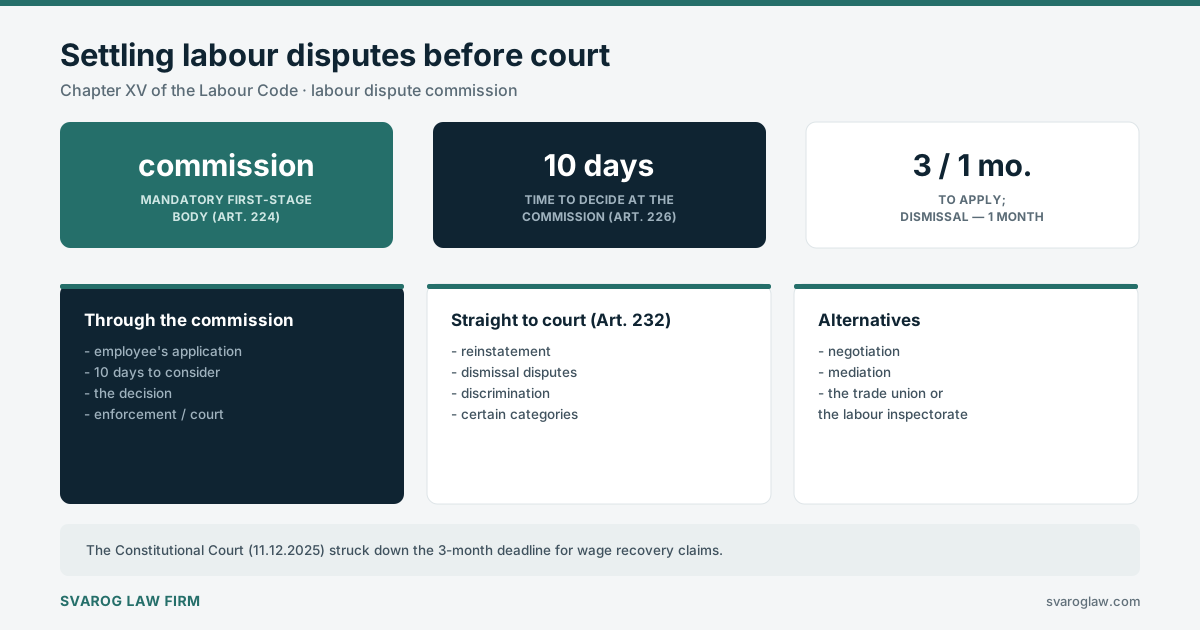
Settling an employment dispute out of court means one of three tools: an application to the labour disputes commission, a written demand with negotiations, or mediation. All three cost no court fee and work faster than litigation: the commission decides within 10 days (Art. 226 of the Labour Code), whereas a first-instance judgment in an employment case usually takes months.
One caveat at the outset. Article 224 of the Labour Code still calls the commission “the mandatory primary body”, but that provision is effectively dead: under Art. 124 of the Constitution and Art. 221 of the Labour Code an employee may go straight to court, and Plenary Resolution No. 9 of the Supreme Court of Ukraine of 1 November 1996 (para. 8) barred courts from dismissing claims because the commission had not been used. So the out-of-court stage is chosen when it pays, and nobody is forced into it. It pays where the employer accepts the facts and argues only about timing or amount.
We assess which route gets a result faster in your situation — the commission, a demand, mediation or going straight to court — prepare the documents, watch the deadlines in Art. 233, and negotiate with the employer on your behalf.
Three ways to settle with an employer without going to court
The choice depends on whether the employer has a commission, whether you are still employed, and what exactly the employer disputes.
The labour disputes commission
Set up at employers with 15 or more staff (Art. 223). The application is filed within three months of the day you learned of the breach (Art. 225); the commission decides within 10 days with the employee present. Its decision can be appealed to court within 10 days (Art. 228), and if nobody appeals, the employer must comply within three days (Art. 229). If it does not, the commission issues a certificate with the force of an enforcement instrument (Art. 230): with it the employee goes straight to the enforcement service, bypassing the court.
A demand and negotiations
A written demand with the debt calculated and reference to Arts. 116 and 117. It pays the employer to settle while the compensation for late payment — average earnings for each month, up to six months — is still small. The agreement is recorded in writing with a payment schedule.
Mediation
Under the Law “On Mediation” No. 1875-IX of 16 November 2021. Apt where the employment continues and both sides want to keep it: a dispute over hours, a transfer, a reprimand, or bullying.
A separate option is complaining to the Labour Inspectorate. It does not resolve the dispute between you and the employer, but undocumented employment or unpaid wages expose the employer to fines under Art. 265, so a mention of the inspectorate in the demand often speeds payment up.
Which disputes the commission does not hear
Under Art. 232 the following go straight to court, without the commission: reinstatement, changing the date or the stated reason for dismissal, pay for enforced absence, and disputes of employees at businesses with no commission. Filing such a dispute with the commission is pointless: it must refuse, while the one-month deadline for a reinstatement claim runs on.
Deadlines you cannot miss
Under Art. 233 the general period for bringing an employment dispute is three months from the day the employee learned of the breach, and one month in dismissal cases from service of the copy of the order or issue of the employment record book. For claims for wages and other sums due to the employee there is no longer any limit: by Decision No. 1-r/2025 of 11 December 2025 the Constitutional Court held the three-month period in wage disputes unconstitutional. A missed deadline can be restored for good reason (Art. 234), but it is not something to count on.
The practical consequence for the out-of-court stage: negotiations and mediation do not stop time running. So we send the demand with a short deadline for a reply (5–7 days) and prepare the claim in parallel, ready to file as soon as it is clear the employer is playing for time.
Common mistakes before coming to us
The most expensive mistake costs the right to reinstatement: someone spends three weeks emailing HR and in the fourth week learns that the one-month period under Art. 233 has expired. The second most common is the wrong addressee: a reinstatement application goes to the commission, which cannot hear it (Art. 232), and time passes. The third concerns evidence: after dismissal access to corporate email, timesheets and payslips disappears, so copies must be saved while you are still at work. And the fourth is the simplest: an oral promise to “pay it all next month” with nothing in writing. For the commission and the court that promise does not exist.
A case from our practice
In February 2025 an accountant at a Kyiv trading company came to us after being dismissed by agreement without her final settlement: about 48,000 UAH of wages and holiday pay. The director promised orally to pay “after New Year” but would only reply by messenger. We sent a demand with the debt and the late-payment compensation under Art. 117 calculated (her average earnings were 32,000 UAH a month, so after two months’ delay the claim had nearly doubled) and gave seven days to reply. Three weeks later the company signed an agreement to pay in two instalments and settled in full, including part of the late-payment compensation. The client paid for a consultation and the demand; the matter never reached court. (details changed)
How we work
- from the documents we establish whether the employer has a commission and whether the dispute is one only a court can hear (Art. 232);
- we calculate the deadline under Art. 233 and, where needed, immediately gather evidence of good reasons for restoring it;
- we prepare the application to the commission or the demand, with the debt and the Art. 117 compensation calculated and the Art. 265 fines cited;
- we negotiate or mediate and record what is agreed in a written agreement with a payment schedule;
- we represent the employee at the commission hearing and, if the decision is not complied with, obtain the commission’s certificate for the enforcement service;
- if the employer does not reply within the deadline, we file the prepared claim through the Electronic Court.
Cost of services (settling an employment dispute out of court)
Court fees in 2026: for claims arising from employment relations the employee is exempt (Art. 5(1)(1) of the Law “On Court Fees”), so moving from a demand to a claim adds nothing to the cost. If the relationship was documented as a civil contract (services or works), the fee is 1 % of the value of the claim, minimum 1,331.20 UAH, and the procedure is set out on the page about settling civil disputes out of court.
Questions and answers (settling an employment dispute out of court)
The employer is not complying with the commission’s decision. What now?
Three days after the ten-day appeal period ends, the commission issues, on your application, a certificate that is an enforcement instrument (Art. 230). It is presented to the enforcement service within three months; the officer recovers the sum from the company’s accounts just as on a court judgment. There is no need to go to court again.
Can the negotiations be run remotely if I have already left the city?
Yes. The demand goes by registered post with a list of contents and to the employer’s official email; negotiations are held by video, and the agreement is signed with a qualified electronic signature. For the commission a power of attorney for a representative is enough; you need not attend the hearing in person if you have asked in writing not to.
What if, after the demand, the employer offers “part now, the rest later”?
Agree only to a written agreement with dates and amounts, and with a clause that if the schedule is broken the whole balance falls due at once. If the employer breaks the schedule, that agreement becomes evidence of an admission in court, and the Art. 117 compensation keeps accruing.
What does mediation cost and who pays for it?
The mediator works under a contract and the parties share the fee as they agree; there is no state charge for mediation. It usually takes one to three sessions over two to four weeks.
Does a demand suspend the deadline for going to court?
No. Neither a demand, nor mediation, nor proceedings before the commission suspend the Art. 233 deadlines; the only exception is wage claims, for which there is now no deadline. So in dismissal cases we send the demand in the first days after the order and file the claim before the month is out, whatever is happening in the negotiations.
Contact a Svarog lawyer about settling an employment dispute out of court
Send us the order, the payslip or the correspondence with the employer, and the lawyer will tell you whether a demand or the commission makes sense in your situation, or whether to file straight away. The calculation, the evidence and the demand then carry over into the claim and the court representation. Employment litigation is handled by our employment disputes practice.