A compulsory motor insurance payout covers only part of the loss. The insurer’s liability is capped, and where the real loss exceeds the cap, the difference is recovered directly from the driver at fault (Art. 1194 of the Civil Code). So compensation after a road accident almost never ends with the insurance.
The right sequence after a crash is: get from the insurer what it is obliged to pay, and claim the rest — loss above the cap, non-pecuniary damage, medical costs and lost earnings — from the driver at fault. In practice victims often settle for an understated payout, not knowing that most of the compensation can be obtained separately.
We calculate the full loss, challenge understated payouts and refusals, and recover the balance and the non-pecuniary damage from the driver at fault, seeing the case through to actual money.
What can be recovered
Compensation after a road accident covers far more than the cost of repairs:
Pecuniary loss
The cost of repairing the car (or its market value where repair is uneconomic); diminished value, because a repaired car is worth less; towing, storage and appraisal costs; property damaged inside the car.
Harm to health (Art. 1195)
Treatment, medicines, rehabilitation and prosthetics; lost earnings for the whole period of incapacity; the cost of care; and where the loss of capacity is permanent, monthly payments.
Where someone is killed
Payments to those who were dependent on the deceased (Art. 1200), funeral costs (Art. 1201), and non-pecuniary damage to the family.
Non-pecuniary damage
For physical and mental suffering (Art. 23) — claimed separately from the driver at fault.
Where the insurer’s cap ends
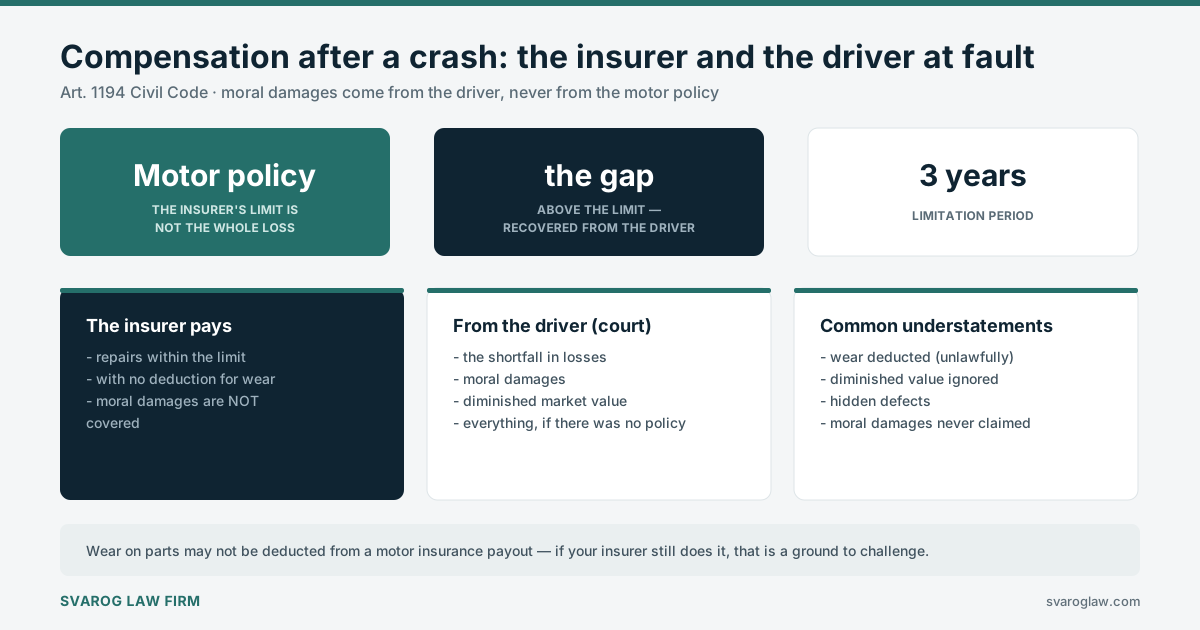
Under the compulsory motor insurance law the insurer’s liability is capped at 250,000 UAH for damage to property and 500,000 UAH for harm to life and health per victim. Anything above that is claimed from the driver at fault.
Depreciation of parts is no longer deducted when the payout is calculated. Insurers used to take off 30–50 % “for wear”, leaving less than half the repair cost; if depreciation is still being deducted, that is a direct ground to challenge. How the loss is calculated we set out on the page about assessing accident damage.
Non-pecuniary damage is generally not covered by the compulsory policy: the insurer covers property loss and harm to life and health, while the victim claims the non-pecuniary element from the driver in court. We check the terms of the particular policy separately, since they determine both what is paid and the deadlines for claiming.
Recovery from the driver at fault
From the driver at fault you recover the difference between the real loss and the insurance payout, the non-pecuniary damage, and the entire loss where they had no policy at all. The claim is filed where the defendant lives or where the damage occurred; the court fee for an individual is 1 % of the value, from 1,331.20 to 16,640 UAH in 2026. If there is a risk the defendant will sell the car or other assets, an application for interim relief goes in with the claim.
A special case: where the driver was intoxicated, had no licence or left the scene, the insurer pays the victim as usual and then recovers what it paid from the driver by way of recourse. For the victim nothing changes; for the driver it means the policy did not in fact protect them, with administrative liability for leaving the scene on top (Art. 122-4 of the Code of Administrative Offences). If anyone was injured, criminal proceedings run in parallel, and there you need a lawyer for Art. 286 cases.
Why payouts come out too low
There are usually several reasons: the insurer calculates by its own method and its own appraiser; diminished value is not counted; depreciation is applied although the law no longer allows it; part of the damage was “not seen”, because hidden defects are invisible without dismantling; the wrong driver was blamed and the claim refused altogether; non-pecuniary damage was never claimed, because the insurer does not remind you. That is why an independent valuation of your own is always needed: it is the gap between it and the insurer’s figure that shows how much more can be claimed.
What to do after an accident
- Do not leave the scene: that is a separate administrative offence (Art. 122-4), and for the driver at fault it is also a ground for the insurer’s recourse claim.
- Call the police, except where the European accident statement can properly be used: no injuries, both drivers agree, and the loss is within the set limit.
- Record everything: photographs, video, witnesses, the other driver’s details and policy.
- See a doctor, even if the injuries seem minor. Without medical records, harm to health and non-pecuniary damage are hard to prove.
- Notify the insurer within the period set by law and the policy. A missed deadline is the classic ground for refusal.
- Commission an independent valuation of the loss rather than relying on the insurer’s.
- Take advice before signing anything with the insurer, in particular a settlement agreement.
A case from our practice
In 2025 the owner of a crossover came to us after another driver failed to give way at a junction in Kyiv. The insurer accepted the claim and paid the sum its own appraiser had calculated, which did not cover the repair: the calculation included neither the hidden suspension damage nor the diminished value. We commissioned an independent valuation, obtained a further payment within the insurance cap, and claimed the balance together with the diminished value from the driver in a separate action. Before the first hearing the defendant offered to pay by instalments, and the case ended in a settlement. About eight months passed from the first approach to the last payment, and the client’s outlay was the valuation, the court fee and our standard court representation rate. (details changed)
Deadlines you cannot miss
The case calendar
- notifying the insurer of the accident — within the period set by law and the policy; delay gives the insurer a formal ground to refuse;
- challenging a police penalty decision — 10 days from the day it was issued;
- a claim against the driver for pecuniary and non-pecuniary damage — three years (Art. 257 of the Civil Code);
- claims for damage caused by injury, other harm to health or death are not subject to limitation at all (Art. 268), but years later it is harder to commission an expert report and find witnesses.
How we work
- we analyse the accident documents: the scene plan, the penalty decision, the reports, the policy;
- we arrange an independent valuation covering hidden damage and diminished value;
- we prepare the demand to the insurer and challenge a refusal or an understated figure;
- we calculate the full loss: property, non-pecuniary, treatment, lost earnings;
- we recover the balance from the driver at fault, with their assets attached where needed;
- we see enforcement through to the money actually arriving.
Cost of services (compensation after a road accident)
The court fee, the independent valuation and any vehicle expert report are paid separately. The court fee in 2026 for an individual is 1 % of the value of the claim, not less than 1,331.20 and not more than 16,640 UAH; a claim for non-pecuniary damage alone is charged as non-monetary, 1,331.20 UAH. Filing through the Electronic Court reduces the rate by 20 %, and if you win the fee and the valuation costs are recovered from the defendant.
Calculate the court fee for a claim against the driver
A claim for non-pecuniary damage alone is charged as non-monetary: 1,331.20 UAH.
Questions and answers (compensation after a road accident)
We used the European accident statement, and more damage turned up during the repair. What now?
Commission an independent valuation with the car dismantled and claim a further payment from the insurer. If the real loss exceeds the limit set for the European statement, the balance is recovered from the driver in the ordinary way: signing the statement does not deprive you of full compensation, it only fixes how much the insurer pays.
The driver at fault was in someone else’s car. Who do I sue?
The loss is compensated by whoever lawfully possessed the vehicle at the time, which is usually the driver (Art. 1187). The owner is joined as a defendant where they handed the car to someone without a licence or while intoxicated, or where it left their possession through their own fault. The claim goes against both, and the court decides who answers for what.
I broke the rules partly too. Will I get anything?
Yes, but the court may reduce the award: the victim’s own gross negligence is taken into account (Art. 1193). Where both drivers are at fault, the loss is apportioned according to each one’s share of the blame (Art. 1188). That is why a vehicle expert’s report is often worth more than all the parties’ explanations.
Who pays for the independent valuation and the expert report?
Initially whoever commissions them, usually the victim. These sums are legal costs and, if you win, are recovered from the defendant along with the court fee and the lawyer’s fees, so keep the receipts and the contract with the appraiser.
Can the case be run remotely if I do not live in Kyiv?
Yes. You send the documents by email or messenger, the engagement letter is signed electronically, and the lawyer acts under a power of attorney and a warrant. Hearings are held by video through the Electronic Court. Attendance in person is needed only for the appraiser’s inspection of the car.
Contact a Svarog lawyer about compensation after a road accident
Send us the accident documents and the figure the insurer offered. We will calculate the full loss, including non-pecuniary damage, diminished value and treatment, and tell you how much more can realistically be claimed from the insurer and from the driver. Everything that follows a crash is handled by our road accident lawyer.