Bank factoring is the financing of a business against the assignment of a monetary claim, with a bank acting as the factor. The arrangement is simple: the supplier ships goods on deferred payment terms, assigns the bank the claim against the buyer — that is, the receivable — and is financed at once, without waiting for the buyer to pay. It closes cash gaps and provides working capital without a conventional secured loan.
Since 30 July 2026 factoring has been governed by a separate Law of Ukraine “On Factoring” No. 4466-IX, which applies alongside Chapter 73 of the Civil Code (Arts. 1077–1086), while banks’ right to provide the service follows from the Law “On Banks and Banking”. Agreements signed earlier and new ones are assessed under different versions of the rules, so we check the terms against the regulation in force on the date of the deal.
The advantage of bank factoring specifically lies in the limits and the reliability: a bank provides the service under its banking licence, so it needs no separate finance-company licence, it works with larger sums and it offers related payment services. At the same time a bank’s agreement is usually more complex and stricter than a non-bank factor’s: it sets out in detail the fees, the right of recourse, and the client’s obligations as to the quality of the receivables and the notification of debtors.
How bank factoring works
The classic arrangement has several steps:
- the supplier (the client) ships goods or provides a service on deferred payment terms;
- the client assigns the bank the monetary claim against the buyer;
- the bank pays the client an advance — most of the value of the supply;
- the buyer (the debtor) pays the bank by the agreed date;
- the bank remits the balance to the client, less its fee and the charge for the financing.
The market benchmarks are these: the advance is usually 70–90 % of the value of the supply, the servicing fee is a fraction of a percent of each supply, and the financing charge is calculated as a percentage a year for the days the funds are actually used. Every bank has its own figures, and it is the combination of them that decides whether factoring beats an overdraft. A factoring agreement is made in writing: this is required by the rules on transactions of legal entities (Art. 208 of the Civil Code) and by financial services legislation, in particular the Law “On Financial Services and Finance Companies” No. 1953-IX.
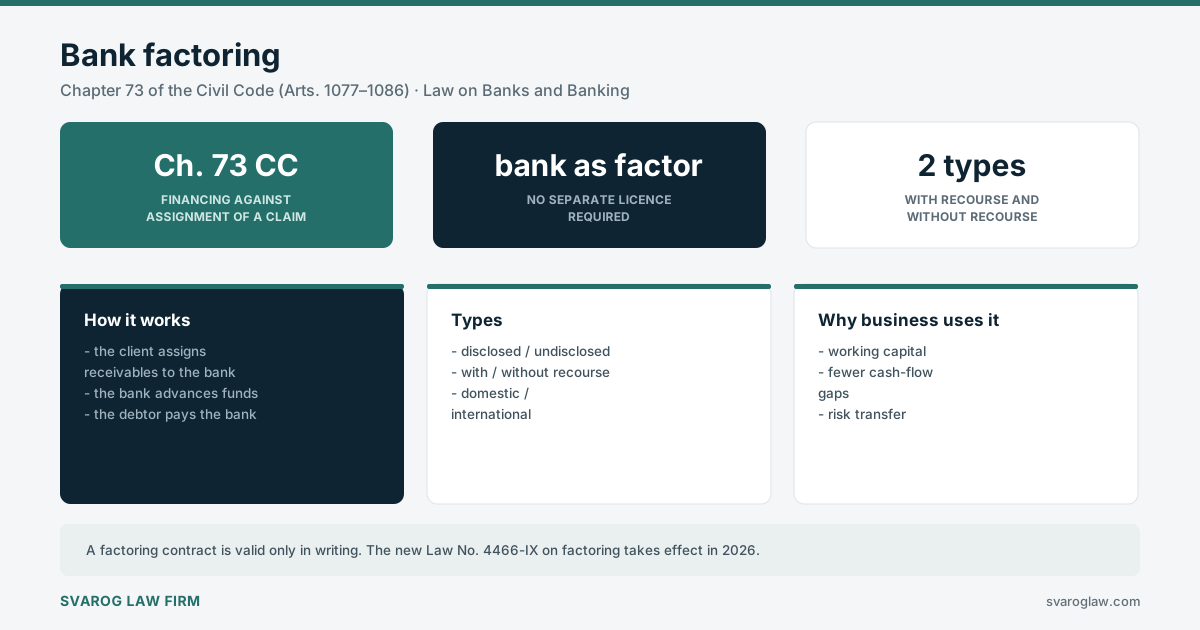
Types of factoring and what they change in the agreement
With and without recourse
Under factoring with recourse the risk of the debtor not paying stays with the client: if the buyer does not pay, the bank will demand the money back. Under non-recourse factoring the bank takes that risk, and the service costs more. The terms of the two kinds of agreement differ fundamentally.
Disclosed and undisclosed
Whether the debtor is notified of the assignment, and whom they pay.
Domestic and international
Depends on whether the parties are in different countries; international factoring adds currency and conflict-of-laws questions.
Most disputes arise over recourse, so we deal with its terms separately: factoring with recourse.
What to check in the agreement before signing
Contract checklist
- the full price of the service: the servicing fee, the financing charge, the fee for processing each supply, the charge for exceeding the deferral period. Add them up as a percentage a year and compare with an overdraft;
- the recourse terms: how many days after the debtor’s default the bank may demand the money back, and whether that right covers every supply or only the overdue ones;
- the client’s warranties about the receivables: what exactly you answer for if the buyer complains of defects or raises counterclaims;
- how debtors are notified and who does it, since that determines whom a payment discharges;
- the grounds for the bank to stop financing unilaterally and the consequences for consignments already shipped;
- penalties for breaches of the client’s obligations, in particular for late submission of documents for a supply.
Before doing business with a new buyer, legal due diligence on the debtor is also worth having: the bank assesses their solvency for itself, not for you.
How we support bank factoring
- we analyse the factoring agreement and identify the risks in recourse, fees and penalties;
- we assess the quality of the receivables being assigned;
- we negotiate wording with the bank in the client’s favour;
- we make sure the assignment is properly documented and the debtors properly notified;
- we support performance of the agreement and the settlement of disputes with the bank or the debtor;
- we advise on the tax and accounting consequences of the transaction.
What a business risks without legal support
- signing a recourse agreement without realising that the risk of the debtor not paying stays with you;
- missing hidden fees and financing charges that make factoring dearer than a loan;
- documenting the assignment incorrectly or failing to notify the debtor, and facing a dispute over whether the assignment is valid;
- assigning problem receivables and receiving the bank’s demand for the money back;
- breaching your own warranties about the quality of the goods and losing financing across the whole supply line.
Every one of these risks is removed by analysing the agreement before it is signed.
A case from our practice
In 2025 a packaging manufacturer came to us having already signed a factoring agreement with a bank to finance supplies to a supermarket chain. The client had looked at the financing rate, but had left out of the calculation the fee for processing each supply and the charge for exceeding the deferral period. We reduced every payment to a single annual rate over the period the funds were actually used, and it turned out that the factoring was dearer than the overdraft available at the same bank. We then went back to the recourse terms: under the agreement the bank could demand repayment across the whole portfolio if a single supply fell into arrears. Both points were resolved in a supplementary agreement: the fee was cut and recourse was limited to the specific overdue claim. The negotiations with the bank took about a month. (details changed)
Cost of services (bank factoring)
The cost depends on the complexity of the agreement and the size of the transaction. If the dispute reaches court, the court fee is added: in the commercial court a company’s monetary claim is charged at 1.5 % of the value of the claim, not less than 3,328 and not more than 1,164,800 UAH, while a non-monetary claim (for example to declare the agreement invalid) is 3,328 UAH. Filing through the Electronic Court reduces the rate by 20 %.
Calculate the court fee for a dispute with the bank
A non-monetary claim to declare an agreement invalid costs a flat 3,328 UAH.
Questions and answers (bank factoring)
Is the buyer’s consent needed for factoring?
No. An assignment of a claim does not require the debtor’s consent, and a factoring agreement is valid even where the supply contract forbids assignment (Art. 1080 of the Civil Code). But the ban does not disappear: you remain liable to the buyer for breaching it, so we check such terms in the underlying contract in advance.
The buyer paid us instead of the bank. What now?
It all turns on the notice. If the debtor received no written notice of the assignment, payment to the original creditor is good performance, and the money simply has to be passed on to the bank. If notice was given, the debt to the bank is not discharged, and the buyer risks paying twice while you face a demand to repay the financing (Art. 1082 of the Civil Code).
How is factoring treated for tax?
Assignments of claims are outside the scope of VAT (para. 196.1.5 of the Tax Code), and sales income is recognised on the supply, not on receipt of the bank’s money. Fees and the financing charge reduce the financial result as expenses. The specific entries are worth agreeing with your accountant before the first supply, because a mistake will repeat in every month the agreement runs.
Does the Law “On Factoring” No. 4466-IX affect existing agreements?
The Law is already in force, and new agreements are made under its rules. For agreements signed earlier, transitional provisions apply: most terms remain valid, but some requirements for factors and for disclosure apply already. At the consultation we check your agreement against the current version and show what needs a supplementary agreement.
Can a factoring agreement be exited early?
Yes, if the agreement expressly allows it or the parties agree. The difficulty is usually in the settlement: the bank requires the already financed supplies to be closed out, and early termination often carries a fee. These terms are read before signing, not when you have decided to change your financing.
What should be done in a dispute with the bank under a factoring agreement?
First a written demand with a calculation: most disputes concern the size of the fees and the grounds for recourse, and some of them close before court. If no agreement can be reached, we prepare a claim to the commercial court and file with it the underlying supply documents, bank statements and the correspondence showing the actual terms of the arrangement.
Contact a Svarog lawyer about bank factoring
Send us the draft factoring agreement: we will analyse it from the standpoint of your risks, calculate the real cost of the financing, point out the unfavourable terms and negotiate the changes with the bank before signing. If a dispute has already arisen, we will prepare the demand or the claim. This work is handled by our finance company support practice.