You have used the property for twenty years, paid for it and thought of it as yours — and legally it is not. You cannot sell, give, bequeath or mortgage it: you are not in the register, and a notary works only with documents.
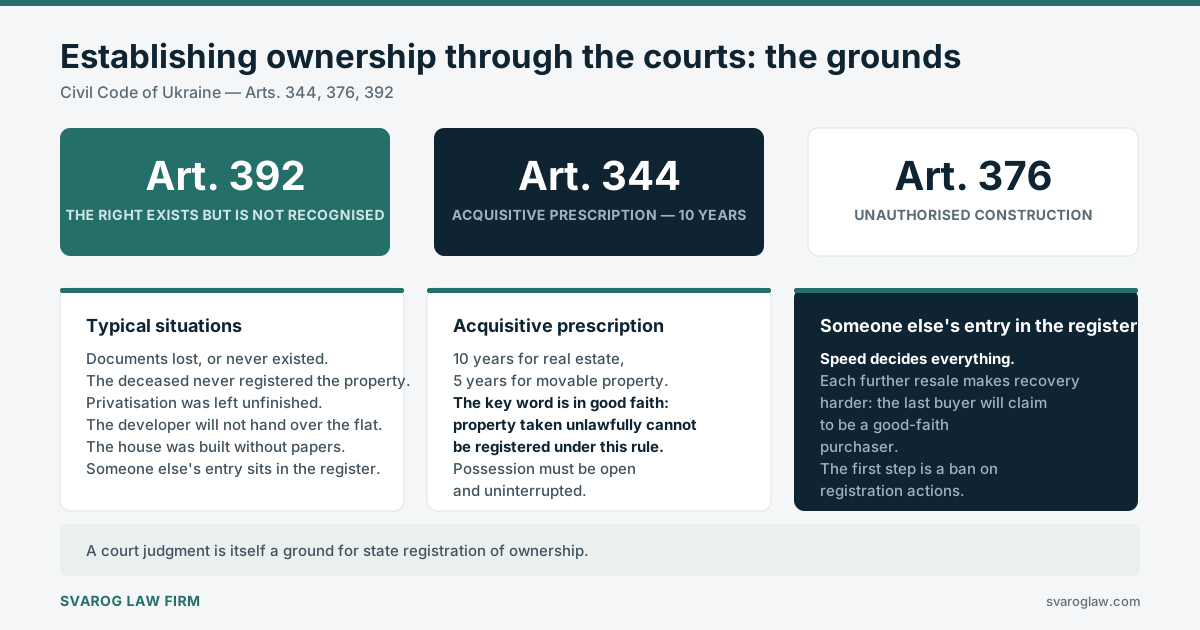
Establishing title through the court Art. 392 of the Civil Code turns possession in fact into ownership in law. The claim is brought where the right exists but is denied by someone else or cannot be evidenced by documents, and no authority can resolve the matter administratively.
This is one of the few categories of case where the judgment is itself the basis for registering title: once you win, you go to the state registrar.
When such a claim is brought
The documents are missing or lost
A house built by a grandfather in the 1970s and documented “the village way” — by a council decision whose counterfoil no longer exists. Or the papers were destroyed with the archive.
Inheritance
The deceased used the property but never registered the right: never privatised the flat, never re-registered the garage, never obtained the state deed to the land. The notary will not issue a certificate — only a court can resolve it.
An unfinished privatisation
The person applied to privatise their home in their lifetime but did not complete it. The right is recognised for the heirs if the evidence of the application survives.
A new-build flat
If the building has been commissioned but the developer has disappeared or refuses to hand over the flat, title is established on the investment contract and proof of payment. Where the building is unfinished, the courts refuse to recognise title to a flat: the property does not yet exist. Other tools work in that situation — the special property right in a future object under Law No. 2518-IX, a creditor’s claim in the developer’s insolvency, and recovery of the money paid plus damages.
Unauthorised construction
Art. 376 CC The building went up without documents. The court can recognise title provided the plot is yours or was allocated for that purpose, the building meets the standards, and the neighbours’ rights are not infringed.
Acquisitive prescription
Art. 344 CC A person who took possession of another’s property in good faith and has held it openly and continuously for 10 years (real estate) or 5 years (movables) acquires title. For land the period is longer — 15 years (Art. 119 of the Land Code). “In good faith” means the person did not know and could not have known that they had no title, so property that was seized or occupied without authority cannot be registered under this rule.
Someone else’s entry in the register
Your property is registered to another person through a registrar’s error, forged documents or a raider takeover. Here the claim to establish title is combined with a claim to cancel the register entry.
Someone else’s entry: why speed decides it
Once a false entry appears, the property is usually resold two or three times in short order, and the last buyer claims to be a good-faith purchaser: recovering the property from such a person is much harder, and sometimes the court leaves it with the new owner and awards the former one compensation only.
What we do in the first days:
- We stop registration actions — an application to bar dealings with the property, interim relief.
- We challenge the registrar’s decision and seek cancellation of the entry.
- We have the subsequent transactions in the chain declared invalid.
- We record the criminal dimension — a report of document forgery or misappropriation.
What we prove in court
The court grants the claim where possession is supported by documents. What evidence is needed depends on the ground:
- Title documents, even incomplete ones: old decisions of authorities, contracts, occupancy warrants.
- Archive certificates from the technical inventory bureau, local councils and asset holders.
- Entries in a household or house register.
- Proof of payment: utility bills, property tax, receipts covering the whole period of possession — in prescription cases they have to cover all 10 years.
- Technical documentation: the technical passport and a construction expert report, without which an unauthorised construction claim is not granted.
- Witness evidence from neighbours and relatives confirming that possession was open and continuous.
- Evidence of good faith: what your belief that the property was yours rested on.
We send lawyer’s enquiries to archives, the inventory bureau, registrars and asset holders. It is often an archive certificate the client did not know existed that decides the case.
Mistakes that lead to refusal
- The commonest is badly framed relief. The court does not go beyond the claim, so asking to “establish title” without asking to cancel the other party’s register entry leaves the case without a result, even where the right is proved.
- The second is suing the wrong defendant: in unauthorised construction cases it is the local council, not the objecting neighbour.
- Another group of refusals concerns prescription. Possession under a lease, tenancy or storage contract is not in good faith, because the holder knows there is another owner, so ten years of that gives no right. Nor does time count while the property was occupied without authority.
- Finally, courts refuse where the value of the claim is plucked from the air: the value of the property is evidenced by a valuer’s report, and the court fee follows from it.
A case from our practice
In 2024 a woman came to us who, after her mother’s death, could not complete the inheritance of a house outside Kyiv: there was no title document, and the notary had refused in writing. The village council said the archive had not survived. Through lawyer’s enquiries we found a 1988 executive committee decision in the regional archive, retrieved the household register entries and an inventory bureau certificate, and confirmed the absence of any dispute with the neighbours’ evidence. The court recognised title by inheritance in about eight months, after which the right was registered on the judgment. Our fee was 25,000 UAH, with the court fee and the archive certificates paid separately. (details changed)
How we work
- We analyse the ground — which rule applies: Art. 392, 344 or 376 of the Civil Code, or inheritance law. Everything to be proved follows from that.
- We gather the evidence — lawyer’s enquiries to archives, the inventory bureau and local councils.
- We block any disposal where there is a risk the property will be resold.
- We draft the claim with the relief properly framed.
- We run the case in court and bring in experts.
- We register title on the strength of the judgment.
Cost of services
Court fees (2026): a claim to establish title is a monetary one, so an individual pays 1 % of its value, from 1,331.20 to 16,640 UAH, and a company 1.5 %, from 3,328 UAH. Through the Electronic Court the rate is multiplied by 0.8. The valuation, the construction expert report and the archive certificates are paid separately.
Calculate the court fee
The rate for an individual. The value of the claim is evidenced by the valuer's report, so understating it achieves nothing.
Full price list · Real estate lawyer
Questions and answers (establishing title)
Which court hears a claim about real estate?
The court where the property is located: claims about real estate are subject to exclusive jurisdiction (Art. 30 of the Civil Procedure Code). Where the parties live is irrelevant, so a case about a house in the Kyiv region is heard by the local court for that district even if everyone lives in Kyiv.
Who applies to bar registration actions, and what does it cost?
The claimant applies for interim relief — with the claim or before it — and the court decides without summoning the parties. A separate court fee is payable, which we calculate at the time of filing. We send the order straight to the registrars, because it is the bar that stops the property being resold.
Why is a valuation needed?
The value of the property sets the value of the claim, and the court fee follows from it. A valuation is also needed to prove the loss if the property has already been resold and cannot be recovered. Understating the value ends with the claim being stayed and time lost.
What happens after winning?
Obtain the judgment marked as having come into force and take it, with the property documents, to the state registrar or a notary. If there is another party’s entry in the register, the order cancelling it must be carried out first, otherwise the registrar will suspend your application.
How long does such a case take?
A straightforward case with clear evidence finishes in about six months. Where a construction or valuation expert report is needed, or there are several defendants, it stretches to a year or more, and an appeal adds several months again.
Contact a Svarog lawyer about establishing title
Describe the situation and we will work out which rule your right can be established under, what evidence is needed and where to get it. The answer often lies in archives we can reach through lawyer’s enquiries.