A debt exists only on paper until it is recovered. This page is about turning arrears into money in the account: under leases, service contracts, works contracts and supply agreements, on obligations of sole traders and companies, and on judgments that go unenforced for years.
Recovery rarely fails for want of evidence. More often the problem is time: the creditor waits for the debtor to “pay up on their own” and comes when limitation is expiring or the assets have already been signed over to relatives.
Debts on IOUs between individuals are covered separately: recovering a debt on an IOU.
The debts we handle
Categories of case
- arrears under contracts: leases, services, works, supply;
- debts of sole traders and companies, including on certificates and delivery notes;
- unenforced judgments, where the case was won but no money arrives;
- loans and IOUs between individuals;
- defending debtors: challenging inflated claims, reducing penalties, personal insolvency;
- disputes with collectors and microfinance lenders: unlawful collection methods, interest charged without basis.
What the claim includes besides the principal
- The principal sum under the contract, certificate, delivery note or IOU.
- Interest for the use of the money. Where the contract names no rate, the National Bank’s discount rate applies Art. 1048(1) CC. The exception: a loan between individuals of up to 50 tax-free minimums (850 UAH) unconnected with business is interest-free (Art. 1048(2) CC).
- A penalty. Recoverable only where the contract or note expressly provides for it: without a written agreement no penalty exists Arts. 547, 549 CC. Between businesses it is capped at double the National Bank discount rate for the period.
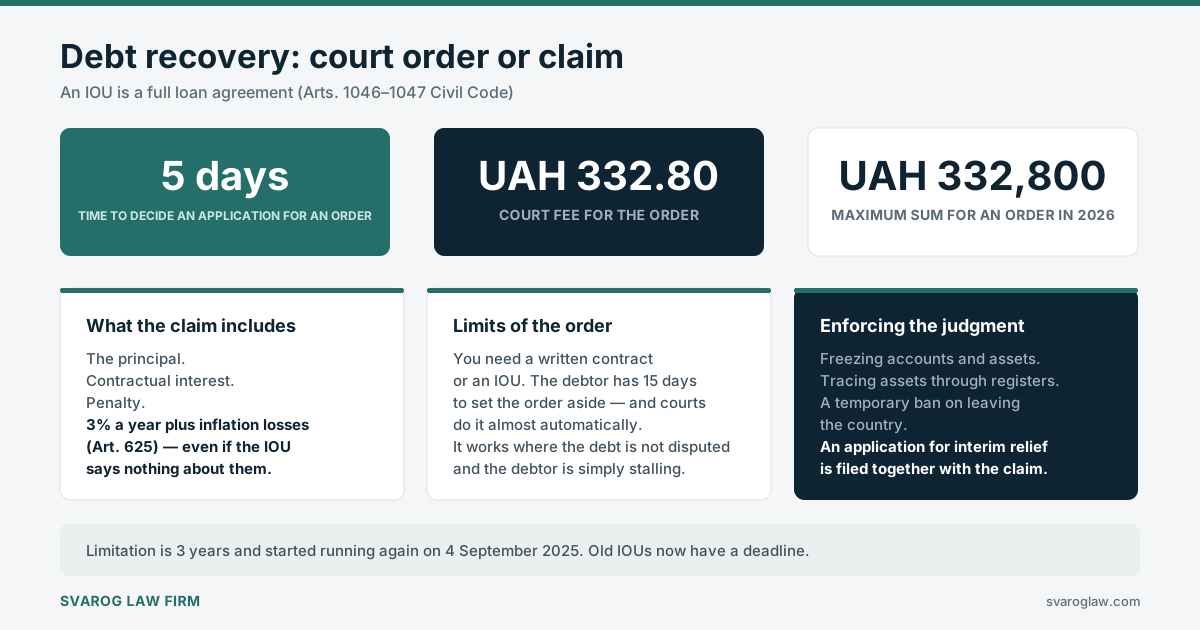
- 3 % a year and inflation losses Art. 625 CC for the whole period of default, whatever the contract says.
- Costs: the court fee and legal fees are recovered from the debtor if you win.
Take the figures. A debt of 100,000 UAH, three years overdue: the 3 % a year alone comes to 9,000 UAH, inflation losses on the state statistics index for the same months are added, and if the contract provided a penalty, that too. The claim grows by a quarter or more. Increasing it after proceedings have begun is harder, so we do the calculation before filing.
Three routes to recovery
A demand letter
2–4 weeksThere is no mandatory pre-action procedure, but a demand with a full calculation often works: the debtor sees that the sum will only grow and that the costs will fall on them.
A court order
5 days, fee 332.80 UAHThe quickest route, and often forgotten. The conditions: the debt is evidenced by a written transaction, there is no dispute as to the right, and the claim does not exceed 100 subsistence minimums — 332,800 UAH in 2026 (Art. 161 CPC).
- decided in 5 days, with no hearing and no summonses;
- the court fee is 0.1 of a subsistence minimum (332.80 UAH) instead of 1 % of the sum;
- the order is itself an enforceable instrument.
A court claim
monthsNeeded where there is a dispute as to the right, or the sum exceeds the limit for a court order. The claim is filed where the debtor is registered; disputes between companies and sole traders go to the commercial court. Cases worth up to 332,800 UAH go through simplified proceedings, the rest under the ordinary rules, with a preparatory hearing and more sittings. The realistic timescale depends on the particular court’s workload, so we give it at the consultation.
Limitation: what changed on 4 September 2025
The general period is three years (Art. 257 CC), and one year for penalties (Art. 258 CC). From 2 April 2020 to 3 September 2025 limitation did not run because of the quarantine and martial law, but Law No. 4434-IX ended that pause, and from 4 September 2025 time began running again. For debts from 2020–2025 the three years expire in September 2028; for older ones the remaining balance is added on, so limitation expires as early as 2026–2027. A part payment or a written acknowledgment interrupts the running of time, and the period starts afresh (Art. 264 CC).
A court applies limitation only if the debtor pleads it (Art. 267(3) CC), and the debtor’s lawyer does not forget it. If you have a contract from 2018–2019 sitting in a drawer, the period needs calculating now.
A judgment and actual money
A judgment on its own brings no money. Enforcement proceedings follow, and it is at that stage that most creditors lose out: on paper the debtor “has nothing”. What works is specific steps:
Enforcement tools
- an application for interim relief filed with the claim: freezing accounts and property, barring registration actions, before the debtor can transfer the assets;
- tracing assets through lawyer’s requests to banks, the State Register of Real Property Rights, the vehicle register and the companies register;
- a temporary ban on the debtor leaving the country within the enforcement proceedings;
- enforcement against the debtor’s share of matrimonial property;
- challenging sham transactions, such as the “sale” of a car to a brother a week before the hearing;
- insolvency proceedings against the debtor where it is a company or a sole trader.
We plan enforcement before the claim is even filed: we check the debtor’s assets against the registers and assess whether there is anything to recover from. If there is not, you will know before you pay the court fee.
A case from our practice
In 2024 the owner of a furniture workshop came to us: a sole-trader counterparty had not paid 180,000 UAH for components. The signed delivery notes existed and so did the correspondence, but the payments had stopped back in 2022. We recalculated the claim with interest, the 3 % a year and inflation losses and sent a demand with the full computation. There was no reply, so we filed in the commercial court together with an application for interim relief. Once the accounts were frozen the debtor came to the table, and the case ended in a settlement paid in two tranches. About nine months passed between the first consultation and the last payment, and the fee was within the court representation rates in our price list. (details changed)
Creditors’ typical mistakes
The commonest mistakes people bring to the consultation:
- waiting until the last moment and coming when only weeks of the limitation period remain;
- claiming only the principal and forgetting the interest, the 3 % a year and inflation losses;
- not applying for interim relief, and obtaining judgment against a debtor who no longer owns anything;
- accepting a part payment without written confirmation of which debt it was credited to;
- stopping after winning in court and not following the enforcement proceedings.
Cost of services (Debt recovery)
Court fees in 2026 are calculated from the subsistence minimum of 3,328 UAH. An application for a court order costs 332.80 UAH. A monetary claim by an individual costs 1 % of its value, from 1,331.20 to 16,640 UAH; by a company 1.5 % of its value, with a minimum of 3,328 UAH and, in the commercial court, a maximum of 1,164,800 UAH. Filing through the Electronic Court reduces the rate by 20 %. If you win, the court awards both the fee and the legal costs against the debtor. Work without an advance is possible for disputes from 100,000 UAH — the minimum at which payment purely on results makes sense.
Calculate the court fee on a recovery claim
Up to 332,800 UAH under a written contract a court order works, with a fee of 332.80 UAH.
Questions and answers (debt recovery)
Can a debt be recovered from a sole trader who has already deregistered?
Yes. Ceasing to trade does not end the obligations: the former trader answers for the debts as an individual, with all their property. What changes is jurisdiction: once the trader status is gone, the dispute goes to the general court rather than the commercial one.
The debtor has left the country. Is that a dead end?
No. The claim is filed at the debtor’s last registered address in Ukraine, and they can be summoned through a notice on the judiciary’s website. If accounts, property or vehicles remain in Ukraine, enforcement takes its usual course. If all the assets are abroad, the Ukrainian judgment has to be recognised in that country; we assess the prospects before filing.
What do the enforcement proceedings themselves cost?
The enforcement fee at the state enforcement service is 10 % of the sum recovered and is paid by the debtor; a private enforcement officer charges a principal fee instead, also at the debtor’s expense. On opening the file the creditor pays an advance of 2 % of the sum, which is returned once the judgment is actually enforced.
Can the case be handled remotely?
Yes. You send the documents by email or messenger, we sign the engagement electronically, and in court the lawyer acts on a warrant. Hearings are held by video through the Electronic Court, so you need not be in Kyiv. Originals are needed only if the debtor disputes a signature and the court orders a handwriting examination.
What if the enforcement file was closed for want of assets?
The writ is returned to the creditor, but the debt remains. It can be re-submitted for enforcement within three years of the return, and that is worth doing every time information appears about new property or official income. In parallel we check whether the debtor disposed of assets after the file was opened.
Can I sell my debt if I do not want to pursue it myself?
Yes, the claim is assigned under a cession agreement (Arts. 512–514 CC). The debtor’s consent is not required, but they are notified in writing of the change of creditor. The price depends on how complete the documents are, the stage of recovery and the debtor’s assets. More on the mechanism on the page about buying debt.
Contact a Svarog debt recovery lawyer
Send us the contract, the delivery notes or the IOU: we will calculate the full claim with interest, penalties, the 3 % a year and inflation losses, check limitation and choose the procedure — a demand, a court order or a claim. We will also check the debtor’s assets against the registers, so that the prospects of recovery are clear before you pay the court fee.