Detention without an investigating judge’s order may last no more than 72 hours from the moment of actual detention (Art. 211 CPC). Within that time the person must be brought before a court to decide on a preventive measure or released, and they must be brought before the investigating judge within 60 hours at the latest.
It is in these hours that a person is questioned, “explanations” are taken, and identifications and searches are carried out. Everything said and signed without a lawyer becomes the foundation of the suspicion, and retracting it in court is then all but impossible.
Defence on detention begins with a call from the family or from the detained person. We go to the police station, obtain a meeting in private before the first interview, and prepare the case for the hearing on the preventive measure. The right to a lawyer from the moment of detention is guaranteed by Arts. 29 and 59 of the Constitution and Art. 208 CPC.
The 72 hours, hour by hour
| Moment | What the CPC requires |
|---|---|
| Hour 0: actual detention | A person is detained from the moment force or an order compels them to stay put or to go with the police (Art. 209). They are immediately told the ground for detention and their rights, and the free legal aid centre is notified of the detention (Arts. 208, 213). |
| The first hours | A detention record is drawn up with the real time and place (Art. 208); the detained person is handed a copy of it and a written statement of rights; they may inform their family (Art. 213). |
| Within 24 hours | Service of the written notice of suspicion (Art. 278). If it is not served, the person is released immediately. |
| Within 60 hours | Being brought before the investigating judge to hear the application for a preventive measure (Art. 211(2)). |
| Within 72 hours | The investigating judge’s ruling on a preventive measure, or release (Art. 211(1)). |
Your rights from the first minute
A detained person’s rights
- to know what you are suspected of: the ground for detention is given at once (Art. 208(4) CPC);
- to stay silent: no one is obliged to testify against themselves or their close family (Art. 63 of the Constitution). Refusing to give evidence is not proof of guilt;
- to a lawyer from the moment of detention and to meet them in private, before the first interview;
- to inform your family of the detention and where you are being held (Art. 213 CPC);
- to medical care and examination by a doctor;
- to an interpreter if you do not speak the language;
- to challenge the detention: its lawfulness is reviewed by the investigating judge (Art. 206 CPC).
A detained person must be handed a written statement of rights. If that was not done, or the record shows a later time than the real one, the breach is entered in the objections to the record and used at the hearing on the preventive measure.
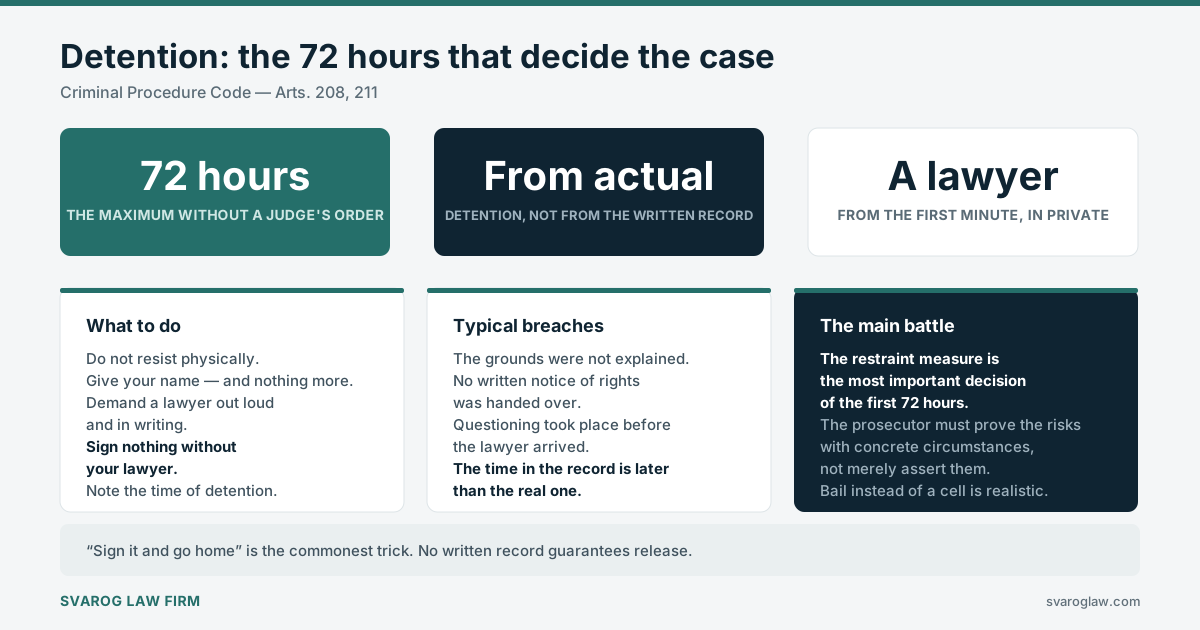
What to do while the lawyer is on the way
- Do not resist physically. Resisting a law enforcement officer is a separate offence (Art. 342 CC) and will only make things worse.
- Give your name and explain nothing further. You have the right to stay silent until your lawyer arrives.
- Demand a lawyer aloud and in writing. Record that demand on every document you are asked to sign.
- Sign nothing without a lawyer — not even “formal” records, and not even if you are promised release once you sign.
- Remember the time of actual detention: the 72 hours run from it. The time of any call you managed to make is evidence too.
- Memorise names, ranks and service ID numbers.
- Tell your family two things: the address of the station and the name of the body that detained you. That is enough for a lawyer to come.
The preventive measure: what is decided in the first days
After the detention the prosecutor applies for a preventive measure. The court chooses from the list in Art. 176 CPC:
- a personal undertaking, the mildest measure;
- a personal surety;
- bail: under Art. 182 CPC it ranges from 1 to 20 subsistence minimums for a less serious crime (in 2026, 3,328 to 66,560 UAH), from 20 to 80 for a serious one (66,560–266,240 UAH) and from 80 to 300 for an especially serious one (266,240–998,400 UAH);
- house arrest, round-the-clock or at night;
- remand in custody: an exceptional measure, applied only where no other will secure proper conduct (Art. 183 CPC).
Under Art. 177 CPC the prosecutor must substantiate specific risks: absconding, destroying evidence, influencing witnesses, continuing criminal activity. The lawyer’s work at the hearing is to rebut each risk with documents about family, work, health and residence, and to offer the court a realistic bail figure instead of custody.
What the investigating judge checks
Under Art. 194 CPC the court refuses the prosecutor if they have not established any one of three things: that the suspicion is well-founded, that at least one of the risks in Art. 177 exists, and that milder measures would not suffice. So our preparation has three parts: analysing the evidence behind the suspicion (often nothing more than the detained person’s own statements), gathering certificates and references that rebut the risks, and a written proposal of an alternative. The hearing is listed quickly, often the morning after the detention, so the family collects the documents while the lawyer is already on the way.
Typical breaches on detention
Each of them is a ground for ruling the evidence inadmissible (Art. 87 CPC):
- the grounds for detention were not given;
- no written statement of rights was handed over;
- questioning took place before the lawyer arrived, though the detained person had demanded one;
- the 72 hours were exceeded, or the suspicion was not served within 24 hours;
- the time of actual detention is recorded later than it really was;
- force was used without lawful grounds;
- questioning as a witness of someone who had in fact already been detained as a suspect.
A case from our practice
In 2024 a detained man’s brother called us at half past nine in the evening: the man had been taken from his home on suspicion of fraud involving advance payments for goods, and the family did not know which station he was in. Our lawyer traced the station through the duty unit, arrived, obtained a meeting before the interview and found that no detention record had yet been drawn up, though more than four hours had passed. That objection went into the record, and at the hearing the next day the prosecutor asked for custody with bail set at 400,000 UAH as the alternative. We produced certificates about his work, his family and his registration in Kyiv; the court set bail at 100,000 UAH and it was paid the same day. The defence at the detention stage cost about 20,000 UAH (details changed).
How we work
- We travel to the station, the investigator or the court anywhere in Kyiv and the region.
- We obtain a meeting in private before the first interview.
- We record the breaches and raise them in writing at once.
- We settle the position on giving evidence: whether to stay silent or to speak, and what to say.
- We prepare the documents for the hearing on the preventive measure and the bail proposal.
- We challenge unlawful detention and the ruling remanding in custody.
Cost of services
There is no court fee at this stage: the law sets no rate for a complaint about detention, an appeal against a ruling on a preventive measure, or other applications to the investigating judge, so in 2026 nothing is payable to the state for them. The only other sum besides the fee is bail, and it is returned when the proceedings end provided the conditions were not breached (Art. 182 CPC).
Questions and answers (Defence on detention)
I was “invited to the station for a chat”. Is that detention?
If you can stand up and leave at any moment, it is not. If you are not let out, your phone has been taken, or you have been told to wait, you are detained under Art. 209 CPC whether or not a record has been drawn up. Ask directly: “Am I detained, or may I leave?” and note the time of the answer. The 72 hours run from that moment.
The family is not being told where the person is. What can be done?
The investigator must inform the family of the detention and of where the person is held (Art. 213 CPC). Call the duty unit for the area of the detention, and call us in parallel: the lawyer establishes the body and the station through the duty unit and through the notification sent to the free legal aid centre, which receives details of every detention.
Who can pay bail, and by when?
Bail is paid by the suspect or by anyone else, an individual or a company, into the court’s deposit account (Art. 182 CPC). If the investigating judge ordered custody and at the same time set a bail figure, the person is released as soon as proof of payment is filed with the court (Art. 202 CPC). The law sets no deadline: it can be paid the same day or a week later, but until it is, the person stays in custody.
Can a custody ruling be appealed?
Yes, to the appellate court within five days of the ruling being announced (Arts. 309, 395 CPC). Besides that, an application to vary the preventive measure can be made to the investigating judge at any time if circumstances change: a job, treatment, a surety’s consent (Art. 201 CPC).
The detention happened in another region. Will you come?
We discuss travel outside Kyiv and the region during the call itself: sometimes it is quicker to bring in a local lawyer for the first hearing and take the case over afterwards. Analysing documents, preparing complaints and applications and appearing at later hearings we handle remotely and with visits, and travel costs are agreed in the engagement.
Contact a Svarog lawyer on detention
Call as soon as the detention happens: the lawyer needs only the detained person’s name and the station they were taken to. We go to the station, obtain a meeting before the first interview, and prepare the defence for the hearing on the preventive measure, which usually takes place the very next day.